
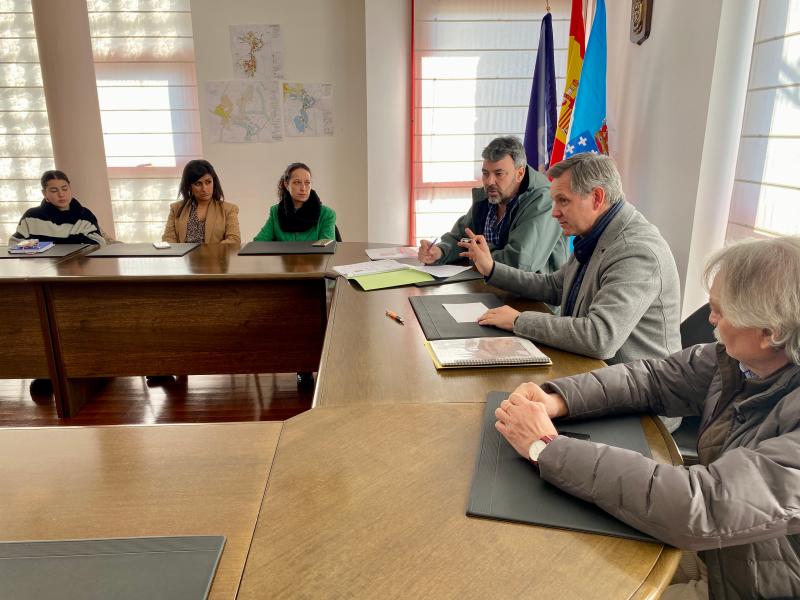
The government delegate in Galicia, José Miñones, reaffirmed today the commitment of the Government of Pedro Sánchez for the digital transition and the green transformation of rural municipalities, “with public policies that are accompanied by investments that are already a reality in municipalities such as A Mezquita and A Gudiña”. José Miñones traveled this morning to the southeast of Ourense, where he visited the municipalities of A Mezquita and A Gudiña to know about the territory the impact of government programs on the citizenship of both municipalities. It was accompanied by the subdelegate of the Government in the province, Emilio González. In both municipalities, the delegate met with their mayors, Rafael Pérez and José María Lago, and with the municipal corporations to present the available lines for housing, ecological transition and public administration, and also to gather their demands and opinions.
José Miñones recalled that “it was this Government that put on the table the problem of rural depopulation and the need to face with means and investments the demographic challenge, which is palpable in the province of Ourense”. The Government’s goal is to reduce the gap between rural and cities in access to basic coverage and services, “for people who want to live in rural areas and also to live in rural areas,” he said.
Towards 100% high-speed internet coverage
José Miñones advanced in A Mezquita the impact of the investments in digitalization that the Government is executing through the Ministry of Economic Affairs and Digital Transformation in these municipalities. This action is part of the UN-Broadband Program, within the Government’s Recovery, Transformation and Resilience Plan.
“We are taking the step to guarantee 100% coverage of high-speed internet access in A Mosque and A Gudiña,” insisted the delegate. He explained that the UN-Broadband Program will provide ultra-fast broadband connection to 1,359 families and businesses in A Mezquita and A Gudiña, through projects run by Internet service companies and funded by the Government. “We are talking about guaranteeing the connectivity of more than 300 megas to almost the entire territory of the two municipalities, in 158 areas that today do not have this type of coverage, essential in the current world.”
In the City Hall of A Mezquita, the UNICO Program will digitize 75 areas where today there is no such connection and where 372 families and companies are located. In A Gudiña 83 connection projects will be executed to bring this service to 987 homes and companies of this city.
Ecological transition
The delegate reviewed in A Mezquita the implementation of the three projects for the renovation of municipal street lighting, which was financed by the Ministry for the Ecological Transition and the Demographic Challenge through the Institute for Diversification and Energy Saving, IDAE. José Miñones stressed that this financial support, which added 458,000 euros, allowed the City of A Mezquita to change the luminaires and modernize the existing technology to achieve a consumption saving of 70%.
With this help, the City of A Mezquita replaced 619 traditional type luminaires with LED type luminaires of greater performance and efficiency, as well as the control panels on which they depended. Airlines that were in poor condition were also replaced and programmable ignition systems were implemented.
José Miñones recalled that these projects are especially important in small municipalities, where they translate into very important economic savings to the municipal coffers “that the local government can allocate to other services to the citizens.” In addition, the savings in consumption “reduces the ecological footprint of the City Council, since it leads to a reduction in the emissions that are generated by producing that energy”.
Tourism and High Speed
In the City Council of A Gudiña, the government delegate put in value the new station of the train “Puerta de Galicia”, which was put into service with the entry into operation of the last stretch of the high speed Madrid-Galicia.
José Miñones pointed out the importance of this infrastructure, in which the ADIF invested more than 3 million euros, at the level of the local economy, since it is used by the citizens of the entire region, of the Bierzo and of the North of Portugal who want to access high-speed services. And, in addition, because it represents an unbeatable opportunity to increase the tourist potential of A Gudiña and the entire region.