
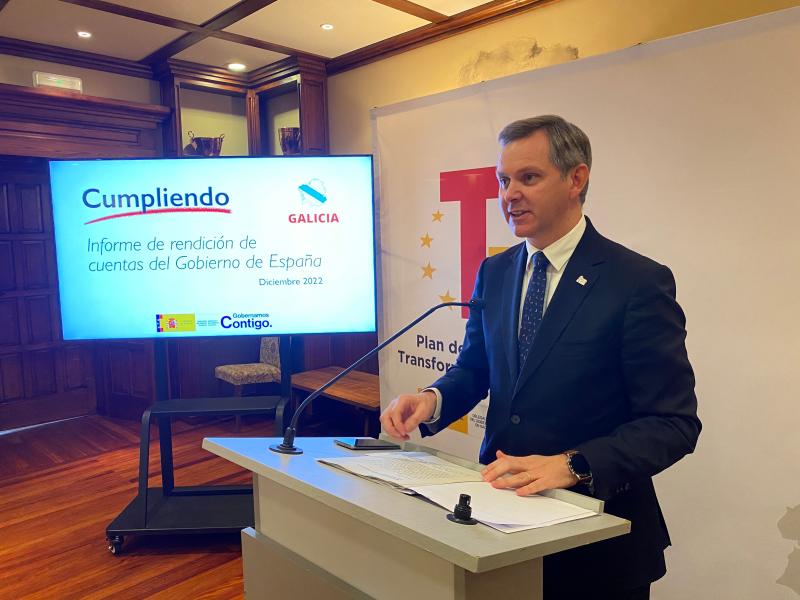
The government delegate in Galicia, José Miñones, has stressed that “the Government of Pedro Sánchez has put on the table more than 13 billion euros to transform Galicia in this year 2023”, between direct transfers, Next Generation funds and state budgets. This has been announced today during the presentation of the biannual “Complying” accountability balance, held at the Hostal dos Reis Católica, in which it has also advanced the forecasts for the coming months.
José Miñones has detailed how the government will face 2023 with the same convictions that have guided its activity in recent months, under the adverse scenario derived from the invasion of Ukraine. A model based on the principles of “protect and advance” in which “we prioritize the protection of families and companies, while moving towards a new economic, social and country model in which Galicia is a power and is being protagonist”.
Record economic resources for Galicia
The government delegate stressed that this year the Xunta will receive 23 million euros of direct transfers per day for its financing, adding a record figure of 9.4 billion euros. “In 5 years of Pedro Sánchez’s government, the Xunta will have received 42,696 million euros, 32% more than in previous years of PP government.”
In addition, Galicia closes the year 2022 having received from the Government 2,690 million euros from the Next Generation funds, of which 2,250 correspond directly to the Recovery, Transformation and Resilience Plan. “Of this amount, Xunta directly manages more than 1,640 million euros,” he said.
To these funds, the items planned for Galicia in the General State Budgets of this year, which are already in force and which will add up to 1.2 billion euros more for the Community, are added.
“In short, never has a government committed or transferred so many resources to Galicia in history,” said José Miñones, who has transferred to the Xunta the responsibility of managing these items responsibly and transparently: “To this day, we still do not know where the funds of the Recovery Plan that the Galician administration has received are destined.”
José Miñones reminded the president of the Xunta that “the future of Galicia is at stake” and that to do so “he must abandon the path of paralysis and pessimism in which the Galician Government is anchored”, hiding his inactivity “in the daily declaration against the Government of Spain”.
Commitments fulfilled
The government delegate has framed the government’s commitments to Galicia in four blocks. A first block includes the measures of dynamization and economic impulse, where the continuity of the F-110 program in Navantia stands out, the 80 million euros for Tourism Sustainability Plans that extend throughout the geography of Galicia, 8 million euros for the modernization of local trade or 17 million euros for the modernization of Galician administrations.
In this block, the delegate has included agreements that “place Galicia at the center of decision-making” such as the designation of A Coruña as the headquarters of the AESIA, the election of Vigo as the headquarters of the Table of Fisheries Science, the celebration in Galicia of the Spanish-German Summit or that three Galician cities host this year high-level meetings of the Spanish Presidency of the EU.
A second block includes the commitments made in social cohesion. In this block, José Miñones has placed the decision to raise pensions by 8.5% to 767,000 people in Galicia; or that almost 70,000 Galicians and Galicians already receive the Minimum Vital Income. Also oriented to people, the Government has agreed to expand active employment and training policies to 300 million euros; provide 240 million euros for care and dependency policies, and launch a new State Housing Plan, which bets on social housing, rent and rehabilitation and which represents 60 million euros more in Galicia.
The third set of commitments calls for ecological transition and territorial cohesion in infrastructure. In this section, the delegate recalled the 82 million euros to guarantee the digital connectivity of rural areas; the 40 million awarded in self-consumption electricity programs with renewable energies and the almost 55 million to finance clean energy generation projects in municipalities of demographic challenge.
After the entry into service of the AVE line to Madrid, investments in infrastructure have made it possible to unlock historical demands, such as the improvement of the Ourense–Lugo line, with commitments of 466 million euros and intermodal stations and to guarantee rail connections with the Community’s external ports.
Finally, the fourth block is focused on the response to the crisis due to the invasion of Ukraine and the protection of families. The delegate pointed out that, thanks to the measures implemented by the Government, 66,410 Galicians and Galicians benefited from free rail travel; 50% discounts were guaranteed on public road transport; 54,000 students with scholarships received an additional aid of 400 euros and 27,000 families received 200 euros to compensate for the effects of the price increase.
This block also includes measures to support the primary sector, “where Galicia has been one of the communities most benefited with 68.5 million euros in exceptional aid for the agricultural, dairy and fishing sector”, concluded the delegate.