
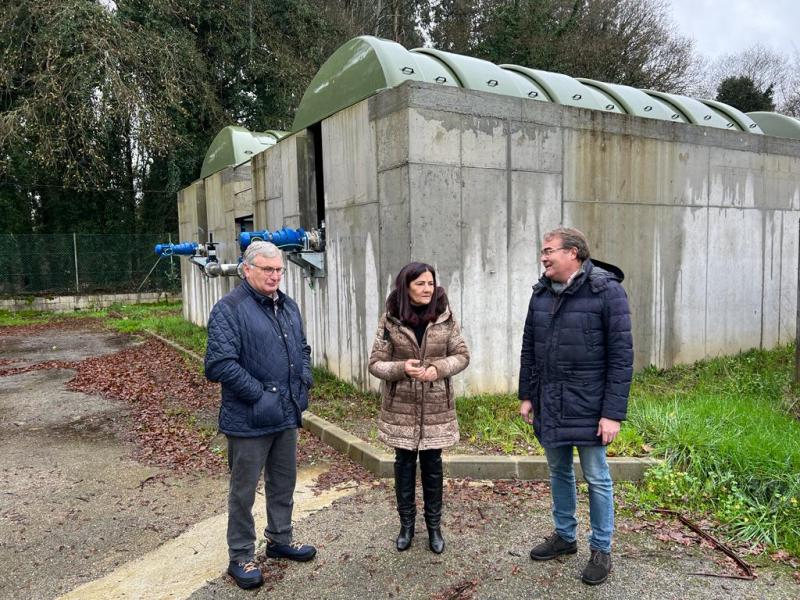
The subdelegate of the Government in Lugo, Isabel Rodríguez, today exemplified in the City of Castro de Rei the footprint that the Plan of Recovery, Transformation and Resilience of the Government is having in the small municipalities. “Castro de Rei is a clear example of how the Government brings the Recovery Plan to all corners of the province, promoting the improvement of infrastructures in those municipalities of the demographic challenge and transforming life in rural areas,” he said.
Isabel Rodríguez traveled this morning to Castro de Rei to check the result of the works of expansion and improvement of the energy efficiency of the wastewater treatment station (EDAR) of the municipality, which had an investment of 792,000 euros by the State. The deputy delegate, together with the mayor, Francisco Balado, explained that this aid granted by the Ministry for the Ecological Transition and the Demographic Challenge is part of the DUS 5000 program, aimed at local projects of clean energy and energy saving in municipalities of less than 5,000 inhabitants, covering 80% of the total action, "means a fundamental contribution so that municipalities such as Castro de Rei can face such an important work," she said.
“The improvements in the Castro de Rei treatment plant are part of the Central Government’s solid commitment to the municipality and the demographic challenge, aimed at fighting depopulation, since this renewed infrastructure allows the population to grow in the municipality, since with the previous capacity of the treatment station the City Council could not grant building licenses to new homes,” said Isabel Rodríguez.
The subdelegate supervised the work carried out at the EDAR, located in Castro de Ribeiras de Lío, which allowed the plant to double its capacity, from 350 to 750 m3 per day. The actions carried out focused on the reform, transformation and modernization of the different elements that make up the wastewater treatment plant. Specifically, a current generator was installed in the anaerobic tank, rotary biological contactors were provided and the pumping well was adapted for the recirculation of nitrified water, among other works.
“The Government complied with the neighbors of Castro de Rei who have been demanding, for a long time, improvements in the WWTP to adapt the treatment capacity of the treatment plant to the real needs of the municipality and put an end to the problems derived from the excessive volume of waste water in the network and its polluting load,” said Isabel Rodríguez.
These works will contribute to improving the efficiency of the treatment plant, avoiding discharges to the Rio Lío, serving the population of more than 3,000 people in the urban center of Castro Ribeiras de Lío, “reaching a more sustainable municipality with better environmental quality standards,” said the subdelegate. In this line, he highlighted the policies that the Central Executive is promoting in terms of energy transition that allow the City of Castro de Rei to reduce the consumption of electric energy of the EDAR by more than 12,000kWh per year, which means a great energy and economic saving for the municipal coffers. “
We are going to continue working in this line so that European funds continue to reach all the municipalities of the province of Lugo and, in this way, the municipalities can promote sustainable actions that help to fix population and improve the quality of life of their neighbors,” concluded the deputy delegate.