
• The Cyberexpert@ program, created by the Citizen Participation Unit of the CNP, aims to protect children through greater digital education • In the Segovian capital, cybercrime-related offenses accounted for 21% of the total in 2022. The increase compared to 2021 was 31.9%. Computer scams increased by 42% • The government delegate stresses that minors must be prepared for an increasingly hostile cyber environment as a result of increased use of social networks and the emergence of new online shopping platforms
Virginia Barcones delivers National Police Cyberexpert@ cards to 195 students from Segovia
13/06/2023
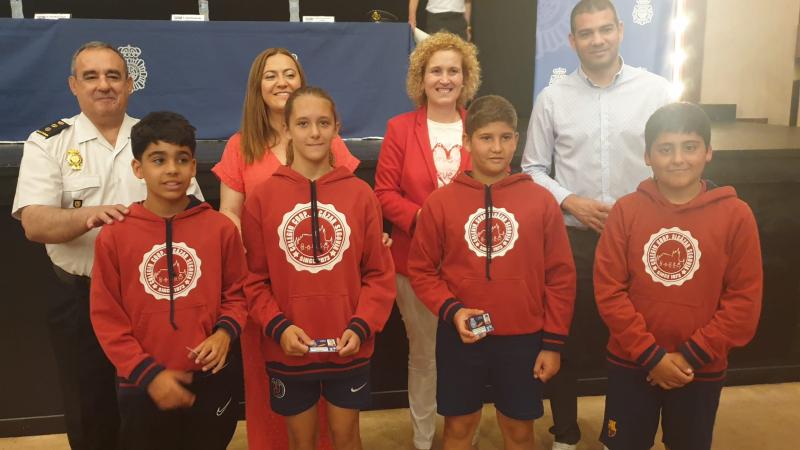
The schoolchildren are from Sixth of First of six educational centers
June 13, 2023.- The delegate of the Government in Castilla y León, Virginia Barcones, has presided today the act of delivery of Cyberexpert@ cards to 195 students of Sixth of Primary of six schools of Segovia. The program, created by the Citizen Participation Unit of the National Police, aims to protect boys and girls by improving their education in the use of new technologies.
Virginia Barcones has explained that, according to the 2022 report of the National Observatory of Technology and Society, 98% of children between 10 and 15 years old use the internet regularly since the pandemic. The report states that in Castilla y León 96.6% of minors have access to the internet, one of the highest rates in Spain.
“WhatsApp, Twitch, TIKTOK, YouTube are part of your daily life. It is a world, the digital world, with many virtues and that is not without risks,” said the government delegate. He said that the world of cybercrime is “increasingly hostile”, adding that almost 25% of the infringements committed last year in Castilla y León, 21,520 out of 87,000, were in a cyber environment. He recalled that in Segovia capital, of the 1,709 infractions committed in 2022, 364 (21%) were related to cyber crimes. Cybercrime in the Segovian capital last year increased by 31.9% compared to 2021. “It is true that some cybercrimes decreased, but it is no less true that cyberscams increased by 42%,” he said.
For this reason, Virginia Barcones has stressed the importance of children having good information and training on the risks involved in the use of new technologies, objective of the Cyberexpert@ program. “Now you know the importance of establishing a secure digital identity, which is the netiquette or what personal information it is not advisable to make known on social networks. You’ve learned to recognize cyberbullying and learn terms like Sexting or grooming. You are aware that there is inappropriate content on the internet and social networks,” he said.
The Ciberexpert@ program, created in 2016 and supported by Telefónica and the Cybervolunteers Foundation, consists of imparting 10 educational topics of special importance in the prevention and information of minors. That today’s schoolchildren avoid the future commission of criminal offenses due to ignorance, sensitize them about the indiscriminate use of the Internet and RRSS, as well as make them aware that ICT is a great advantage in different daily areas, but can also involve risk and disadvantages in case of misuse.
Within the topics we work: digital identity, netiquette, social networks and privacy, identity supplantation, cyberbullying, sexting, grooming, technoaddictions, inappropriate apps and games and other resources.
Those interested in participating in the cyberexpert program can request it through three channels: the Central Citizen Participation Unit (cgsc.pdirector@policia.es); the Citizen Participation Delegate or in the email seguridadescolar@policia.es. Once the application is received, the Citizen Participation Delegate goes to the schools that have requested them in order to hold a meeting to explain the project in more detail and set the dates to develop the program.
In the event that has been held today, 195 students from six centers have received their Cyberexpert@ card. In particular, students from Ceip Eresma, Ceip Fray Juan de la Cruz, Ceip San José, Madre Concepcionista, Cooperativa Alcázar and Los Maristas have attended.
Virginia Barcones, who has recognized that it is the “commitment” of the Executive and National Police to reach an increasing number of minors, has meant the importance of institutional representatives, educational centers, teachers and parents working together in the training of minors on the virtues and risks of the Internet. “We can’t stop insisting to our children on the importance of looking both ways as they cross a street, how to feed themselves or speak well and yet ignore the fact that they are exposed to other risks at the click of a button,” he concluded.