
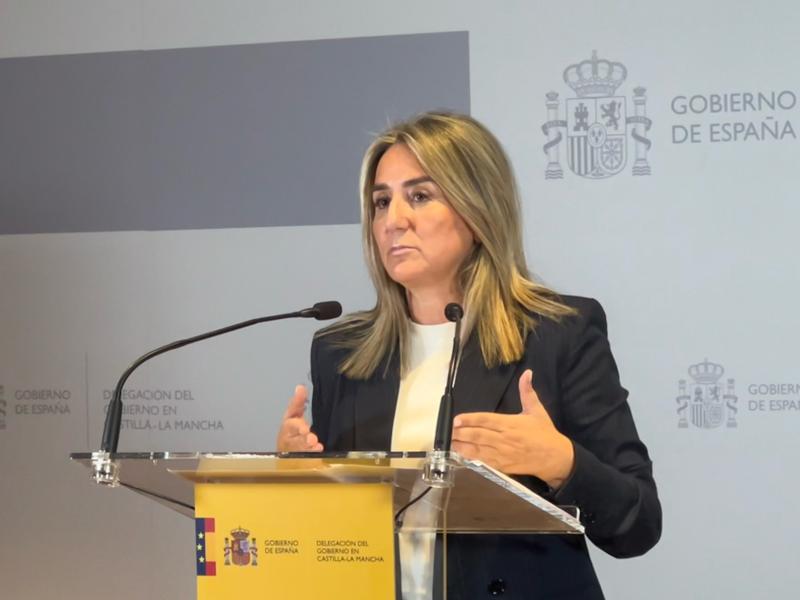
Toledo.- The delegate of the Government of Spain in Castilla-La Mancha, Milagros Tolón, presented this Wednesday at a press conference the Winter Road Campaign 2024-2025 in the State Road Network in the region. An action plan that aims to guarantee the safety, comfort and fluidity of traffic during the winter months, especially in the face of adverse weather phenomena such as snowfall or frost.
“We are talking about a deployment of human, material and technical resources superior to that of previous years, in order to maintain the roads in the best possible conditions and reduce traffic disturbances as much as possible,” said the delegate, who thanked the planning work carried out by the State Road Demarcation in Castilla-La Mancha and its head, Javier González Cabezas.
The main actions that are carried out focus on the prevention of the formation of ice sheets on the roads when frosts are expected with founding products, informing road users of any incident sufficiently in advance, and, in case of snowfall, the removal of snow to minimize disturbances to traffic, the selection of vehicles that can circulate depending on the conditions of the road and enabling alternative detours if road cutting is required.
To guarantee road safety, Castilla-La Mancha will have a reinforced device that includes, as detailed by the delegate, the following means:
180 snowplow trucks, 3 more than the previous year.
101 weather stations.
37 brine plants.
33,756 tons of founders (500 tons more).
2,237,500 litres of brine (95,000 additional litres).
13 emergency parking spaces with capacity for 3,639 heavy vehicles.
In addition, 709 workers will be mobilized among staff of concession companies and the administration itself, responsible for carrying out the necessary operations to prevent the formation of ice, remove snow and ensure safety on the roads.
The delegate has also announced the approval of two new emergency car parks that are in the project phase and that will come into operation in future campaigns, one at kilometer 61 of the A-2 (Guadalajara) and another at kilometer 51 of the A-31 (La Gineta, Albacete).
This device is operational from this month of November and will remain active until April 30, affecting a total of 3,780 kilometers of roads, highways and state highways that pass through our autonomous community.
Coordination and institutional commitment
Milagros Tolón has highlighted the good coordination between public administrations in Castilla-La Mancha, highlighting the collaboration of the Board of Communities, deputations, municipalities, State Security Forces and Bodies, the Armed Forces, the General Directorate of Traffic and the State Meteorology Agency.
In this regard, this same information has previously been transferred to the members of the Regional Commission for Winter Roads, which has been chaired by the Government delegate, an organization in which all the administrations and actors involved in safety and assistance in the event of an emergency on our roads are represented.
“We are all part of the same system of prevention and assistance. Our preparation and joint work are fundamental to guarantee security not only in Castilla-La Mancha, but throughout the national territory” given the strategic enclave of the region, he said.
The Regional Commission of Winter Roads, which integrates all the actors involved, has reviewed the resources and protocols of action to ensure an agile and effective response to possible emergencies.
Call to Citizenship
The government delegate has also called on citizens to pay special attention to AEMET’s weather forecasts and to the information disseminated by the DGT on the state of the roads. It has also urged that the recommendations of official bodies be followed and that precautionary measures be taken when travelling. “We are facing a climate change context that requires not only a strengthening of prevention services, but also greater public awareness,” he said.
With initiatives such as this campaign, “the Government of Spain reinforces its commitment to road safety, sustainable mobility and an effective response to any eventuality on the roads,” he concluded.
Together with the delegate, the subdelegate in Toledo, the heads of the Territorial Civil and Emergency Protection Unit and the Promotion Area of the Government Delegation participated in the meeting; representatives of the General Directorate of Citizen Protection, of the Roads and the Provincial Development Delegation, of the Community Board; and heads of the State Road Demarcation in Castilla-La Mancha, of the AEMET, of the DGT, of the provincial FEMP, of the UME, of the Civil Guard and National Police of Toledo.