
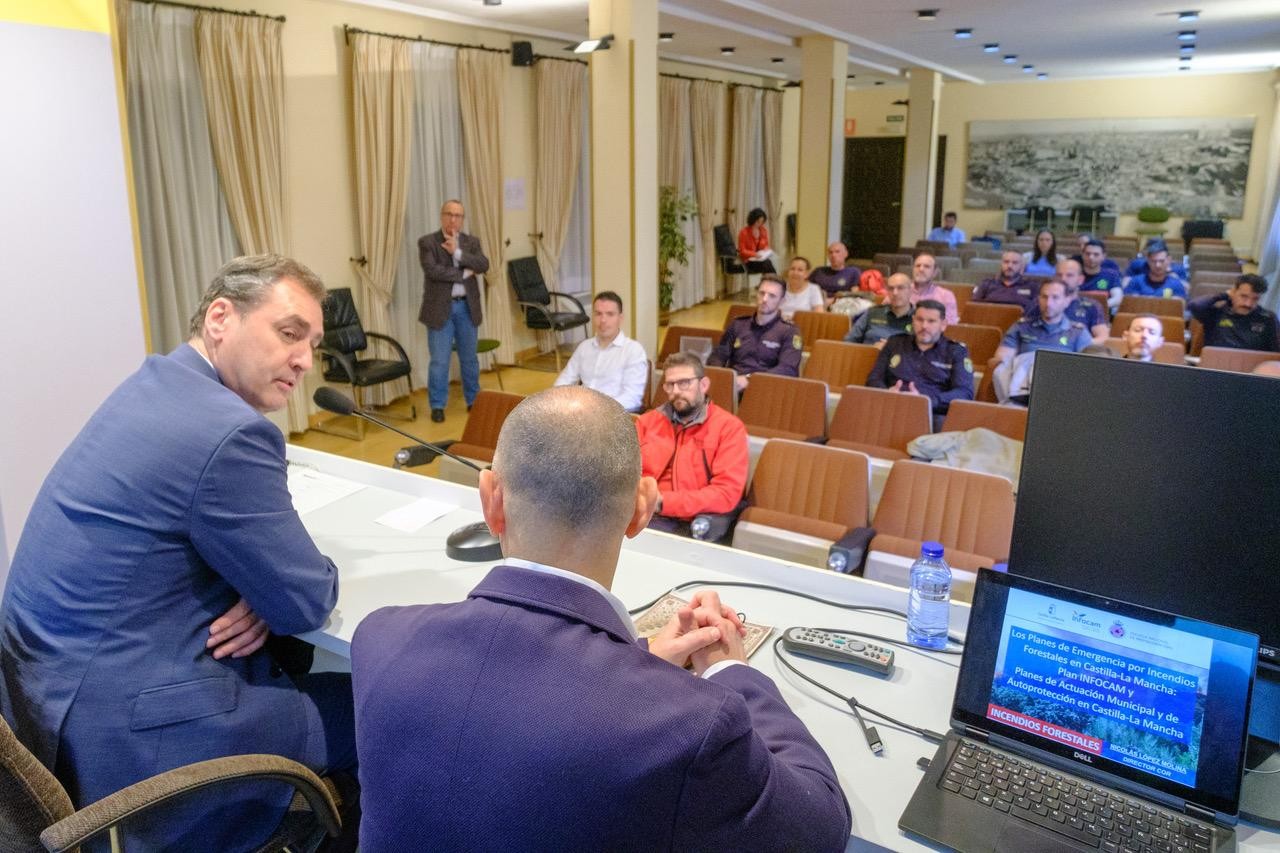
Toledo.- The delegate of the Government of Spain in Castilla-La Mancha, Francisco Tierraseca Galdón, has highlighted the fundamental role of collaboration and coordination between the different administrations that have services or units that act in the fight against forest fires.
He has done so in his greeting to the 25 attendees from all over the country to the course that is taught on April 24, 25 and 26 at the Delegation of the Government of Spain in Castilla-La Mancha under the title ‘Civil Protection Action against the risk of forest fires in Castilla-La Mancha’, accompanied by the coordinator of the activity, Valentín del Hierro, head of the Civil Protection and Emergencies Unit.
A training activity aimed at acquiring knowledge about the bases of the National Civil Protection System, its legislation, structure and organization, and about the different prevention, planning and recovery instruments, focusing specifically on the autonomous community of Castilla-La Mancha, since one of its main risks is forest fires.
“It is true that it seems that fire extinguishing services are the only ones that act, but the incorporation of more and more capacities obliges us institutional leaders to reinforce the coordination work,” said Tierraseca in his speech.
An idea that has defended before technicians and managers of Civil Protection in municipalities of Madrid and Toledo, members of groups of volunteers of Civil Protection, firefighters of Madrid, Toledo and Albacete, forest firefighters of the Generalitat Valenciana, technicians of the IGN and of Civil Protection of Castilla-La Mancha and of Orense and personnel of National Police, Civil Guard and the sanitary service SUMMA112.
The Government of Spain’s delegate in Castilla-La Mancha has specifically “wanted to mention” all those services and units that act against forest fires “because it is an increasingly large deployment, with more and more resources and more capacities and where – Francisco Tierraseca insisted – the great challenge we have is that of coordination”.
Advancing in that objective will be the key to tackle forest fires whose campaign “every year advances its beginning and delays its completion”, the delegate warned, mentioning that this year there have already been some forest fires of relevance in this Autonomous Community, such as those that have happened so far this month, in Ocentejo (Guadalajara) or in Yeste and Ayna (Albacete).
“That collaboration, that communication and, above all, having all the lines of communication open are those that allow us to act as soon as possible, warning any of the components, from 112, to the services of the Autonomous Community itself, to the mayor or mayor of a small municipality,” he said.
Finally, the government delegate thanked the participants for their interest and encouraged all professionals and volunteers of the bodies involved in these emergency situations to continue training to offer a faster and more effective response to the increasingly “virulent” forest fires.
During these three days, this training action programmed by the General Directorate of Civil Protection and Emergencies will address, among other contents, the structure, organization, regulations and emergency plans of the Spanish Civil Protection System; the Emergency Plans for Forest Fires in Castilla-La Mancha (INFOCAM); the factors of fire behavior and the incidence of meteorology; an introduction to COPERNICUS, addressing the possibilities of analysis with satellite images on the risk of forest fires; the importance of coordination and communication; or the regulated subsidy systems to attend to the damages of these catastrophes.