
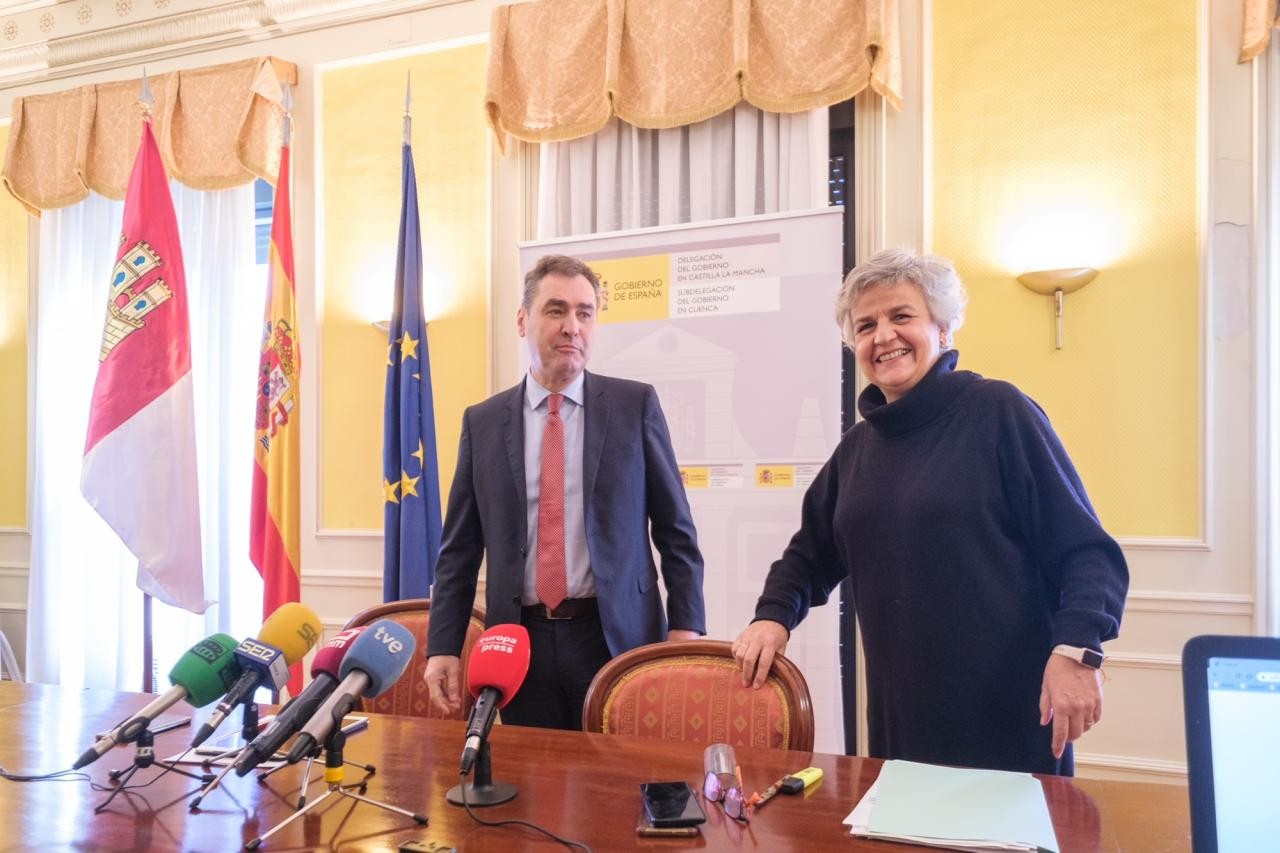
Cuenca.- The delegate of the Government of Spain in Castilla-La Mancha, Francisco Tierraseca, has affirmed that the province of Cuenca "has been the province of this region in which the decisions of the Government of Spain have had more impact on the population."
This has been highlighted in the informative breakfast offered together with the subdelegate of the Government in the province of Cuenca, María Luz Fernández, to detail the political action of the Executive of Pedro Sánchez in this territory.
An action that has been based on three axes: the measures aimed at guaranteeing a social shield to the middle and working class, those aimed at promoting the dynamization of the economy and, in the specific case of Cuenca, “the measures applied directly in this territory and related to the demographic challenge,” said Francisco Tierraseca.
Thus, this balance sheet has detailed, among other measures, the 12,000 workers who, from 2020 to the end of 2022, have benefited from the IADs to alleviate the effects of the pandemic (to whose payment 35 million euros have been allocated), the 48,000 pensioners who enjoy the revaluation of pensions according to the IPC, the 8,300 families who receive the electric social bond or, related to the youth collective, the 1,036 young people with Young Cultural Bond in the province.
In economic terms, to boost dynamization, the delegate and the subdelegate have alluded to the more than 1,000 companies benefiting from the Digital Kit, the 1,887 companies that have enjoyed the fuel bonus for professionals, the 1.6 million euros for the Rural Employment Plan that has allowed the hiring of 341 people, or the more than 2,000 high-speed and medium-distance subscriptions that benefit workers who are recurrent travelers, “and also students,” said the government delegate.
And, in relation to the demographic challenge, with special and direct impact in the province of Cuenca, they have specified that 6,620 companies have been able to benefit from bonuses in new contracts, and the group of self-employed people enjoys, for the new hikes, a reduced quota of 80 euros for three years.
Along with these three pillars, Tierraseca and Fernández have also referred to other important investments and actions of the Government of Spain in Cuenca, such as the “ambitious and realistic” project, as described by the delegate, of the X Cuenca plan, which has already involved the direct investment of 17.3 million euros to guarantee an integral mobility in this province.
Fernandez, for his part, alluded to the works of the Provincial Commissariat, with 8.4 million euros of investment, and that “the building is expected to be completed this year”, the 11 million euros for the Penitentiary Studies Center, project “of which we will soon have news”, the 3.7 million euros to improve the facilities and act in energy efficiency of the Penitentiary Center or the 841,000 euros for the reform of the Civil Guard headquarters of Priego.
The government action in this province throughout 2022 also leaves a boost to tourism, with the tourism sustainability plans of Cuenca and the Cabriel Valley, and a tangible advance in infrastructure improvement projects, such as the 36 million euros for the approval of the route of the link of the A-3 with the A-40, the almost 26 million euros for the Cuenca–Teruel motorway or the more than 29 million euros for road conservation and maintenance.
There are many actions that demonstrate, said the subdelegate in Cuenca, that “the only profitability that this Government pursues is not leaving anyone behind”.
By 2023, the delegate also pointed out in this hearing, the same objectives are going to be maintained, because they are key in the action of the Government of Pedro Sánchez, and they go through “guaranteeing the protection of the social majority, continuing to modernize the economy, with a boost to digitalization, and delving into measures of demographic challenge and fight against depopulation in the province of Cuenca”.