
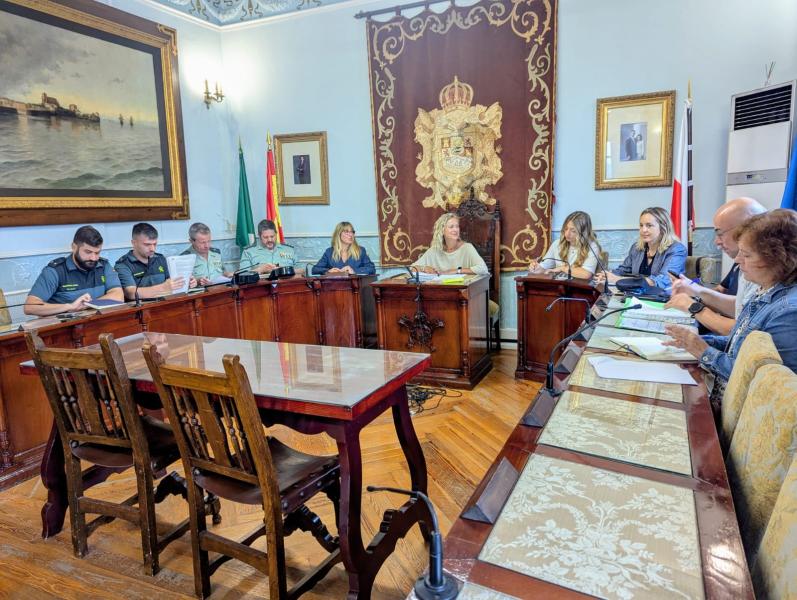
The Local Security Board of Castro Urdiales has met this Wednesday to assess the security situation in the municipality, in a meeting presided over by the Government delegate in Cantabria, Eugenia Gómez de Diego, and the mayor, Susana Herrán, who have highlighted the stability of crime levels and reaffirmed their commitment to strengthening means and effectiveness in the locality.
In this regard, the delegate has announced the incorporation next week of new agents in practices and one more of staff coverage, a "historic" reinforcement resulting from the successive calls for public employment promoted by the Government of Pedro Sánchez, which aims to reverse the cuts in personnel suffered during the stage of the previous Executive of the PP, when around 15,000 agents, one in ten, were lost.
As for the security statistics, the data for the first quarter of 2025 reflect a slight decrease of 0.26% in criminal offenses compared to the same period of the previous year. A figure that, in the words of the Government delegate, confirms the "contained trend" of crime in the area and is framed in the general context of Cantabria, one of the communities with the lowest crime rate in Spain, a country that is also among the 25 safest in the world.
During the Junta, in which the Chief Colonel of the Civil Guard in Cantabria, Antonio Orantos, also participated, the recent operation carried out by the benemérita in April was recalled, in which a criminal organization settled in Ramales de la Victoria was dismantled, to which more than seventy robberies are attributed, several of them in Castro Urdiales.
In the area of the fight against gender violence, 152 active cases are currently counted in the VIOGEN system in Castro Urdiales, which highlights the need to maintain adequate resources and institutional coordination for the protection of victims. In this regard, the Board has approved the signing of a new collaboration agreement between the Consistory and the Civil Guard.
New bike lane
After the meeting of the Local Security Board, the delegate of the Government and the mayor visited the new bike path that connects Castro Urdiales with the hamlet of Sámano, an action financed by the Government of Spain with European funds of the Recovery, Transformation and Resilience Plan and which has involved an investment of close to 300,000 euros.
The government delegate in Cantabria, Eugenia Gómez de Diego, stressed that this new bike lane “is a clear example of how European funds arrive at street level and serve to improve people’s daily lives, betting on safer, more comfortable and sustainable mobility”. For her part, the mayor of Castro Urdiales, Susana Herrán, has stressed that the new infrastructure “safely connects Castro with Sámano, moving pedestrians and cyclists away from traffic and offering a much more pleasant environment to walk, play sports or simply move in another way”. Both have agreed that this action “improves the quality of life of the municipality and responds to a real demand of the neighbors”.
The new infrastructure, promoted by the City Council, allows to connect the existing bike path on Leonardo Rucabado Street with the pedestrian route under the link of the A-8 towards Sámano, through a route of 749 meters in length that runs partly in an urban area and partly on a green path parallel to the Sámano stream. The route includes a metal walkway of 20 meters and 2.60 meters of useful width, raised more than six meters above the riverbed, equipped with safety handrails and pavement of recycled plastic boards.
The itinerary is completed with LED lighting and improved road safety – including the movement of the Castro Bus stop within the station. The route, for exclusive pedestrian and cyclist use, offers a safe, green and motorized traffic-free alternative to the current connection between Castro Urdiales and Sámano, which runs through the industrial area of Brazomar.
Government of Spain investments
During the visit the delegate highlighted "the great opportunity that the Recovery Plan promoted by the Government of Spain means for the municipalities" and the "ability of the City of Castro Urdiales to take advantage of that opportunity and attract resources to promote projects to improve the life of its neighbors".
“The government team, with its mayor at the head, are taking advantage of it very well and only makes a turn to see actions with funding from the Government of Spain, whether from the European Funds or other programs,” said Gómez de Diego.
Among the important actions that are being carried out in Castro Urdiales, with support from the Ministry of Transport and Urban Mobility (MITMA) such as the energy rehabilitation of the Peru Zaballa Sports Center with an investment of 1.5 million euros or the subsidy of 1,125,000 euros from the 1.5% cultural for the rehabilitation of the Charterhouse of Dicido, Asset of Cultural Interest and one of the most recognizable historical symbols of Castro Urdiales.
It has also highlighted the 3.5 million euros for the development of the Tourism Sustainability Plan that aims at a transformation and revitalization of the tourist destination of Castro Urdiales through an integration in its offer of sustainable aspects in environmental, socio-economic and territorial matters.
In total, the Government of Spain has promoted, together with the City of Castro Urdiales, actions worth about 10 million euros in the municipality financed through the European funds of the Recovery Plan.