
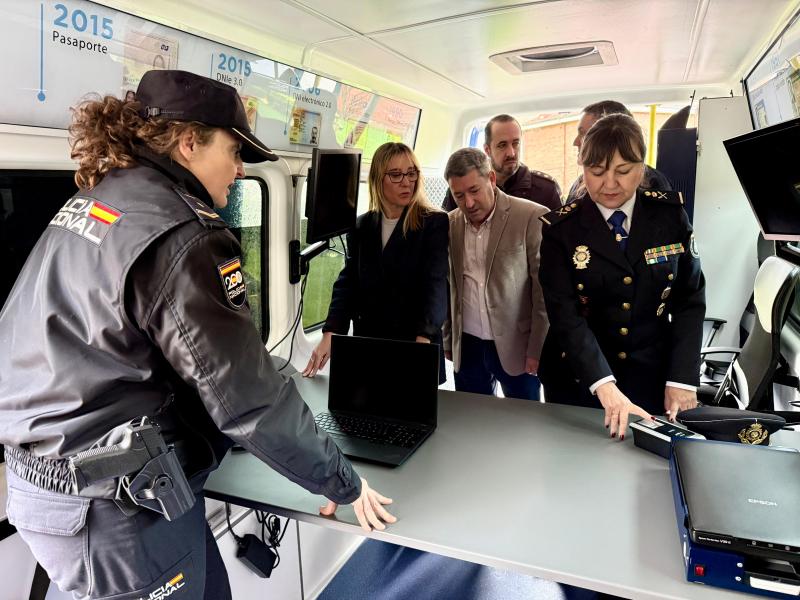
The Government delegate in Cantabria, Eugenia Gómez de Diego, together with the Superior Chief of the National Police, Carmen Martínez, has today presented the new Comprehensive Documentation Vehicle (VIDOC) to speed up the issuance of ID cards and passports in places far from the large urban centers. The new mobile unit of the National Police allows the issuance of documents in a single procedure, without the need to go to a physical office for printing and represent a saving of time and resources.
"This project of the Ministry of the Interior and the National Police is a step forward to bring essential services closer to citizens, especially in rural and less populated areas, where historically displacement has been a barrier to carrying out administrative procedures," said Gómez de Diego. "It is an advance in the attention of citizens, we take the procedures to their home with faster, closer and efficient procedures for everyone," he added.
The delegate presented the new VIDOC of the National Police during an event held in Cabezón de la Sal, where she was also accompanied by the mayor of the town, Óscar López.
The VIDOC brings two important improvements. The first is the ability to issue a document in just ten minutes, so citizens will not need to go through the three usual procedures so far in mobile units (one day for fingerprinting, one day for printing at a police station and one day for delivery).
The second novelty is the possibility of issuing passports. Until now, this document was made exclusively in the Police Stations, so the VIDOCs will facilitate and equalize in possibilities the population centers that do not have National Police infrastructures, which in Cantabria are all but Santander, Torrelavega and Castro Urdiales.
"This deployment responds to a historical demand of the municipalities furthest from the urban centers, and reinforces the commitment of the Government of Spain to accessibility and territorial equality," said Gómez de Diego, highlighting the central government's commitment to improve the services of citizens through innovation.
In this way, this new mobile vehicle has the same document issuing capabilities as a physical office and also has PAD to renew the electronic certificates. The new mobile unit will start serving in eight municipalities of Cantabria twice a month (Potes, Laredo, Reinosa, Santoña, Villacarriedo, San Vicente de la Barquera, Los Corrales de Buelna and Cabezón de la Sal) and will go quarterly to Corvera de Toranzo, Noja and the Penitentiary Center of El Dueso, although it is planned to extend its range of action to other municipalities. The Superior Police Headquarters will determine the days of travel and it will be the municipalities that make the list of citizens mentioned.
Upgrade points
In the same act, Eugenia Gómez de Diego has announced the installation of the first Document Update Points (PAD) in Cantabria outside an office of the National Police. These devices allow citizens to renew electronic ID certificates and update their access keys autonomously.
The PAD kiosks have been installed in Cabezón de la Sal, Reinosa, Potes and Santoña, and are designed to guide users through the process through an interactive screen and an assisted audio system.
Finance and development
The National Police is developing lines of work within the framework of the Digitalization Plan of the Public Administrations, scheduled for the period 2021-2025, whose objective is to improve the efficiency and effectiveness of the public administration and the accessibility of digital public services to citizens and companies.
Within this framework, a set of projects has been proposed within the so-called Digital Identity Plan (PID) that, by updating the existing technical means, will allow to dynamize and extend the use of digital identity.
One of the most relevant projects is the VIDOCs, which have been fully funded by the European Union through the Next Generation EU European Funds of the Recovery, Transformation and Resilience Plan. "This effort to decentralise essential services is a tangible example of how the European Next Generation EU Funds are being used to respond to the demands of citizens and, in this particular case, to reduce the gaps between urban and rural areas," said the delegate.
As early as last October, the National Police installed in the Police Station located in the center of Santander a multiple expedition module (express DNI). This measure allows the simultaneous attention of two people, maintaining the privacy of each citizen, by a single dispatcher in the time equivalent to a standard DNI-e expedition. The system is based on the simplicity of handling for both the shipper and the citizens.