
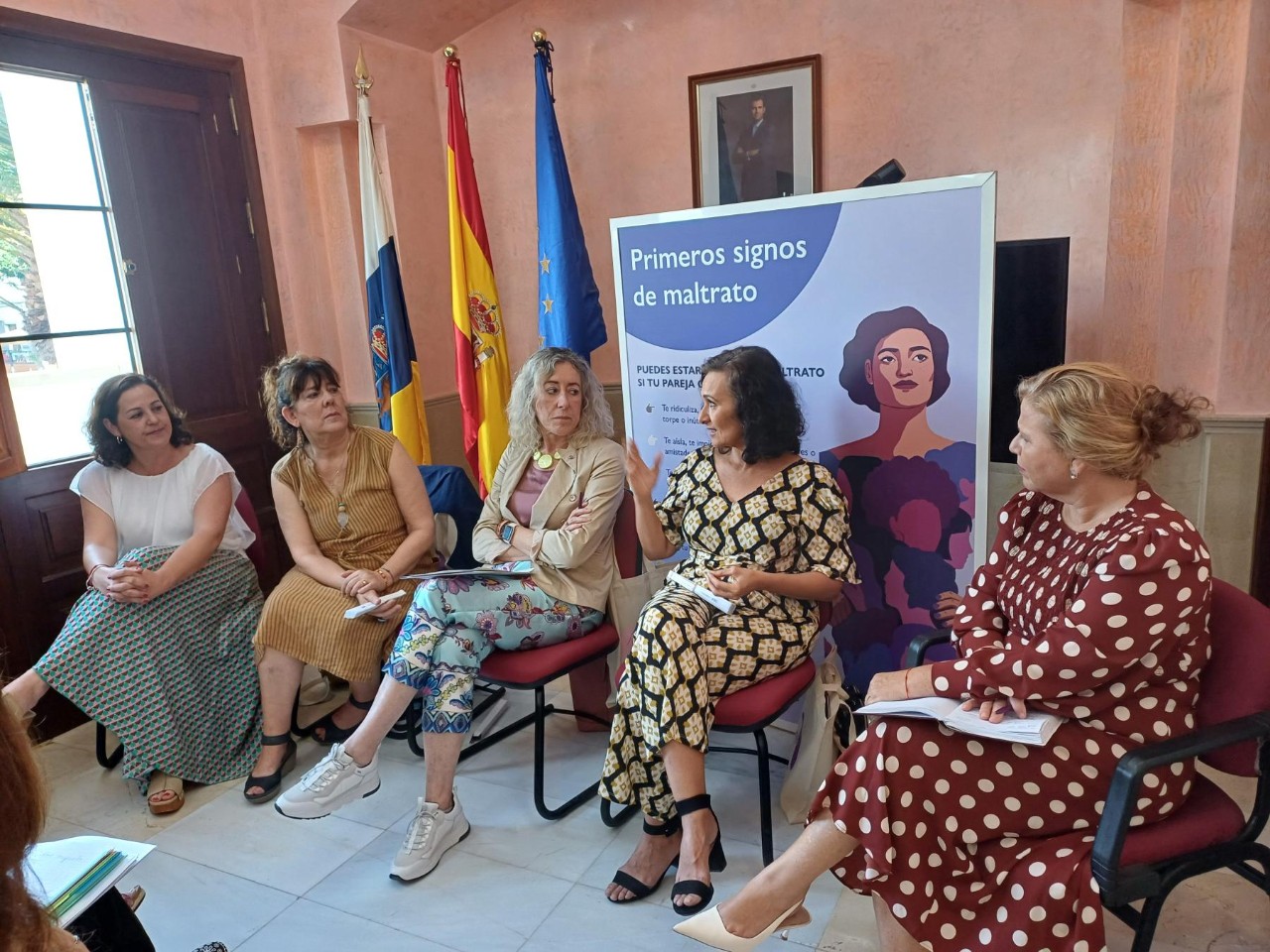
The Insular Directorate of the General Administration of the State in Fuerteventura has held today a new day within its cycle of Meetings with the presence of women, a meeting that has had a round table moderated by the subdelegate of the Government in Las Palmas, Teresa Mayans.
In this session, the island director in Fuerteventura, María Jesús de la Cruz, also participated and had as speakers María Leonor Pulido, lawyer of the legal service of the Spanish Commission of Aid to Refugees (CEAR); María Greco, technical advisor of Migrations of the Service of Attention, Advice and Information to the Migrant Population (SAAIM) of the Socio-Cultural Association Entre Mares, and María Lareo, lawyer of the Social Association Project Ikual.
The meeting, the second that is held within this cycle in the Island Directorate in Fuerteventura, focuses on the situation of migrant women from the perspective of equality, human trafficking and gender violence, issues analyzed by authorized voices that, from the third sector, work to meet the needs of these people and improve their situation.
“The Government of Spain always seeks to give voice and listen to the most vulnerable groups, trying as much as possible to improve their personal situations. The collective of migrant women is a collective in which the Government Delegation, and in particular the Government Subdelegation in Las Palmas, have always focused our attention,” says Teresa Mayans.
“The issue of migration and the difficult circumstances faced by women in Africa, which also forces them to go to sea on a very dangerous journey, is a matter in which I feel particularly concerned. That is why I am here today, listening and learning from the experts who, with a female voice, put on the table the problems of other women who are not normally listened to,” she adds.
For her part, the island director values the work carried out in Fuerteventura by the three associations represented in the presentations of this day, three associations to which she has wanted to convey her gratitude not only for their willingness to participate in the Meetings with the presence of women, but also for the daily work they do in the assistance and advice to migrants.
“In Fuerteventura we know very well what is the drama of migration without resources, of migration that seeks a better life by going out to sea. We know the complicated situation that women particularly face in some environments on our neighbouring continent and the despair that leads many to try simply to seek their survival, a future in which they are recognised as people, embarking on Europe. From this side of the sea we can only take charge and work to alleviate their situation”, says María Jesús de la Cruz.