
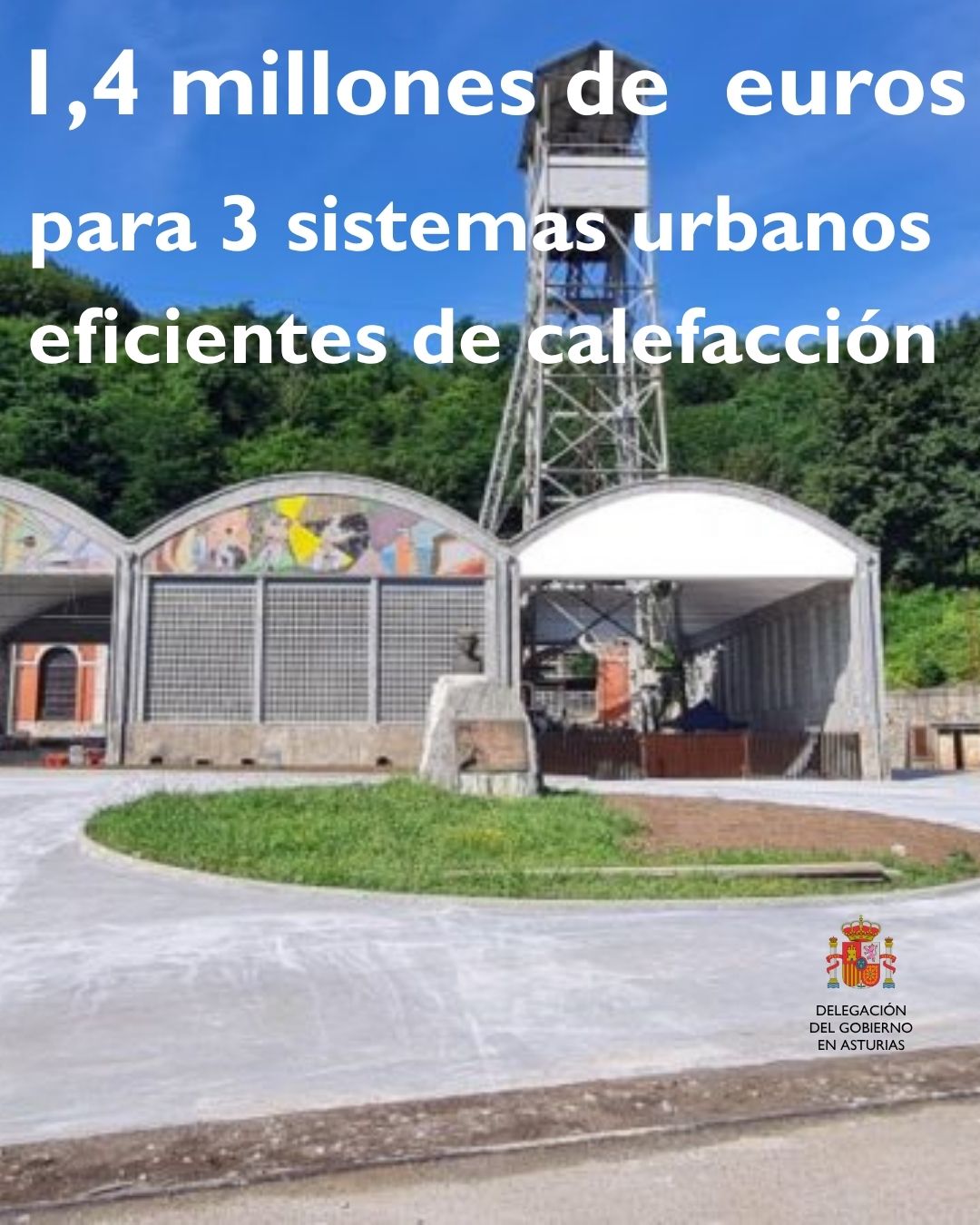
Three efficient heating and cooling systems in Asturias receive almost 1.4 million from MITECO. The Ministry allocates 50 million to 37 renewable heat and cold networks, linked to an investment of 271 million, in nine autonomous communities. The Thermal Biomass Generation Room of the Pozo Batán will receive more than 833,000 euros, the DH of the Pozo Fondón more than 160,000 euors and the expansion of the DH Batán more than 376,000 euros.
The Ministry for Ecological Transition and the Demographic Challenge (MITECO) takes two steps in the promotion of urban heating and cooling systems. On the one hand, it has launched a second hearing of the Royal Decree Project regulating urban heating and cooling systems, the evaluation and planning of heating and cooling, and the use of waste heat, available here. On the other hand, it allocates 50 million euros to promote 37 heat and cold network projects, within the framework of the Recovery, Transformation and Resilience Plan (PRTR), according to a draft resolution that can be consulted here.
The normative proposal, which transposes elements of the European directives on energy efficiency –Directive (EU) 2023/1791– and renewables –Directive (EU) 2023/2413–, establishes the promotion and the legal regime applicable to urban heating and cooling systems (SUCYR), efficient urban heating and cooling systems, the use of waste heat and the evaluation of and planning of heating and cooling in Spain.
EFFICIENT URBAN HEAT AND COOLING SYSTEMS
The future decree defines efficient SUCYRs based on their energy mix of renewables, waste heat and high-efficiency cogeneration, establishing a growing path of demands in these three areas that begins on January 1, 2028 and reaches 100% of renewables and waste heat in 2050. Any new SUCYR that is projected must be efficient and all existing ones with more than 5 MW will have to be reconverted to be efficient.
To take advantage of the waste heat, certain facilities, such as industrial plants with more than 8 MW, wastewater treatment plants or data processing centres with more than 1 MW, will have to make their waste heat available to the environment from the moment they are projected or substantially renewed. And the facilities that can use this residual heat must analyze their viability through a cost-benefit study, according to the methodology that defines a ministerial order.
To facilitate the development of the SUCYRs, MITECO, among other measures, will develop a database with the facilities that emit residual heat, design a complete evaluation of the heating and cooling system of the country –more detailed than the current Heat Map–, approve a system of Guarantees of Origin for thermal energy and coordinate with the autonomous communities and local entities to implement promotion policies, with a Roadmap with measures and monitoring indicators.
All municipalities over 45,000 inhabitants will have to draw up local heating and cooling plans according to the content of a future ministerial order. MITECO will coordinate these local plans and coordinate with the municipalities and autonomous communities in order to provide guides, technical assistance and financial mechanisms to facilitate their design.
MORE THAN 300 MW IN HEAT AND COLD NETWORKS WITH RENEWABLES
The Institute for Diversification and Energy Saving (IDAE), a subsidiary of MITECO, has published the draft resolution of the second call for the Incentive Program for Heat and Cold Network Projects Using Renewable Energy Sources (RENORED), which plans to allocate 50 million to 37 projects with a combined output of 304.5 MW.
Linked to a total investment of 271.4 million, 18 new generation plants will be built, along with new distribution networks, and 19 extensions or replacements of existing plants and networks. The projects mostly incorporate biomass (151 MW), although there are also facilities with heat pumps, aerothermia, hydrothermia and geothermia.
By autonomous communities, Castilla y León stands out with 10 files and 98.4 MW, followed by Catalonia, with eight files and 38.3 MW, and Madrid, with five files and 54.9 MW. The project with the most proposed help is in Toledo.
(four million), followed by Ourense (another four million), and Móstoles (Madrid), with 3.8 million, where there are also two other projects, with 1.1 and 0.6 million, respectively.
The allegations and comments on the draft royal decree can be submitted until June 17, through the questionnaire that can be accessed here.