
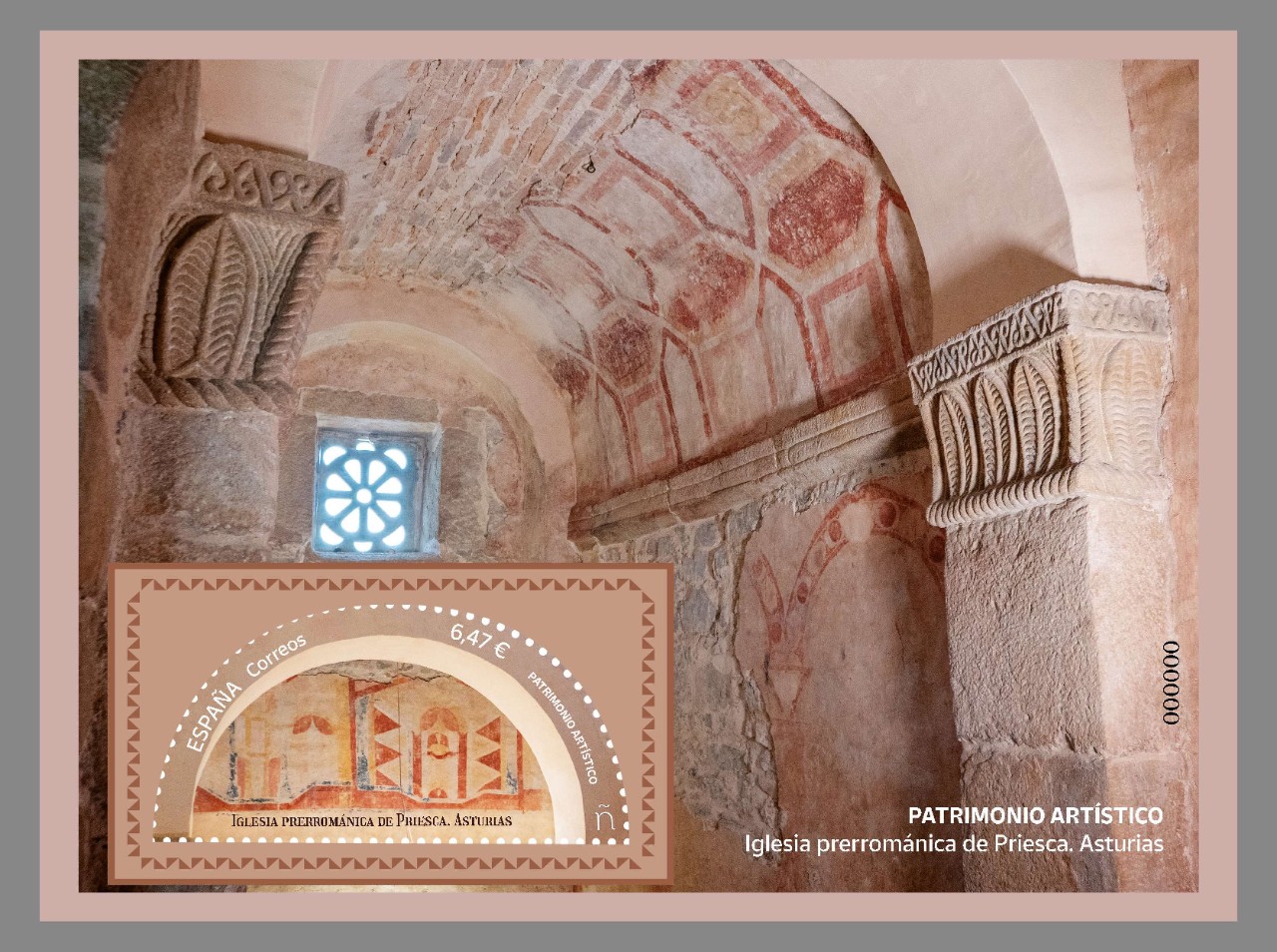
Correos has today put into circulation the seal dedicated to the pre-Romanesque church of Priesca, located in the council of Villaviciosa. The exhibition belongs to the series ‘Artistic Heritage’ and highlights this temple that is one of the most relevant examples of the Asturian preromnic.
The stamp has a value of 6.47 euros and a circulation of 65,000 copies. It is available at the post offices of Correos and at Correos Market. It can also be purchased by contacting the Philatelic Service in the e-mail atcliente.filatelia@correos.com or by calling 915 197 197.
This issue, with which Correos intends to recognize the enormous artistic value of the church of Priesca, is added this 2026 to a philatelic series in which Asturias has another recent stamp: the one dedicated in 2024 to the Millennium of the foundation of the Monastery of San Salvador de Cornellana, in Salas.
With the launch of the stamp today, the capitals and wall paintings of the temple of Villaviciosa will travel around the world in postal format and will be part of the collections of philatelic fans.
A pre-Romanesque jewel
The church of San Salvador de Priesca, which to this day continues with liturgical activity, was consecrated in the year 921. It was part of an old monastery that acted as a religiosio center of a large territory and its historical importance was reinforced by its early link to the Camino de Santiago de la Costa.
The building responds to the characteristic basilic model of Asturian architecture, with three naves separated by arches on square pillars, a tribune at the western end and an original wooden cover in two waters. The headboard is tripartite, with vaulted chapels, and on the central apse there is a small raised chamber, accessible only from the outside.
The sculptural decoration of the capitals and the exceptional collection of preserved wall paintings, with geometric, architectural and figurative motifs, linked to the high-medieval iconography and the Blessed Virgin Mary, stand out.
The most recent recovery actions, completed in 2025 under the direction of the Institute of Cultural Heritage of Spain, have allowed the integral conservation of wall coverings and paintings of the interior, following criteria of minimum intervention and respect for historical and artistic values.