
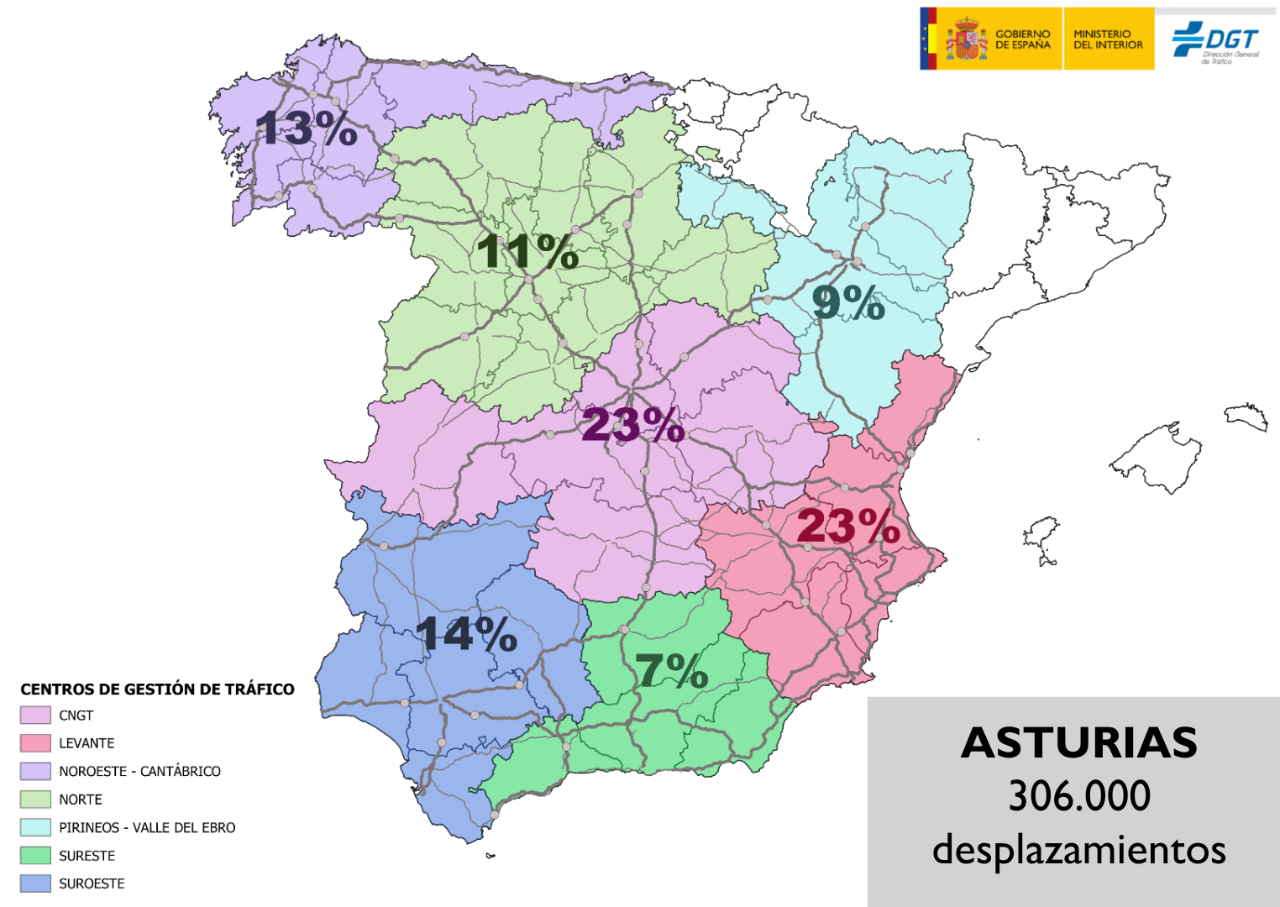
This noon begins the second and most important phase of the Special Holy Week Traffic Operation, an operation that will end at 24 hours on Monday, April 6 and in which there are plans 9.9 million of long-distance journeys by road, of which 306,000 in Asturias, 2.03% more than those registered in the same period last year.
This period concentrates the greatest volume of traffic through simultaneous departures from large urban centers to tourist areas and second residences, as well as important return movements during the weekend by Operation Return.
We must not forget also, the trips that are made to nearby towns to see religious events or enjoy days of beaches or practice winter sports. This type of travel presents a greater risk by concentrating on secondary roads, where the presence of vulnerable users is more frequent - pedestrians, cyclists and motorcyclists - and therefore surveillance on speed, alcohol and drug consumption and mobile use on these roads will be increased.
In the first phase of the operation starting this Holy Week, eleven people died on the road. Behind these figures there are lives and families truncated, so it is essential to exercise caution and responsible behavior at the wheel with an eye on these next few days both on short trips, during rest days, and on the journey back home.
THE DAY-TO-DAY OPERATION
Wednesday, 1 April
On Wednesday, circulatory problems and detentions are expected in the exits and accesses of the big cities from midday. The complications will accentuate as the afternoon progresses to move late in the afternoon to the destination areas. The most unfavorable time slot to start a trip will be between 15:00 and 23:00 hours.
Thursday, 2 April
From the early hours of the morning, departures from large cities with high traffic intensities will be resumed, which can generate retentions on the main roads until 15:00 hours. The main difficulties foreseen will be in the accesses to the coast and routes to places of tourist attraction.
Friday, April 3rd
The festival will favour short trips to places of leisure close to the large urban centers. In the afternoon, an increase in the influx to municipalities with religious acts is expected, with possible punctual congestion.
Saturday, April 4th
Possible difficulties of movement in holiday destinations due to short-distance travel, especially on coastal roads. In the afternoon, the first advanced returns will increase the intensity on some main road axes.
Sunday, April 5
The first mass return begins. From mid-morning onwards, roadblocks are expected to be progressively moved from the duty stations to the main roads. Throughout the day, traffic management and regulation measures will be established to encourage entry into large urban centers.
Monday, 6 April
The holiday tour is completed in the communities where Monday is festive: Catalonia, Valencian Community, Navarre, Basque Country and La Rioja. Traffic problems are expected on the main axes of these territories and on the access roads from neighboring provinces. In the rest, returns will also continue, motivated mainly by the start of school and university activities the next day. The Special Operation will be officially completed at 24:00 hours.
HUMAN AND TECHNICAL RESOURCES
To carry out these and other measures, this year the operation has 7,000 personnel and more than 8,500 technical resources, including:
- 5,700 agents of the Traffic Group of the Civil Guard.
- 657 operators in the 8 Traffic Management Centers.
- The Air Media Unit with 9 helicopters and 39 drones.
- Personnel in charge of the maintenance of equipment and installation of measures, such as TV cameras, time-of-travel equipment, meteorological stations, license plate readers, panels and light signals, beacons using signals and cones, containment fences, light globes or signage carts.