
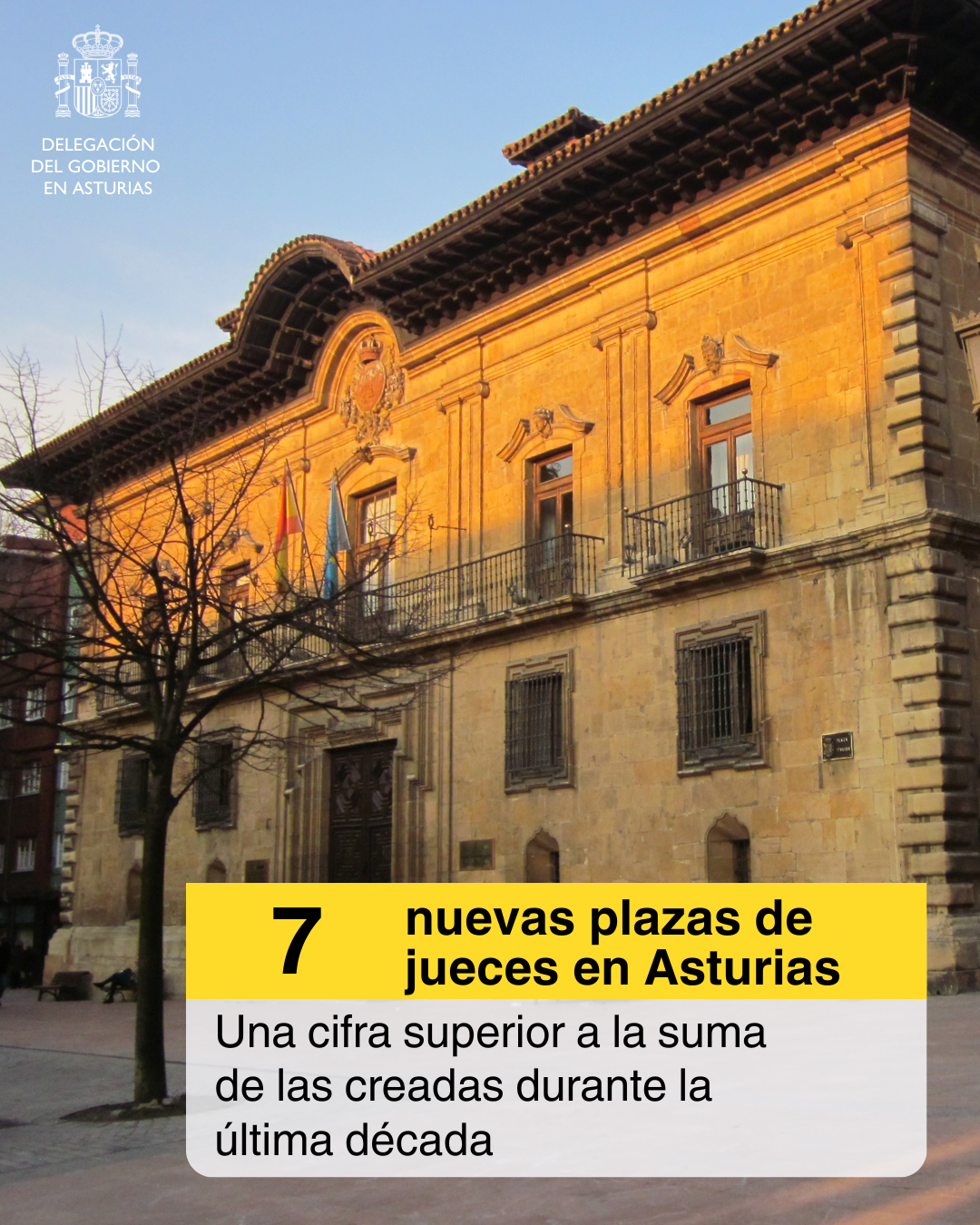
The Government will create 7 judicial seats in the Principality of Asturias in 2026 to strengthen the courts of instance and other bodies such as provincial hearings. It is an extension of historic squares. What is more, with this increase, more judicial seats will be created in a single year than in the last decade (since at that time 6 were created in total).
We are therefore facing another milestone in the ambitious transformation of Justice promoted by the Ministry of the Presidency, Justice and Relations with the Courts. A transformation that aims to turn it into a more agile, efficient and citizen-friendly public service.
In total, the government will create 500 seats throughout the country, a record that is possible thanks to the Public Justice Service Efficiency Act. This law introduces a new, more modern and efficient organizational model: it eliminates the old courts formed by a single judge and his team of officials and replaces them with courts of instance, collegiate bodies formed by various judges that have a single Judicial Office of technical support.
The new model allows you to create a court space without having to create a full court and at a cost of around €100,000. Creating a traditional court, on the other hand, cost around €500,000. Therefore, the creation of the 500 judicial units planned for this year will have a cost of € 55.7 M, while with the previous model it would have been € 260 M.
La planta judicial del Principado de Asturias se amplía un 4,4% en un año
Of the 7 new seats, 5 will be for courts of instance (TI) and 2 for the provincial hearings of Oviedo and Gijón. The courts of appeal in Oviedo, Gijón and Avilés will be strengthened.
Of the total of 500 new seats for the whole country, 363 will be for courts of instance, 2 for the Central Court of Instance and 85 for collegiate bodies such as provincial hearings (71), higher courts of justice (7), the National High Court (4) or the Supreme Court (3). The remaining 50 will be places of territorial ascription, destined to a territory, but movable according to the changes in the workloads in its courts. In total, the current judicial plant, which has 5,876 seats, will grow by 8.5% in a single year.
The distribution of the new places has been carried out according to objective criteria such as litigation and the population of each autonomous community and taking into account the workload reports of the General Council of the Judiciary and the proposals of the communities themselves with the transferred competence and of the higher courts of justice.
The creation and distribution of the 500 new judicial units is detailed in a Royal Decree that now begins its processing, collecting the contributions of the CGPJ, the CCAA and various ministries such as those of Finance or Equality.
More human resources for a better public justice service
In addition to the 500 announced for 2026, the Bill on the Expansion and Strengthening of the Judicial and Fiscal Careers, which provides for the convening of 2500 seats for judges and prosecutors in three years, a historical record that will mean an increase of 42.5%, continues to be processed by Parliament.
The Ministry also continues to strengthen the bodies of procedural and administrative management, procedural processing and judicial assistance, with the call for 1,155 places last December.