
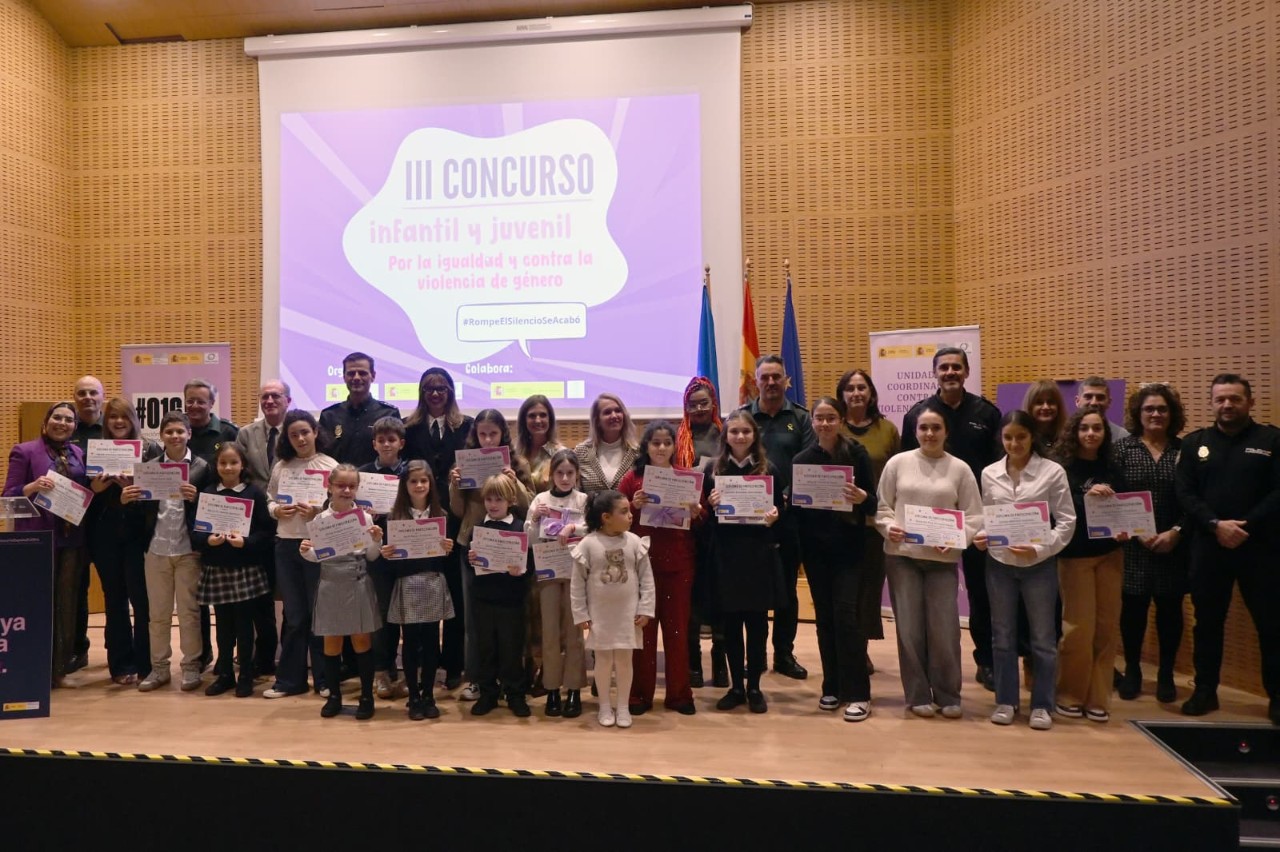
The Delegate of the Government, Sabrina Moh, has highlighted the commitment of the educational community - educational centers, equality leaders, students, mothers and fathers, Provincial Education Directorate - for its commitment against gender violence.
“Thank you from the heart, not only for the participation in this type of contest, but for the work you do every day, which you also carry in the classroom, you develop a work with this gender perspective, for the work that is being done by those responsible, the equality agents, for the impulse that is being given from the Provincial Directorate, from here, on behalf of the Government Delegation, thank you very much.”
This afternoon, the IES Virgen de la Victoria hosted the awards ceremony of the III Children and Youth Competition for Equality and Against Gender Violence aimed at students of all educational stages and all educational centers of Melilla and that this year has reached its record of participation with more than 400 works presented.
Moh stressed the relevance of this high participation, which he described as “good news and a sign that we are increasingly aware that we have a problem, male violence, and that we must work from very early ages”.
The Delegate has welcomed the interest raised by this contest and that, each edition, increases in participation, since, she has recognized that it is an activity that was born “with some doubt” in its first edition and that today is consolidated as an annual event.
During her speech, she thanked the work of the Unit against Gender Violence, organizer of the contest, as well as the involvement of the Provincial Directorate of Education, the management teams, teachers and families. He also highlighted the role of the State Security Forces and Corps, whose presence on the spot is “a sign of commitment” in the fight against this scourge.
The Delegate, in her speech, dedicated special words to the students who, in addition to presenting their projects, have been encouraged to expose them publicly. “You have not only put your messages on paper, you have also given them a voice. You have remembered stories like those of Ana Orantes or Giselle Pellicot, and you have done so courageously and rigorously,” he said.
Moh has stressed the “hopeful” nature of the messages transmitted by the young participants, who have been recognized for their ability to identify, analyze and denounce gender violence. “From an early age they are able to give us real life lessons,” he said.
The head of the Government Delegation closed her speech by reiterating her gratitude to the educational staff and those who work throughout the year in the promotion of equality and the prevention of male violence and announced that they are already waiting for the fourth edition of the contest.
School free of male violence
The Head of the Unit, Laura Segura, for her part, expressed her satisfaction at the great reception of this new edition of the contest, which has had hundreds of works delivered and has shown her gratitude to the Provincial Directorate of Education, to the educational centers, to those responsible for equality for their collaboration, and especially to the students who have participated and who through their work have expressed their rejection of gender violence and their commitment to equality.
“The eradication of all the inequality that is the origin of violence against women has its fundamental pillar in education,” he said. We know that schools are not just transmitters of knowledge, schools, besides being transmitters of values, have a powerful power of social transformation.” And “these recognitions today and your involvement are proof of that,” he said.
Segura also highlighted the involvement of teachers and students “to achieve a school free of male violence”. “You are the future and thanks to you and you will move towards a society that is equal and free of male violence,” he said.
Winners
The Government Delegate and the Head of the Coordination Unit against Violence against Women have presented the awards, accompanied by the Provincial Director of Education, Elena Fernández Treviño; the Secretary General of the Government Delegation, Augusto Hoyo; the Superior Head of the National Police, Juan de Dios Piedra; and the Colonel Chief of the Command of the Civil Guard, Jesús Rueda.
The winners have been recognized with an accrediting diploma and a tablet. Thus, in the category of Primary and Special Education, in comics, the first prize went to Angela Davinia Egea Martínez of the CEIP Painter Eduardo Morillas; the second prize went to Yusef Amar Hadi of the CEIP Constitution and the third prize to María Fernández Quintero of Enrique Soler.
In the drawing modality, the first prize was for Rubén Saavedra Guillén of the CEIP Eduardo Morillas Real; the second prize for Olivia Aragón Pachón of the CEIP Reyes Católica and the third prize for Carmen González Hernández of Nuestra Señora del Buen Consejo.
In the form of letter or email, the first prize was for Abril Bravo Carmona of the CEIP Reyes Católica; the second prize for Imen Amar Zarioh of the CEIP Mediterráneo and the third prize for Javier Bueno Herrera of the CEIP Reyes Católica.
As regards the category of Secondary Education, Baccalaureate, Vocational Training, Adult Person Education Center and Special Regime Teachings, in comic, the first prize has been for Nuhad Abdelkader Bilal of the IES Virgen de la Victoria; the second for Hiba El Yousfi Et Souli of the IES Virgen de la Victoria; and the third prize for Rocío del Pilar Berruezo Ranea of the IES Enrique Nieto.
In the drawing modality, the first prize has been given to Malak Amazouy Mohamed of the Miguel Marmolejo School of Art; the second to Cloe Téllez Bazataqui of La Salle-El Carmen; and the third prize to Kimberly Kalunga of the IES Juan Antonio Fernández Pérez.
And finally, in the category of letter, email or WhatsApp conversation, the first prize has been for Salma Mohand Azaoum of the IES Enrique Nieto; the second for Ouassima El Mamouni of the ECA Carmen Conde Abellán; and the third prize for Amira Anajjar Boukbar of the IES Leopoldo Queipo.