
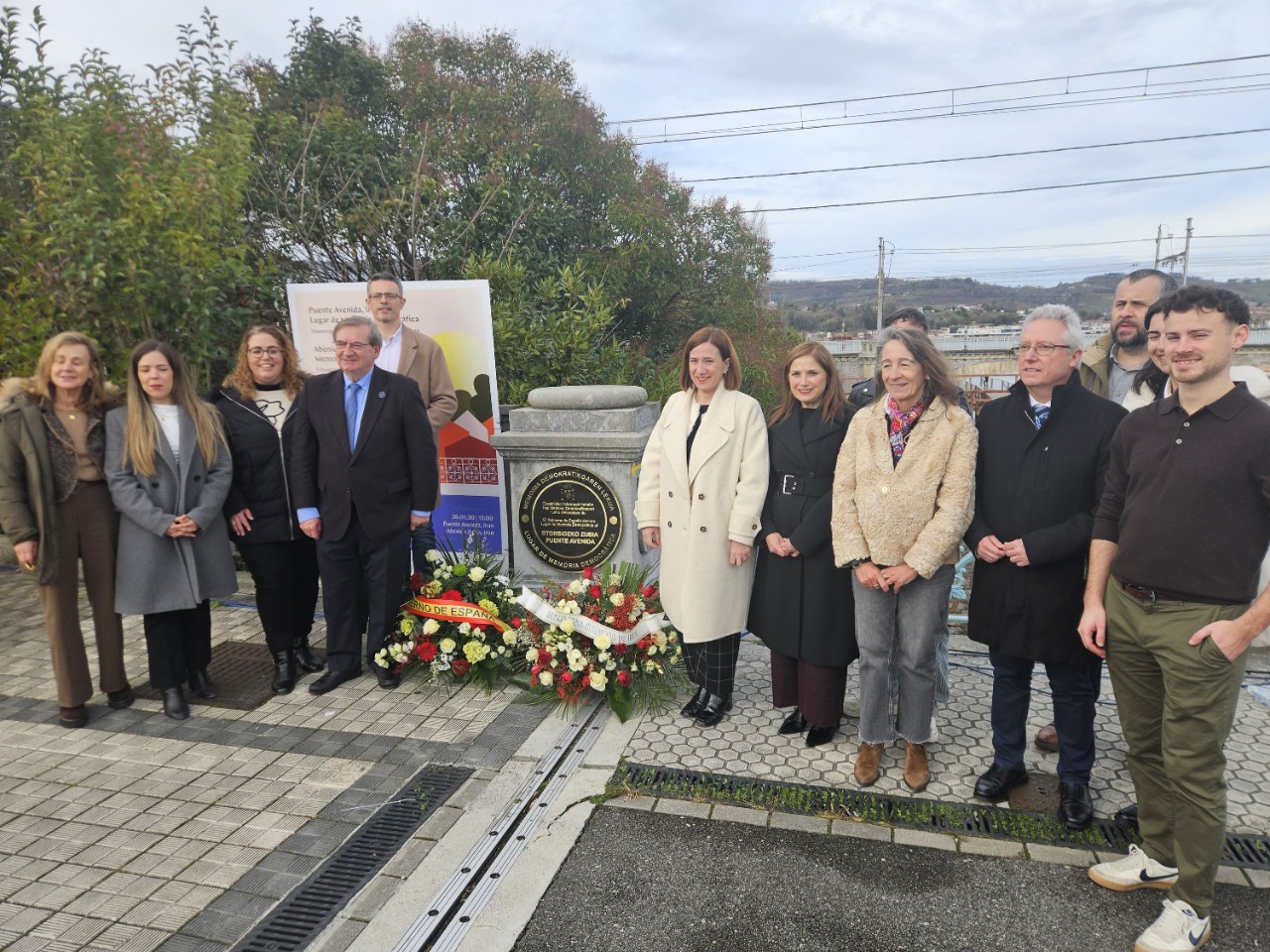
The Government of Spain and the City of Irun have discovered this noon the commemorative plaque that declares the Avenida Bridge as a Place of Democratic Memory, recognition that was agreed on January 21 and published this week in the Official State Gazette. The event was chaired by the Secretary of State for Democratic Memory, Fernando Martínez, and the mayor of Irun, Cristina Laborda, accompanied by the delegate of the Government in the Basque Country, Marisol Garmendia, the Minister of Justice and Human Rights, María Jesús San José, and other authorities, institutional representatives and memorialist associations of the city.
The institutional act with which the memory of the victims of the Republican exile has been honored has been developed on the same historical bridge that connects Irun with Hendaye. After the aurresku and the speeches, an institutional representation has deposited two floral centers in front of the plate that has been previously discovered and that officially recognizes the bridge as 'Place of Democratic Memory'.
In his speech, the Secretary of State for Democratic Memory, Fernando Martínez, pointed out that "the declaration of the Avenida de Irun bridge as a place of memory by the Government of Spain obliges the Spanish State to remember and disseminate permanently to the citizens and especially to young people the great republican exodus to France through the Avenida bridge as a result of the coup d'état of July 1936 against the Second Republic and the war of Spain. And it also obliges us to reclaim the legacy of those men and women who crossed the bridge and left their land in forced exile for defending democracy and republican and Basque institutions. That legacy enlightened us during the cruel Franco dictatorship and is now present in our democratic institutions."
For her part, the mayor of Irun, Cristina Laborda, has stressed that this act “is not just another act, it is an act of responsibility with those who preceded us and with
who will come,” and recalled that the Avenida Bridge was the scene of the exodus of “about 15,000 people, mostly women and children.” Laborda has stressed that this plaque “should not only be a tribute to the past, but a lesson and a message for the future”, and has appealed to keep alive the memory affirming that “not a step backwards in the commitment to the truth and to the dignity of those who suffered so much”, so that this place is from today “a space of democratic commitment and permanent memory”.
The placement of the commemorative plaque is part of the dissemination and interpretation measures planned by the Secretariat of State for Democratic Memory, which will develop institutional mechanisms to integrate this place of memory into international circuits that respond to similar democratic memory construction situations. This signage will identify the Avenida Bridge as a Place of Democratic Memory and facilitate its knowledge by the citizens and people who visit the city.
The declaration highlights the historical, symbolic and social relevance of this space, closely linked to the events of the Spanish War (1936-39) and to Republican exile. The Avenida Bridge was one of the main border crossings used by thousands of people fleeing violence and repression after the attack in 1936, becoming a symbol of the exodus to France and the defense of freedom and democracy.
According to the agreement of the declaration, in this place there were events of singular relevance to the collective memory, related to the struggle for rights and freedoms, exile, repression and the subsequent Franco dictatorship. The text also underlines its value as a material reference for the memory of the victims and as a space for the transmission of democratic values to present and future generations.
Inventory of Places of Democratic Memory
With this act, the Avenida Bridge is incorporated into the State Inventory of Places of Democratic Memory, forming part of the network of spaces intended for the preservation and dissemination of historical and democratic memory throughout the State.
In addition to the Avenida de Irun Bridge, Euskadi has other spaces recognized in the State Inventory of Places of Democratic Memory, such as the urban space of Gernika-Lumo, which includes the House of Boards and other enclaves linked to the bombing of April 26, 1937; the whole of the urban center of Eibar, declared for its historical relevance during the and by the bombings suffered in 1937; and the Church of San Francisco de Asís de Vitoria-Gasteiz, scene of the events of March 3, 1976.
These four Basque spaces have been incorporated into the State Inventory in accordance with the provisions of article 51 of Law 20/2022, on Democratic Memory, which regulates the cataloguing of those places where events of singular relevance to democratic memory, the defense of rights and freedoms and the preservation of collective memory took place.
Puente Avenida, an escape route for exile
The military coup of 1936 led to the displacement and exile of thousands of people fleeing war and repression. In this context, the Avenida de Irun Bridge played a fundamental role as one of the main land connection routes with France during the first months of the conflict. After the start of the war, Irun became a strategic target for the uprising forces, as it was the only point at which Republicans in the north could receive ground support. The city was taken on September 5, 1936 after intense fighting and bombing, leaving the bridge under the control of the rebels until the end of the fighting.
In the first months, the Bridge was the scene of the Irun fire and the flight of Republican civilians and soldiers to France, becoming the crossing point of the first great wave of refugees of the Spanish War (1936-39). An estimated 15,000 people, mostly women and children, crossed the border into Hendaye. This episode was immortalized in the photograph of Raymond Vanker with a child in his arms, an emblematic image of Republican exile.
Subsequently, the Avenida Bridge continued to be a main escape route and a place of great strategic, social and political relevance, being also the scene of prisoner exchanges and the delivery to the Franco police of figures such as Julián Zugazagoitia and Lluís Companys.