The Government Delegation in the Principality of Asturias and the General Directorate of Traffic (DGT) have updated the Coordination Protocol for Snowfall and other Adverse Weather Phenomena that may affect the State Road Network during the 2026-2027 campaign.
In winter there are frequent weather situations unfavorable to driving, mainly snow and ice, that affect the roads and compromise the road conditions, generating a risk for the safety of the people who circulate through them.
In these situations, the General Directorate of Traffic plays an important role in coordination with the other bodies of the General Administration of the State involved; regulating and managing traffic with the support of the Traffic Group of the Civil Guard and keeping users informed about the incidents on the roads that may condition their circulation.
The Protocol aims to strengthen coordination between the various bodies of the General Administration of the State, within the scope of their respective competences, in order to guarantee the road and safety of travel on the State Road Network in the event of possible snowfall or other extreme weather events.
To this end, it establishes the necessary actions to minimize the risk of accidents and disturbances of the circulation, determine the traffic restrictions that must be adopted until the restoration of normality and guarantee adequate attention to the occupants of the vehicles when circumstances so require.
Permanent coordination device
The Government Delegate directs and coordinates the Executive Committee of the Protocol, in which the heads of the main bodies involved participate (State Road Demarcation, Civil Guard, National Police, Government of the Principality of Asturias, Civil Protection and State Meteorology Agency), setting in motion in case of activation a Coordination Center from which the situation of the roads and the meteorological evolution will be monitored in real time.
The protocol contemplates three operational phases According to the evolution of the situation:
- Alert, when red or orange level snowfall warnings are issued from AEMET.
- Pre-emergency, when the intensity of the snowfall makes it possible to foresee difficulties for the circulation or the falling snow on the road, the ice or any other circumstance effectively hinder the circulation.
- Emergencywhen it is necessary to care for people who are blocked or unable to travel by their own means.
Available means and areas of action
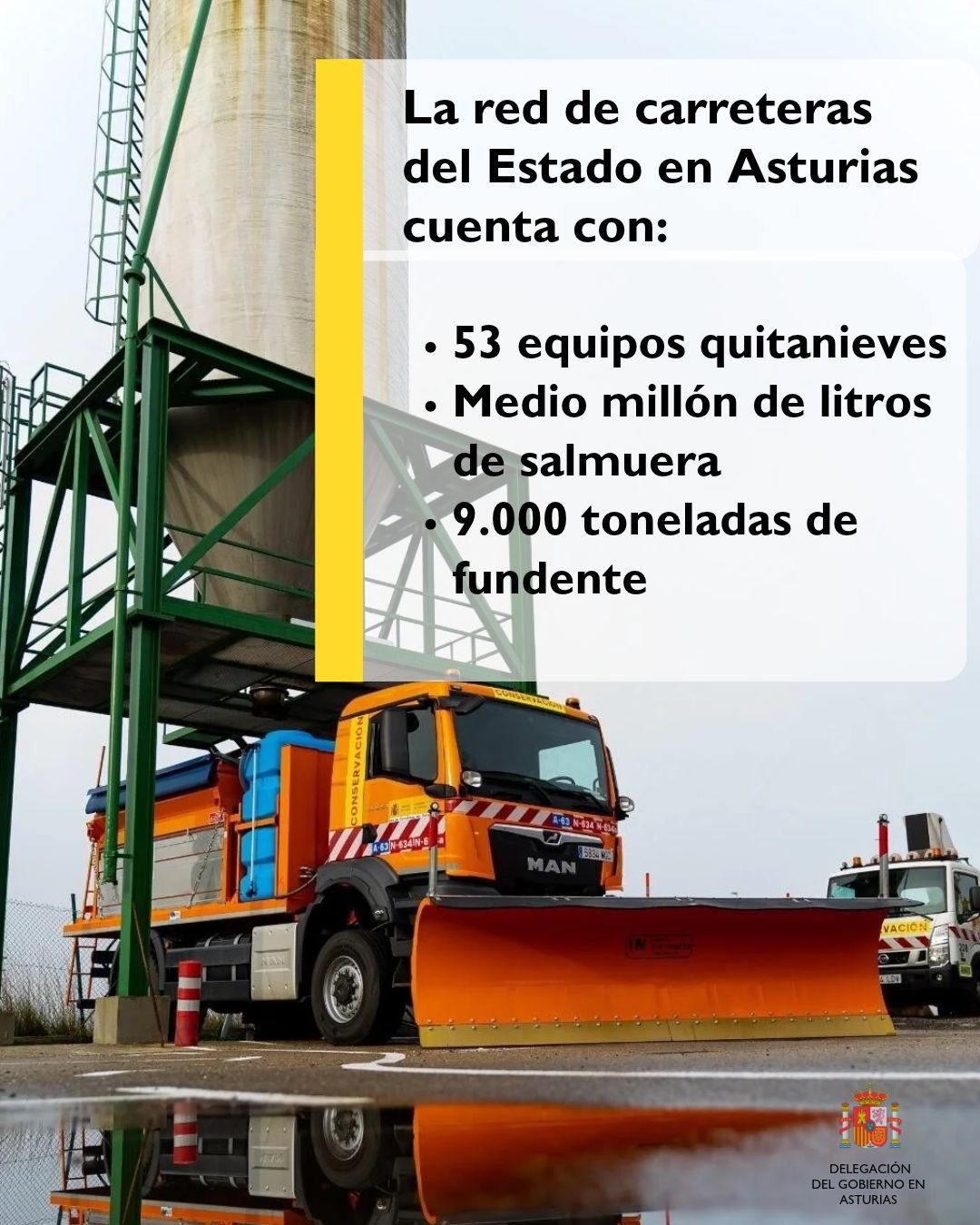
In Asturias, the State Road Network consists of about 400 Km of motorways and 450 Km of conventional roads, having for its winter operation 53 snow removal equipment (snow removers, loaders and turbo milling machines), tanks with 9,900 tons of fluxes and almost half a million liters of brine available at strategic points.
The most sensitive points are located in the Port of Pajares (N-630) and the AP-66 Highway (Campomanes-Leon), where most of the winter roads are concentrated and where there are 8 pocketing areas with capacity for 770 trucks and 885 cars.
In the case of the AP-66, the protocol includes specific measures during this campaign due to the adaptation works of several tunnels (group Entrerregueras–Pando–Vegaviesga, Negrón, Oblanca, Cosera and Barrios), which involve lane cuts from Monday to Friday. These cuts will be removed when there is a risk of snow accumulation on the road, which must be completely cleared two hours before the expected start of the episode, to maintain the fluidity and safety of traffic.
Collaboration and communication
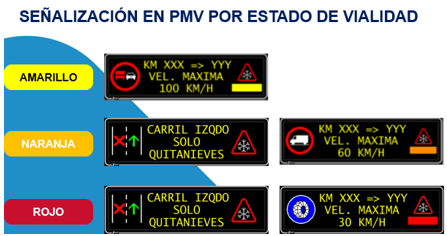
During the snow or ice episodes will be reported continuously through variable message panels on the main roads, official channels of the DGT (www.dgt.es, @DGTes in X, radio bulletins and DGT app) and press office of the Government Delegation, in charge of centralizing the information to the media.
In addition, coordination will be maintained with 112 Asturias and transport associations to report on traffic restrictions and pocketing zones.
Indispensable
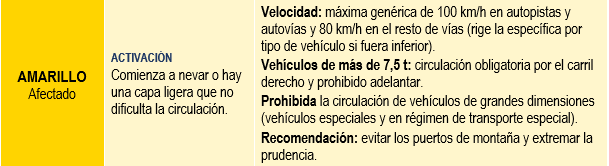
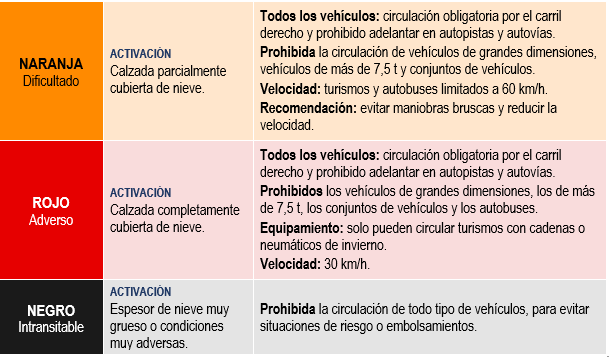
In case it is necessary to travel through areas with orange or red warning for snowfall, the conditions of the trip may be affected, so it is necessary to attend to the following indications:
Extreme caution when travelling through the areas and roads affected by this forecast, as well as having the appropriate means and equipment to travel in safety conditions, including chains or winter tyres.
Pay attention to the signage in the variable message panels and the indications of the agents of the Traffic Group of the Civil Guard.
ü Obligation, in the event that the movement is hindered by the conditions of the road due to snow, to leave the left lane or lanes free to allow the passage of emergency vehicles and snowploughs.
If the Variable Message Panel is available, it will signal the prohibition of overtaking indicating that it must be compulsorily circulated in the right lane, being able to use its contiguous in sections with three or more lanes per direction.