
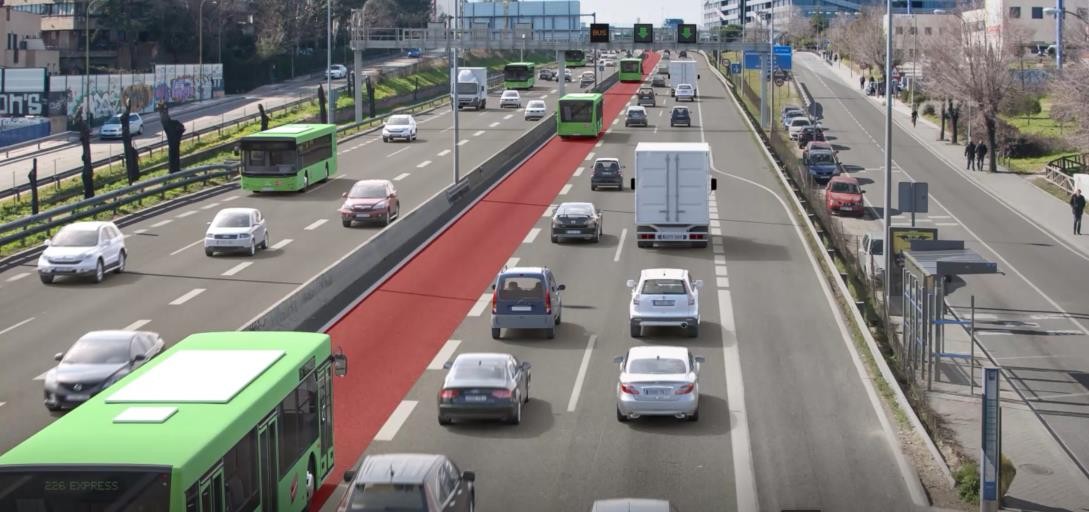
- The left lane between Alcalá de Henares and Madrid, direction in and out, has been enabled to limit traffic to BUS and VAO at peak times and open it to other vehicles the rest of the day.
- In the first phase, it will reach only Torrejón de Ardoz and it will be able to circulate public transport, vehicles with two or more occupants, motorcycles and emergency vehicles.
- More than 15,000 travelers will benefit from this measure, which will allow a 25% reduction in the time it takes to leave or enter Madrid.
- The investment to implement the VAO Bus has been 13.9 million euros.
The Ministry of Transport and Sustainable Mobility, the General Directorate of Traffic, the Consortium of Transport of the Community of Madrid and the City of Madrid will launch, in the first quarter of 2026, the new lane reserved for bus and high-occupancy vehicles with which it is sought to decongest traffic in and out and thus promote accessibility to Madrid.
This is a project in which the four administrations involved have been working since the signing of the Collaboration Agreement in 2019, with the aim of promoting public transport, improving mobility, promoting the sustainable use of private vehicles and improving air quality at the entrances and exits of Madrid. In the works to enable the lane, the administrations have invested a total of 13.9 million euros.
The lane will consist of the technological empowerment of the left lane of each direction of the motorway between Madrid and Alcalá de Henares so that, through a system of dynamic management of the track capacity in real time, it works as a Bus-VAO lane at peak hours and as a free circulation lane the rest of the day.
Operation of the lane
Although the lane has been technologically enabled between Madrid and Alcalá de Henares (19.2 kilometers in total), in a first phase of operation it will only reach Torrejón de Ardoz. For this, both public transport, as well as vehicles with two or more occupants, as well as motorcycles and emergency vehicles, can circulate.
On your route, there will be embarkation and disembarkation areas where you can enter or leave when the signs indicate so. In particular, the signalling shall consist of:
- Luminous beacons at ground level. They will become green in the areas of embarkation and disembarkation, and amber in the areas where you cannot enter or leave. If the beacons are off, the lane will be free to use for all vehicles.
- Road markings.
- Light panels: the porticoes will also report with pictograms when the Bus-VAO lane is operational, so that there is no confusion.
In the direction of entry to Madrid, the first boarding will be located at the height of Torrejón de Ardoz (km 18.6), the second in Rejas (km 13.6) and the last in Canillejas (km 7.7), to disembark all in Avenida de América.
In the direction of departure, the shipments are at the height of Arturo Soria/Josefa Valcárcel (km 5,85) and the Eisenhower knot (km 11,4) and the landings in Canillejas km 9,100) and in Rejas (km 15,200) where this lane ends.
The lane will be guarded with license plate reading and occupancy detection equipment, so there will be penalties for all those who travel by themselves or enter and leave through unauthorized places.
Although it is planned to activate this VAO BUS in the first quarter of 2026, for weeks its operation will be carried out as tests with the objective that the users of this motorway will be aware of its operation and have time to adapt their movements to make use of public transport or shared vehicles.
Improving accessibility to Madrid
In recent years, all the administrations involved in mobility in the Madrid region have been making a great effort to improve accessibility on the access roads to the capital. The access to the big cities concentrates a large part of the movements that citizens make every day in private vehicles, neighbourhoods, metro and intercity buses.
The latter suffer the problem of traffic congestion at rush hour, in most of the entrances to Madrid. On the A-2 in particular, about 85% of vehicles enter Madrid with a single passenger on board, reducing the average speed of circulation to 20 kilometers per hour in some sections.
On this axis, in the rush hour of the morning, about 4,500 cars carry about 5,000 people, while 125 buses channel more than 5,500 travelers, that is, more than half of the people access by public transport by bus.
Therefore, this Bus-VAO rail project becomes a flexible and low-cost solution, which can be transferred in the future to other corridors, and which represents a high return for society, since it is estimated that every day some 15,000 travelers would benefit from the measure that would reduce the time of entry or exit to Madrid by an average of 25%, which would mean savings for all users of 500,000 hours per year and a reduction of 900 tons of CO2 emissions per year .