
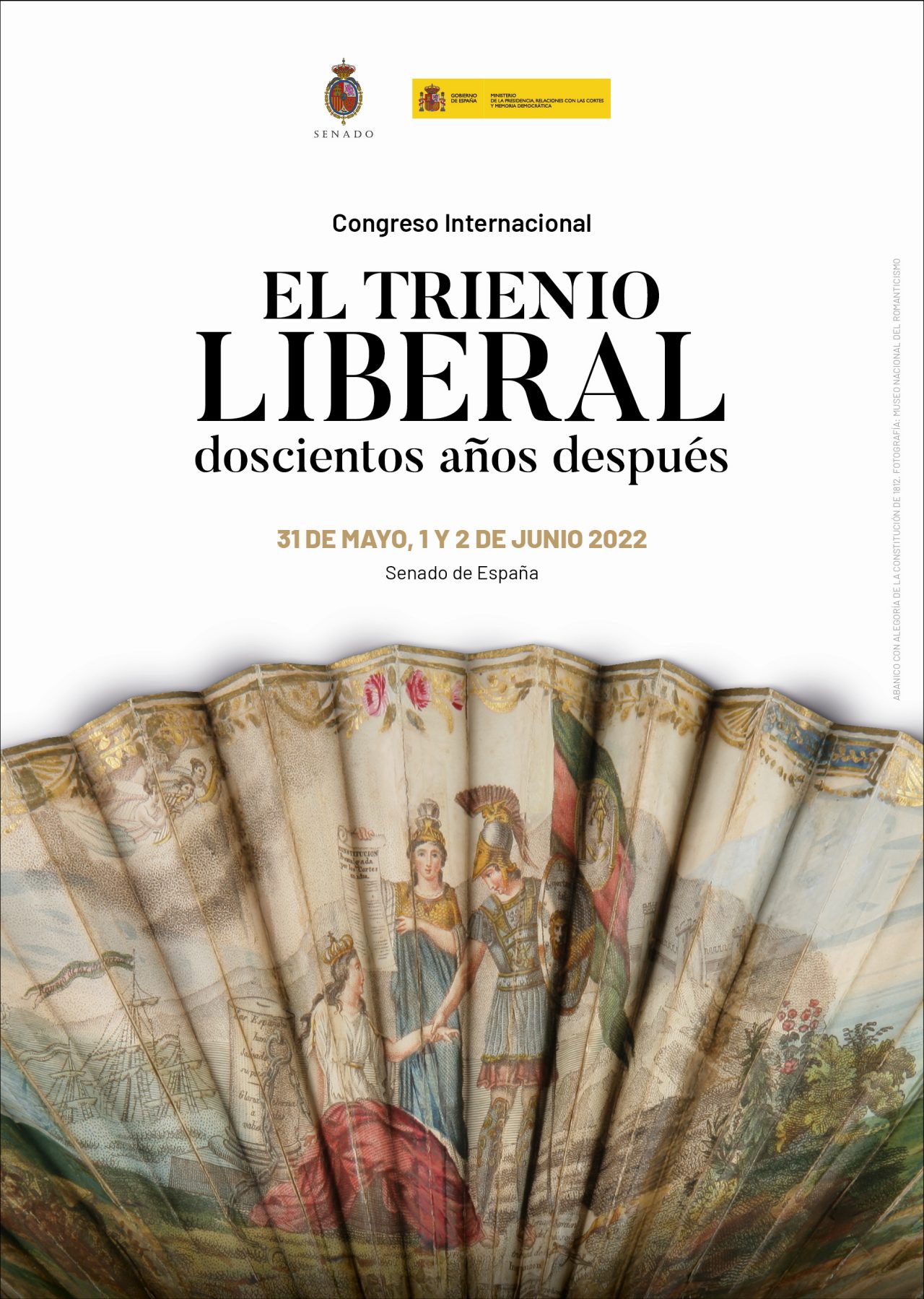
The slogan “Understand the past, reflect on the present” will preside over the meeting of experts that will be held in the Senate between May 31 and June 2. En el Congreso, codirigido por los catedráticos Manuel Chust e Ignacio Fernández Sarasola, participarán medio centenar de especialistas de universidades de España, Portugal e Hispanoamérica e invitados de distintos ámbitos. The program addresses the participation of women in social and political debates in the constitutional origins of Spain.
The Liberal Triennium (1820-1823) laid the foundations for the fall of the Old Regime and the implementation of parliamentary activity, the division of powers, freedom of printing, citizen participation and the birth of political parties, also exerting a notable influence on many of the constitutional processes, both in Europe and in America. These and other aspects will be addressed at the International Congress “The Liberal Triennium two hundred years later”, which will be held between May 31 and June 2 in the Spanish Senate. With this event the Government of Spain, in collaboration with the Senate, intends to remember and commemorate this important historical moment in the construction of democratic culture in Spain.
On the occasion of two centuries of the period begun with the pronouncement of Rafael del Riego, which led to the restoration of the Constitution of 1812, the meeting of experts invites us to “Understand the past, reflect on the present”, as its subtitle says. Co-directed by the Professor of Contemporary History of the Jaume I University of Castellón, Manuel Chust, and by the Professor of Constitutional Law of the University of Oviedo, Ignacio Fernández Sarasola, the Congress will have the participation of half a hundred specialists from different universities in Spain, Portugal and Latin America, guests from different fields, such as journalism and administration, and representatives of various institutions.
The President of the Senate, Ander Gil, and the Minister of the Presidency, Relations with the Courts and Democratic Memory, Félix Bolaños, will preside over the opening of the Congress, whose inaugural lecture will be given by the professor of the University of Alicante Emilio La Parra, Comillas Prize for History, Biography and Memories for the work Fernando VII. A desired and detested king. The title of his presentation, “The liberal triennium, plural impulse for the construction of a new system”, points out the general lines that will be developed in the ten thematic blocks with which the program will shed light on the achievements of the Constitutional Triennium and its imprint on the historical development of Spain and the world.
The role of women, constitutional education.
A transversal issue, such as the participation of women in social and political issues in the constitutional origins in Spain, will be the reason for one of the debates. Following the presentation of Elena Fernández, from the University of Barcelona, and moderated by the president of the Equality Commission of the Congress of Deputies, Carmen Calvo, the former delegate of Government in Gender Violence and lawyer in the Cortes, Blanca Hernández Oliver, and the professors Claudia Rosas Lauro (Pontificia Universidad Católica de Perú) and María Cruz Romeo (University of Valencia) will speak as guests.
Likewise, the training in civic and democratic values of citizens during the Triennium will be the subject of the last scheduled meeting, “Constitutional education”, which will feature the presentation of Pilar García Trobat, from the University of Valencia, and the meeting moderated by the ambassador of Spain to UNESCO, José Manuel Rodríguez Uribes, in which the professors Mercedes Cabrera, from the Complutense, will participate; Pilar Billarín Domingo, from the University of Granada, and Olegario Negrín Fajardo, from UNED.
Constitutional restoration and its multiple effects.
The different round tables will address the historical period marked by the restoration of the Constitution of Cadiz and will delve into specific aspects of that new system, from the division of powers and the guarantee of rights to the constitutional education of the citizen.
Under the title “The Liberal Triennium. Constitution, rights, freedoms», the first thematic block will recall the application in all its extension of the constitutional text of 1812 - abolished by Fernando VII two years after its promulgation - with the contributions of specialists of the University of Zaragoza, Pedro Rújula; of the University of Santiago de Compostela, Roberto Luis Blanco Valdés, and of the University of Malaga, represented by the also judge of the Constitutional Court María Luisa Balaguer Callejón, in a session moderated by the Minister of the Presidency, Relations with the Courts and Democratic Memory, Félix.
The activity of the second day of the International Congress, on June 1, will begin with the analysis of “The echoes of the Liberal Triennium”. Mariana Terán Fuentes, from the Autonomous University of Zacatecas and member of the Academy of the History of Mexico; Juan Marchena Fernández, from the Pablo de Olavide University; Rosario de la Torre del Río, from the Complutense University of Madrid, and Fernando de Sousa, from the University of Porto, with the director of the Cervantes Institute, Luis García Montero, as moderator, will show the impact of the Spanish precedent in European and American revolutionary processes.
On the subject “Parliamentarism, popular mobilization and counterrevolution” will be another of the tables, moderated by the Secretary of State for Relations with the Courts and Constitutional Affairs, Rafael Simancas, and in which María Antonia Peña (University of Huelva), Gonzalo Butrón Prida (University of Cadiz) and Jordi Roca Vernet (University of Barcelona) will intervene. Three outstanding figures of the historical period: the military Rafael del Riego, the economist José Canga Argüelles and the politician Antonio Alcalá Galiano will lead the meeting on «The faces of the Triennium», with the specialists Clara Álvarez Alonso (Autonomous University of Madrid), Carmen García Monerris (University of Valencia), Raquel Sánchez (Universidad Complutense) and the professor of the University of Alicante Emilio La Parra as moderator.
The first afternoon session of that day will serve to remember “The attacks of religious politics, deamortization, Masonry and communism” by the hand of Manuel González de Molina (Pablo de Olavide University), Luis P. Martín (University of Pau) and Pedro Álvarez Lázaro (Pontifical University of Comillas), moderated by the Secretary of State for Democratic Memory, Fernando Martínez López. The second, “Ways of citizen participation in political life”, will deal with aspects such as the freedom of printing, the activity of the people’s juries and the creation of the Patriotic Societies – precedents of the political parties – with the intervention of Gonzalo Capellán de Miguel (University of La Rioja), José Antonio Pérez Juan (Miguel Hernández University), Luis Fernández Torres (University of the Basque Country/EHP) and Celso Almuiña (University of Valladolid), accompanied by the co-director of the Congress Ignacio Fernández Sarasola.
The third and final day of the international meeting, on June 2, will enter “The debates of the reformist project of the Triennium”, among which the provincial division adopted in 1822, which will be presented in a paper by the professor of the University of León Francisco Carantoña, took a prominent place. In a complementary debate, the Mayor of Vigo and President of the FEMP, Abel Caballero, will participate as guests; the President of the Provincial Council of Castellón, José Pascual Martí García, and the Mayor of Hospitalet de Llobregat and President of the Provincial Council of Barcelona, Nuria Marín Martínez, moderated by the Secretary of State for Territorial Policy, Alfredo González Gómez.
The “Freedom of the press” will be the subject of another session, which from the presentation of Beatriz Sánchez Hita, from the University of Cadiz, will facilitate the exchange of views among the invited journalists: Montserrat Boix, of Radio Televisión Española; Carmen Juan, of Onda Cero, and Jesús Maraña, of Infolibre, with the director of El Español, Pedro J. Ramírez, as moderator.
Congressional poster.
With the collaboration of Museum of Romanticism, this poster has been elaborated using the allegorical image of the Spanish Nation liberated from its chains by the Constitution of 1812.
Registration, dissemination and more info.
The inscriptions are free and can be made through an electronic form available on the website. Ministry of the Presidency website. In addition to face-to-face attendance, the sessions of the Congress can be followed through streaming. Those who attend in person may be provided with a certificate of participation in the room in which the Congress is held.