
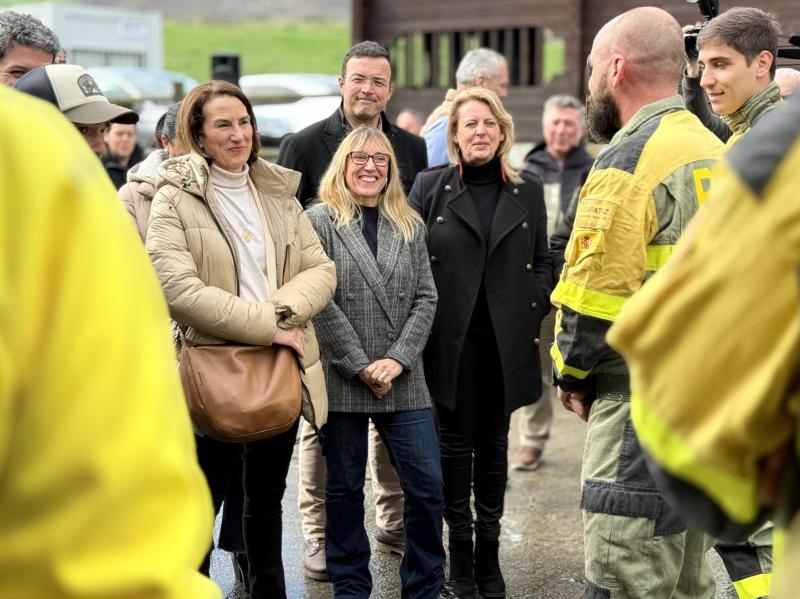
The Director General of Biodiversity, Forests and Desertification of the Ministry of Ecological Transition and Demographic Challenge, María Jesús Rodríguez de Sancho, announced on Wednesday that the base of the Forest Fire Brigade (BRIF) in Ruente will be a permanent headquarters. He confirmed this during his visit to the facilities, in which he was accompanied by the Government delegate in Cantabria, Eugenia Gómez de Diego, and the Councilor for Rural Development, María Jesús Susinos.
Rodríguez de Sancho highlighted the importance of the work carried out by the BRIF in the prevention and extinguishment of forest fires, stressing that its professionalism and dedication are "irreplaceable" within the state operation that also has about 60 air assets of different capacities. "This device has more than 600 highly qualified professionals, whose intervention is key in situations where the air media cannot operate due to weather conditions or orography," he explained.
The BRIFs constitute the mechanism that the Ministry provides to support the autonomous communities, which are competent in the matter, for the extinguishment of forest fires. In this regard, he stressed that "the work that this brigade does here in Cantabria is really very productive" and he trusted that his permanent stay in the region will contribute to reducing the number of fires that occur.
Budget effort
The Ruente BRIF, which until now operated on a temporary basis during the high-risk months – February to May – will become a permanent unit from June onwards. "It will be permanent and will have to be made up of personnel, preferably attached to this autonomous community living in this area, collaborating also with the fight against the demographic challenge, which we know is another of the challenges we have to face," said Rodríguez de Sancho. "This budget effort has been complex in a context of extended accounts, but it has been worthwhile," he added.
When it is not in the works of extinction, the brigade will perform prevention tasks, supporting the integral management of forest fires. "We believe that with this new team that we will have here, we will contribute to reduce the number of fires that occur and also attending, of course, to the cause of the fires that we will be more able to know, precisely because we are closer to the territory," he added.
The Director-General recalled that BRIFs are state-owned and can move between different territories depending on the emergencies that occur, having participated in emergencies beyond the forest fires, such as the great Filomena snowfall, the eruption of the volcano of La Palma or episodes of floods caused by DANA.
Certified mechanism
In his speech, Rodríguez de Sancho highlighted the Ministry’s effort to approve the Forest Fire Law and the Law on Environmental and Forestry Agents, with the aim of strengthening the rights and working conditions of these professionals. "A law is just a role that we must take to reality and develop later," he said.
He also stressed the importance of coordination between administrations in the fight against forest fires, mentioning the role of the Committee to Fight Forest Fires, in operation since 1994, and collaboration with the European Civil Protection Mechanism. In this regard, he has said that Spain is in the process of having the European Union recognize the BRIF as a certified mechanism within this international device, as is already the case with the FAS team, specialized in fire planning and analysis.
Finally, the CEO has acknowledged the uncertainty in the upcoming fire campaign, recalling recent episodes in other parts of the world, such as the fires in California or Japan. "We hope the situation is not too serious, but if it is, we are confident in the commitment and collaboration that emergency teams have always shown," he concluded.
Appreciation for professionalism
For her part, the Government delegate in Cantabria has had words of thanks for the work and professionalism with which they carry out their work, and has highlighted the good collaboration between administrations.
In addition, he has insisted on the need for crimes “not to go unpunished” and has called for citizen collaboration to denounce arsonists.
From the regional government, Susinos has shown its satisfaction for “this is the last time we welcome the brigade” because, as announced by the Director General of Biodiversity, Forests and Desertification of MITECO, María Jesús Rodríguez, it will have a permanent character in Cantabria, as a reinforcement and support to the operation of the Autonomous Community.
In this regard, the councilor thanked the economic and budgetary reinforcement for this device and highlighted the collaborative work, which dates back to 2006, in support of the Forest Fire Prevention and Control Operation of the General Directorate of Forestry and Biodiversity which, as you know, is composed of on-call technicians, emisorists, agents of the natural environment and forest fire brigades.
For the councilor, this is a team “founded by the Government of Cantabria in the fight against the more 4,563 fires that have been declared in Cantabria in the last 6 years (between 2019 and 2024), an average of 760 forest fires that, on average, are caused every year in our Community, a total of almost 68,000 hectares.
During the visit, the general director, the delegate and the councilor were accompanied by the mayor of Ruente, Jaime Díaz; the mayor of Los Tojos, Belén Ceballos, and the mayor of Mazcuerras, Javier Camino.