
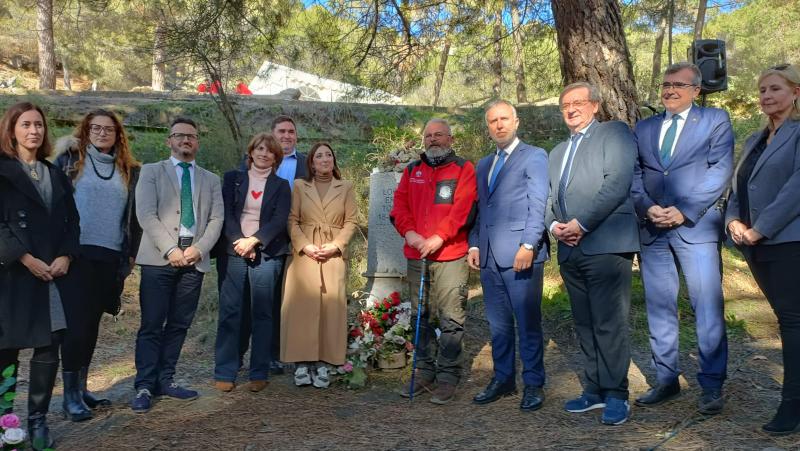
“With the application of the Democratic Memory Law, we are looking for places like Víznar to become spaces for reflection and reparation for the victims,” said the minister, who has pledged to collaborate with the other public administrations to continue with the rescue of memory.
Torres pointed out that the project, funded with 190,000 euros by the Secretary of State for Democratic Memory, will not be completed until all the remains are rescued. “We will continue to excavate to the last pit of the Ravine of Víznar to restore the dignity of those who were killed for defending freedom,” he said.
The visit to the graves and the laboratory where the remains are processed was also attended by the subdelegate of the Government in Granada, José Antonio Montilla; the prosecutor of the Human Rights and Democratic Memory Room, Dolores Delgado; the Secretary of State for Democratic Memory, Fernando Martínez; the general director of Victim Care and Democratic Memory, Zoraida Hijosa; the mayor of Víznar, David Espigados; the president of the Grenadian Association of the Recovery of Historical Memory, Rafael Gil; as well as the director of the excavation, Professor, Carrión.
Of the 114 murdered whose remains have been rescued to date, 34 were women. The work has been carried out since 2021, within the framework of the four-year exhumation plan promoted by the Democratic Memory SE, which is already in its final phase, with the collaboration of the Junta de Andalucía. It is estimated that the exhumations will last until June of this year.