
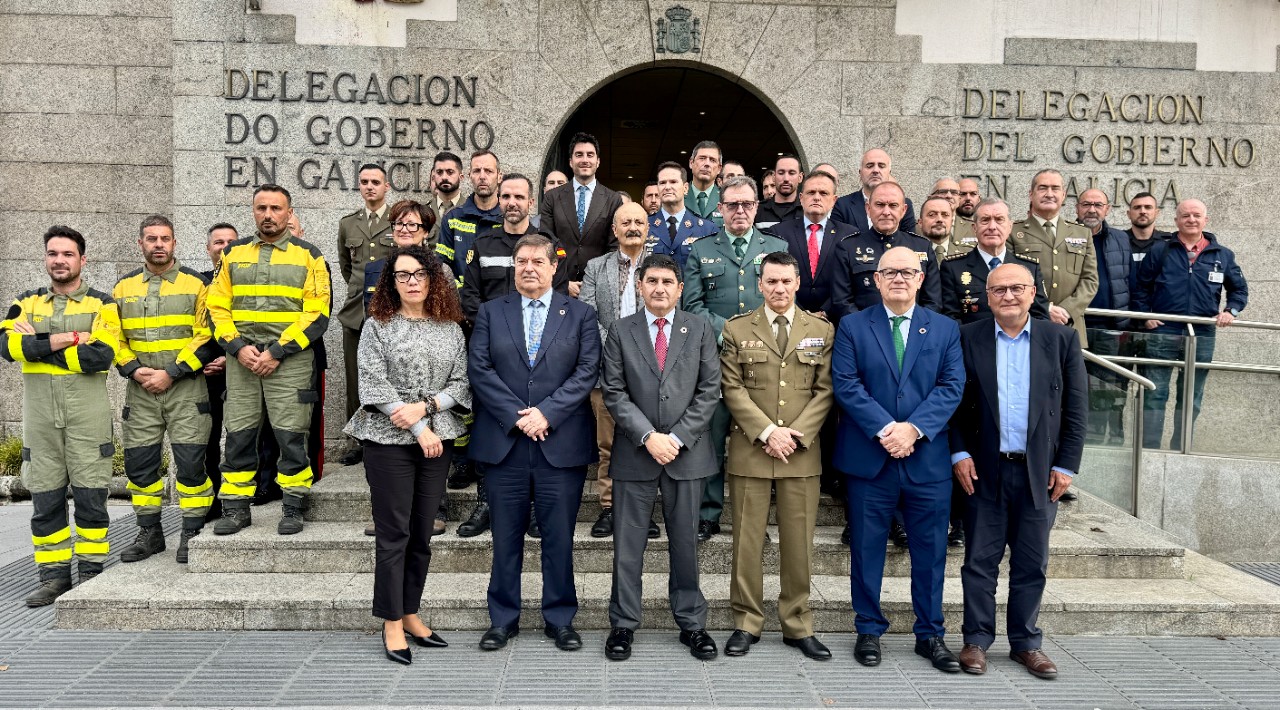
The government delegate in Galicia, Pedro Blanco, thanked today for the “great work and the incomparable example of public service demonstrated by each and every one of the state media and personnel who fought against the fires that devastated more than 170,000 hectares in Galicia this summer”. Pedro Blanco recalled that Galicia experienced “the worst fire crisis in its history, with evacuated villages, razed landscapes and a sky that ceased to be blue to become a thick shadow for days”, but stressed that, faced with that hell, “Galicia had something stronger than fire: its professionals”. “Those of us who lived were not just figures, they were life stories reduced to smoke”, a drama before which, he said, “Galicia felt fear, yes, but it also felt something much more powerful: pride, pride of those who did everything to protect this land”.
In the tribute ceremony organized by the Government Delegation to the state media that participated in the defense against fire, the delegate stressed that the Government of Spain carried out the largest operation ever deployed in Galicia, with the simultaneous mobilization of more than 3,000 troops in the hardest moments of the crisis, counting on land, air, military and security forces units, as well as international teams activated by the European Union. Thus, in the act participated and were recognized: The Military Emergency Unit, with the largest deployment in its history in Galicia, with more than 500 military and 200 land resources, the Air and Space Army, with up to 25 aircraft operating, the Land Army – BRILAT, guaranteeing security with openings of roads and support to the evacuated villages, the BRIF of the Ministry for Ecological Transition, with the ten state brigades acting at some point in the community, the State Security Forces and Bodies: Civil Guard, National Police, Traffic and Seprona, as well as the teams arrived for the first time in the history of the fight against fires in Galicia through the European Civil Protection Mechanism, with means and personnel from France, Finland, Estonia or Romania.
The delegate also thanked the work of the Civil Protection team of the Government Delegation, “which works 24 hours a day, 365 days a year, without media focus but being indispensable.”
Pedro Blanco remarked that the Government of Spain was “where it had to be”, accompanying Galicia “from the first minute” of the crisis. In this regard, he thanked the sub-delegates and sub-delegates of the Government of the four provinces for their work. “You were there day and night, as you should be, because in emergencies public servants have to be where decisions are made on the ground, with people, seeing the smoke and being aware of the dangers,” he said.
He also recalled that Galicia was the first place visited by the president, Pedro Sánchez, who traveled to Ourense at the most critical moment of the wave of fires and that also were in Galicia the Minister of Interior, Fernando Grande-Marlaska, the Minister of Defense, Margarita Robles, and the Minister of Agriculture, Luis Planas, “demonstrating that for this Government Galicia is a priority.”
Hand laid to the Xunta and call to the State Climate Pact
Pedro Blanco stressed that the collaboration with the Xunta “was absolute, loyal and constant” and reached out to the president, Alfonso Rueda, to incorporate Galicia into the State Climate Pact, because “this is not about political colors: it is about life, about the future of our sons and daughters, and to prevent Galicia from suffering again in an August like this”.
The delegate stressed that “climate change is a reality and the fires are not extinguished with slogans or looking for culprits, they are extinguished with professionals and with well-managed taxes, with a strong public system, with planning, with investment and with prevention,” he said. In this way, it highlighted that the Government recently approved the retirement age reduction coefficient for forest firefighters, paying a historical debt, in the face of the recent layoffs of forest brigades of the Xunta de Galicia.
Finally, Pedro Blanco said that the Government of Spain will continue to strengthen media, improve protocols, invest and learn. “The fire went out, but our commitment did not. We will be here today, tomorrow and always. Because this country showed that it is strong, supportive and capable. And because Galicia will never forget the one you did”, he concluded.
Acknowledgements
In the tribute ceremony, which was introduced by the head of Civil Protection of the Government Delegation, María Dolores Gómez, also intervened the lieutenant colonel head of the BIEM V of the UME Pablo Samaniego Pérez, who thanked “the initiative of the Government Delegation to bring all the teams together in an act of recognition” and recalled that this was “one of the most complicated campaigns for the UME”. He stressed “the absolute dedication of the Fifth Battalion”, the ability to “reach everything” thanks to the use of drones, aerial means and the integrated command system, which allowed to coordinate the response in extreme situations.
On the part of the BRIF of Laza, the coordinating head, Bruno Ondoño Álvarez, stressed that only his unit made 83 interventions in this campaign, and highlighted “the enormous responsibility that each brigadier assumes when he gets off the helicopter to enter the fire”. He also defended the importance of prevention work, “much less visible than extinction, but strategic and essential to avoid the repetition of such serious situations.”
The general of the 15th Zone, Miguel Ángel González Arias, explained that the Civil Guard performed “more than 35,000 services during the crisis,” including the evacuation of 40 population centers and the preventive confinement of more than 50 villages. He stressed that the agents acted “protecting lives, ensuring safety and accompanying families in the midst of an unprecedented emergency.”
The honorary consul of Romania, Diego Esquer Rufilanchas, stressed that the international performance was “an example of European cooperation”, in which “all the countries responded and supported Galicia at an extremely difficult time”. He noted that the operation showed “that, when emergencies strike, Europe is united and acts as one body.”