
The Government Delegation in the Canary Islands has published today the seventh episode of What do you know about gender-based violence?, the new audiovisual campaign to inform and raise awareness of this social scourge launched by the Government Delegation in the Canary Islands, through its Coordination Unit against Violence against Women.
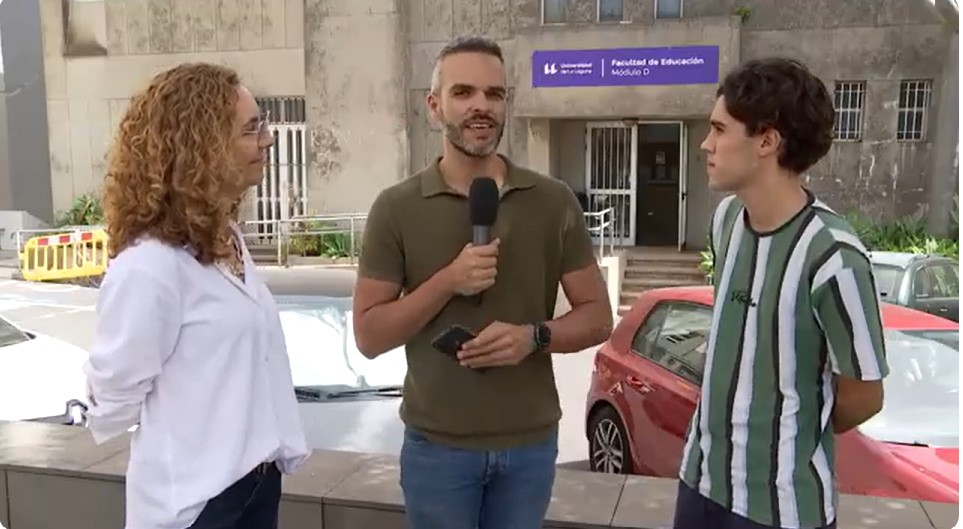
In the last of the seven chapters that make up this series, the head of the Service against Violence against Women of the Delegation of the Government in the Canary Islands, Evelia Déniz, and the journalist David Perdomo go out on the street in Tenerife to analyze with young people the use made of pornography and its link with violence against women.
This episode takes place on the campus of the University of La Laguna (ULL), where students are asked about the consumption of pornography and its impact on affective sexual relations; in particular, about its influence on harmful or violent behaviors, especially with the representations of aggression and coercion of women.
As Evelia Déniz recalls, today the first contact with pornography occurs at the beginning of adolescence, and even at younger ages: “Pornography at the moment is being the school where many young people and girls are being trained in their affective sexual relationships. Therefore, it is very necessary to talk about these issues, in the area of the family, schools, and society in general.”
In this last chapter of the campaign they also interview Esther Torrado, professor in the Department of Sociology and Anthropology of the University of La Laguna and responsible for the Guide to Pornography ANDREA, designed as a tool at the service of mothers, fathers and youth mediators to accompany and sensitize young people about the effects of pornography, develop critical thinking and promote healthy sexuality.
It is a guide prepared by the association APLEC Inclusion Plus Equality with the coordination of personnel linked to the Sexual Violence Group (VIOSEX) of the ULL and subsidized by the Ministry of Equality in the call for grants aimed at programs and projects of awareness, prevention and research of the different forms of violence against women.
“There is violent, male pornography, which dehumanizes women in general, treats them as if they were mere objects of sexual consumption,” says Torrado, who warns of how this influences the children who access it: “Children are not prepared to see these images and will tend to reproduce these behaviors.”
The deputy delegate of the Government in Santa Cruz de Tenerife, Javier Plata, highlights the importance of promoting a positive sex education based on equality, respect, desire and consent: “The misuse of pornography links sex with violence. We must abandon fears and taboos and educate ourselves in a healthy sexual policy.”
Seven episodes, seven themes
In What do you know about gender-based violence? A team led by Evelia Déniz travels through the seven Canary Islands where the Government Delegation has an island headquarters to ask different questions and offer answers to people who are in the street, issues that address issues directly or indirectly related to violence against women, such as the myths of love or the use of pornography.
The head of the Service against Violence against Women of the Government Delegation in the Canary Islands will respond to doubts, but, above all, to erroneous approaches, placing special emphasis on the existence of a whole series of assistance resources for victims and their daughters and sons, sponsored by the State Pact against Gender Violence.
The campaign, funded by the State Pact against Gender Violence and also distributed to the media, will be extended until the week before the International Day for the Elimination of Violence against Women, 25N, two months in which the media channel will acquire particular prominence. YouTube of the Government Delegation in the Canary Islands and its new profile in Instagram, in addition to their accounts in X, Facebook and LinkedIn.