
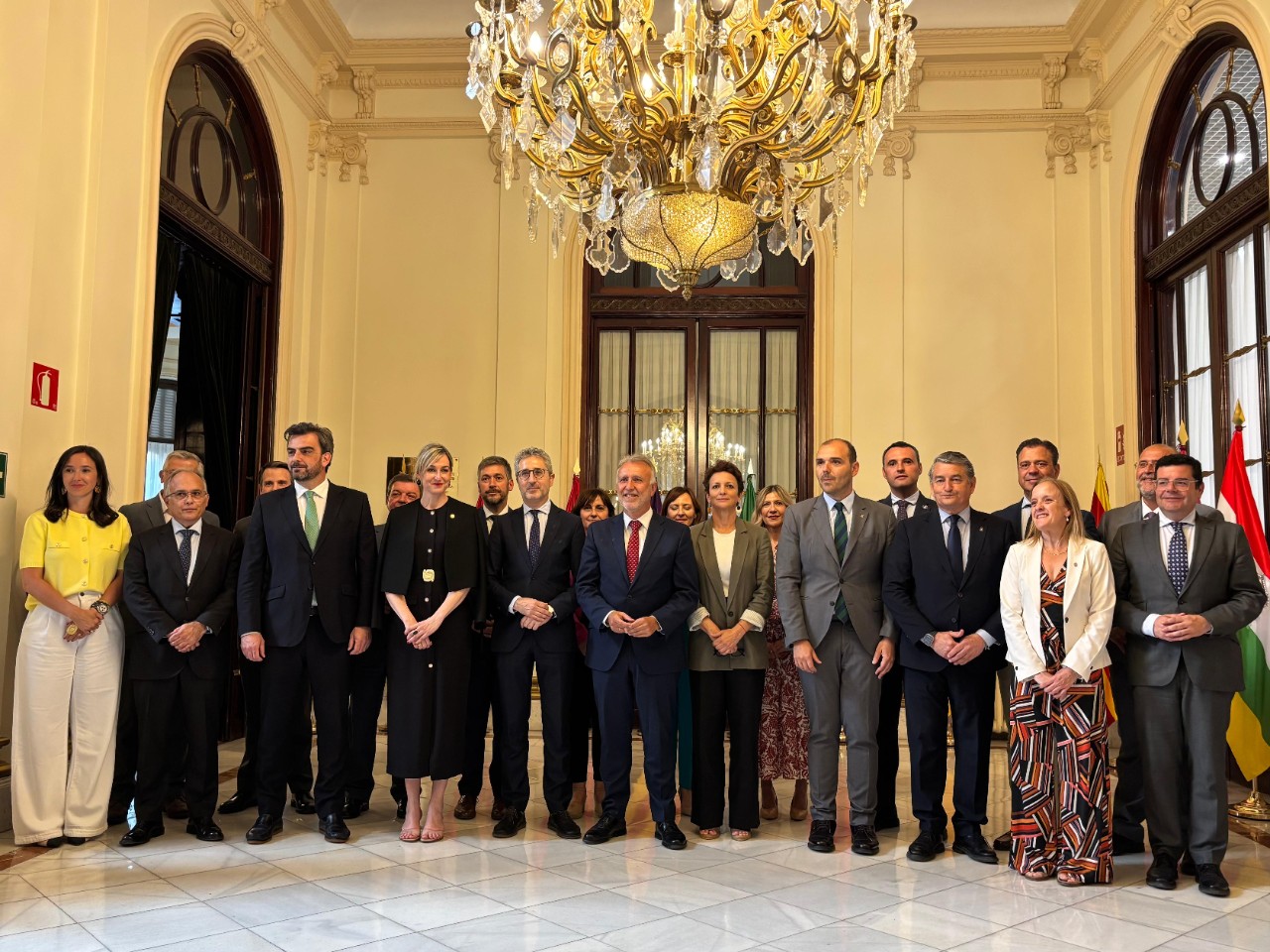
The Minister of Territorial Policy and Democratic Memory, Ángel Víctor Torres, today regretted, after the meeting of the Preparatory Committee for the Conference of Presidents, which will hold its XXVIII meeting in Barcelona, on June 6, that the agenda of the next multilateral meeting has not been approved, by the vote against the eleven communities and the two autonomous cities governed by the People's Party.
Torres has announced that, “in principle” and after the lack of agreement, work will be done with the two points of the day raised by the Government of Spain, such as access to housing, and university education and Professional Training. “After listening to all the representatives of the CCAA, we have made a proposal to modify the agenda in which almost all the demands of the autonomous communities were included, except those that do not fall within the competence of the Conference of Presidents, but they voted no,” said the minister, who explained that this proposal was supported by the Government of the Canary Islands, the Basque Government and the communities governed by the PSOE (Asturias, Catalonia, Castilla-La Mancha and Navarra).
In this proposal, issues requested by the different autonomous governments had been included. “In point one, of access to housing, we added ‘housing policies’, which was requested by Catalonia; ‘acquisition by foreigners’, which was requested by the Canary Islands; and ‘occupation’, which was requested by all the CCAA of the PP,” the minister said. “Regarding point two, University and FP, we had added ‘Child Education funding’, requested by the PP communities,” he continued.
“In addition, we have added a third point that most of the CCAA have proposed to us, such as the energy model. To this, we have added, at the proposal of the Basque Country, ‘decarbonization’; and ‘security’, at the request of the popular communities,” he explained.
Point number four had remained “literal” at the request of the PP presidencies: “Financing: restructuring CCAA debt and approval by RDL of account deliveries.” Finally, point five has been added, with “the migratory pact”; and point six with “infrastructures, as requested by the PP”.
“Despite this, the communities presided over by the People’s Party have voted against,” insisted Torres, who has indicated that the Conference of Presidents is a space for “co-governance and inter-administrative cooperation, not confrontation,” and has pointed out that “you cannot come to institutional meetings with party premises and mandates, because that is not what the citizens demand, that what they want is solutions to their real problems.”
Proposals outside the competency framework
The minister added that the communities presided over by the PP have finally wanted to add proposals that exceed the competency framework of the Conference of Presidents, such as “the indelegable competence of border control, which cannot be included in this multilateral meeting, according to a legal report”. In addition, proposals have been made in voce such as that “the Government of Spain withdraws proposals for legislation that are being presented within the framework of Justice; which also does not fit, because it corresponds to the Courts,” said Torres.
Finally, he referred to the proposal of the popular representatives to modify the Regulation, and recalled that this is a regulatory framework that was approved unanimously and has not been tried to modify either with Mariano Rajoy as president of the Government. “In politics we must renounce maximalist postulates, for the benefit of the majority, we cannot be in the non-permanent”, he concluded.