
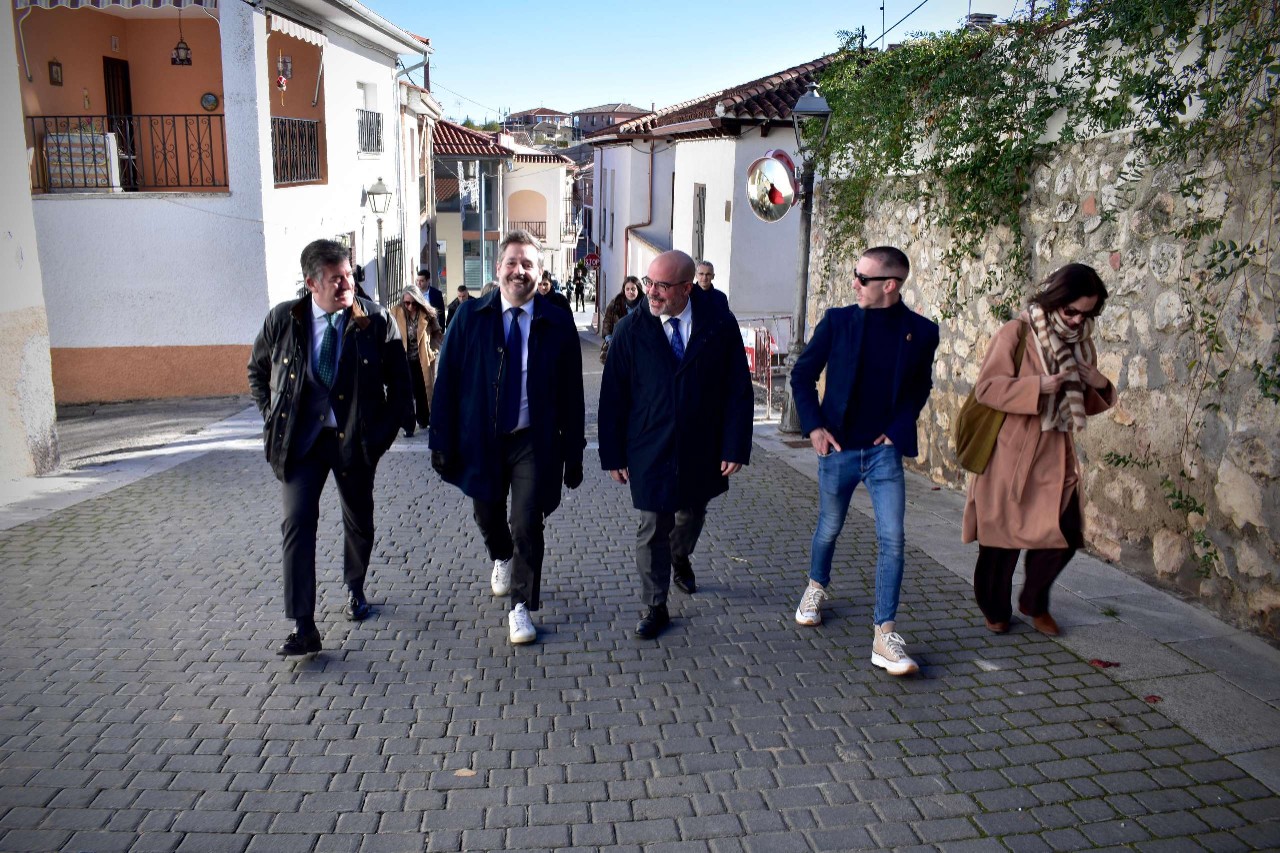
· The delegate of the Government of Spain in the Community of Madrid, Francisco Martín Aguirre, has visited some of the actions aimed at consolidating Santorcaz as a destination for active tourism and nature together with the Minister of Culture, Tourism and Sport of the Community of Madrid, Mariano de Paco
· Among them, those carried out on the wall, the Torreón del Olivo and the viewpoint.
· They were accompanied by the mayor of the municipality, Rubén Gómez Buil, and representatives of ARACOVE (Grupo de Acción Local de Sureste de la Comunidad de Madrid), who presented the project that covers several localities in the region of Las Vegas and Alcarria de Alcalá.
· The Destination Tourism Sustainability Plans (PSTD) are projects aimed at promoting more sustainable and balanced tourism, funded through European Funds.
The Government of Spain has allocated two million euros of European Funds to the heritage and tourism of municipalities in the region of Las Vegas and La Alcarria. Among them is Santorcaz, which today has received the visit of the delegate of the Government of Spain in the Community of Madrid, Francisco Martín Aguirre, along with the Minister of Culture, Tourism and Sport of the Community of Madrid, Mariano de Paco.
The project seeks to promote a sustainable tourism model thanks to the Sustainable Tourism Plan, a commitment of the Government of Spain to sustainable, innovative tourism and generate opportunities for the rural environment.
The town of Santorcaz, included in the “Tourism Sustainability Plan Comarca of Las Vegas and Alcarria de Madrid” in the category of Rural Tourist Destination, has several actions under way to promote a sustainable tourism model based on active tourism and nature that today have been visited by the delegate of the Government of Spain in the Community of Madrid, Francisco Martín Aguirre, together with the Minister of Culture, Tourism and Sport of the Community of Madrid, Mariano de Paco.
For the government delegate, this project is an example of the "total commitment of the Government of Spain to the development of the interior of the Community of Madrid" that materializes in the 200 million investments in 159 municipalities of the region to develop sustainable tourism projects.
The tour has included a stop at the medieval wall, the Torreón del Olivo, the viewpoint —from which you can see the environment under rehabilitation— and the digital totem installed to access tourist information of interest.
Later, back in the town hall, representatives of the Local Action Group of the Southeast of the Community of Madrid ARACOVE made a presentation of the “Tourism Sustainability Plan Comarca of Las Vegas and Alcarria de Madrid”, which was incorporated into the Territorial Plan 2021 of the Community of Madrid and which has a subsidy in the amount of 2,000,000 euros.
This Plan is committed to promoting a sustainable tourism model based on active and natural tourism, especially in the tourist products of hiking and cycling tourism. In addition, it intends to make an effort for the digitalization of destinations, mainly through the implementation of systems for monitoring tourist flows and data processing.
For a sustainable tourism
This strategy and its actions are framed within the Tourism Sustainability Plans in destinations promoted by the Secretary of State for Tourism and financed through European Funds, and in the interterritorial cooperation project Madrid Destino Rural (MadRural).
The strategy is based on the search for sustainable tourism, which starts from the historical, environmental, ethnographic or patrimonial characteristics of an area to propose, around them, a tourism that generates economic activity in the villages. To elaborate this plan, the tourist resources of the 30 municipalities that make up the region of Las Vegas and Alcarria de Madrid have been carefully studied: the cultural, festive, environmental heritage, the restoration, the accommodations…From there a possible visitor profile has been built and a wide variety of routes and thematic experiences have been created that are attractive and that promote rural tourism in Madrid.
The actions contemplated within the Tourist Sustainability Plans in Destination are distributed in four axes:
AXIS 1: Ecological transition
· Fire prevention and climate adaptation: forest measures, signage, mountain access control and awareness campaigns.
· Creation of the Interpretation Center – Nature Classroom.
AXIS 2: Energy efficiency and sustainable mobility
· Reducing the carbon footprint and promoting sustainable mobility.
· Charging infrastructures and zero emission electric vehicles for tourist use.
AXIS 3: Digital transition:
· Digital tools for user integration and tourism impact management in destinations.
· Tourism training.
AXIS 4: Competitiveness:
· Outsourcing and hiring of technical manager for the PSTD
· Protection, improvement of accessibility and valuation of the Historical-Cultural Heritage.
· Environmental Quality and Sustainable Tourism Audits and Certifications.
These investments are part of the state’s strategy to promote greener, more digital and cohesive tourism. In total, the Tourist Sustainability Plan of the Government of Spain reaches 37 million euros in the Community of Madrid, benefiting about twenty municipalities and natural spaces.