
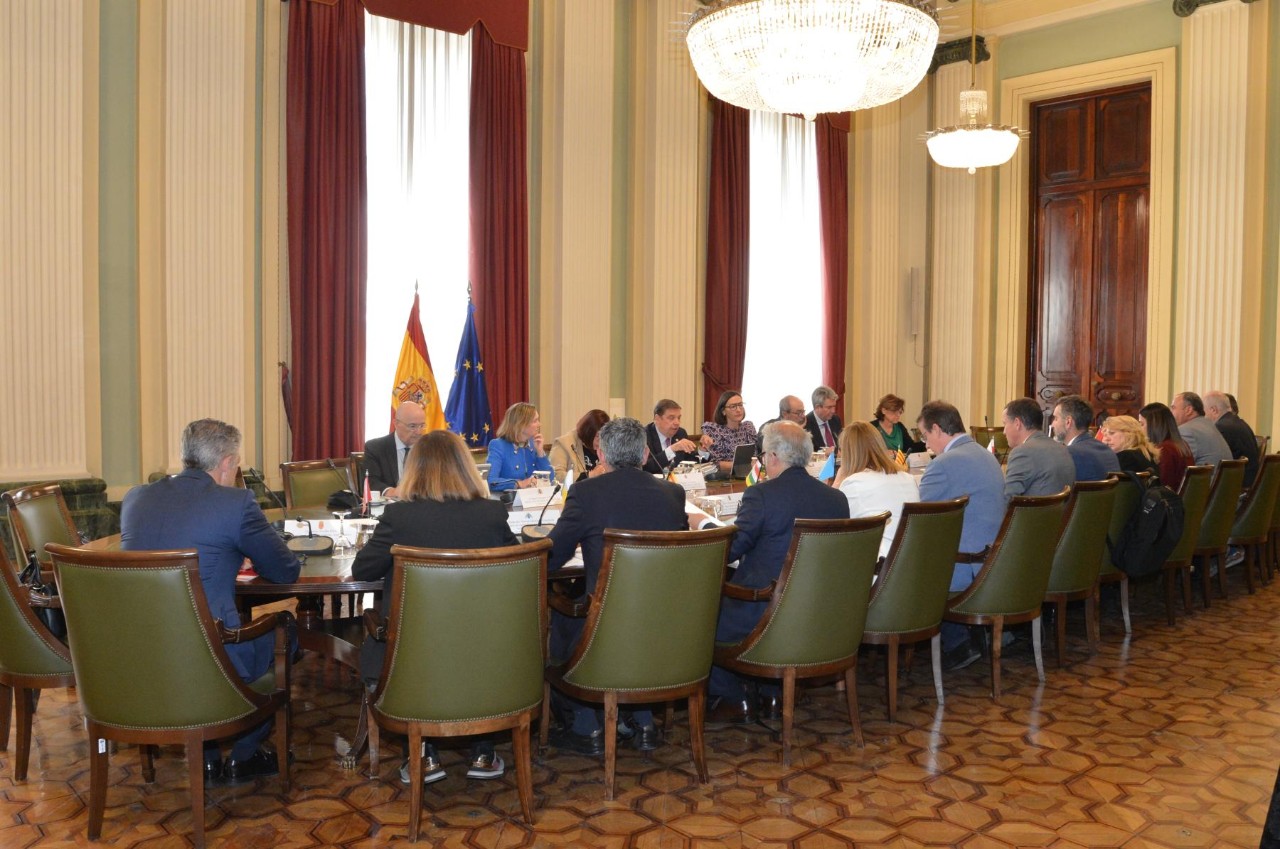
The Sectoral Conference on Agriculture and Fisheries held this afternoon has agreed on the territorial distribution between the autonomous communities of various credits for a total amount of 234,646,613.41 euros to finance rural development interventions contemplated in the National Strategic Plan of the Common Agricultural Policy (CAP) and different actions in the field of competitiveness and quality of production and agricultural markets and the Community Support Program for Agricultural Productions (POSEI) of the Canary Islands.
Specifically, the amount allocated to La Rioja amounts to 2.29 million euros.
It also includes the school programme for the promotion of the consumption of fruit, vegetables and milk and the financing of aid to compensate for the temporary stops of the fishing fleet in the Cantabrian, Gulf of Cadiz and the Mediterranean.
RURAL DEVELOPMENT
The main appropriation, amounting to 158,225,557 euros, is for the financing of interventions of the European Agricultural Fund for Rural Development (EAFRD) included in the Strategic Plan of the Common Agricultural Policy (CAP) 2023-2027, which was authorized by the Council of Ministers last Tuesday 6th. The budget for La Rioja amounts to 2,056 million euros.
The CAP Strategic Plan includes support measures of a different nature, aimed at improving the competitiveness of the agri-food sector, ensuring the sustainable management of natural resources and action against the climate and achieving a balanced territorial development of rural areas. These measures are financed by the EAFRD and contributions from the General Administration of the State and the autonomous communities themselves.
AGRICULTURE AND LIVESTOCK
The Sectoral Conference has also approved the territorial distribution of four credits for the financing of various lines of action in the field of quality and competitiveness of productions and markets, for a total amount of 30,223,512.68 euros, which was authorized by agreement of the Council of Ministers on 30 April.
Apiculture Sector Intervention
The Apiculture Sector Intervention (ISA) is included in the National Strategic Plan of the CAP 2023-2027 with an allocation of 4.3 million euros. This intervention aims to alleviate the structural weaknesses of the sector and strengthen its competitiveness.
The funding is structured under a 50% cofinancing scheme between the European Union and the Member States. In the case of Spain, the national 50% is distributed between the Ministry of Agriculture, Fisheries and Food (25%) and the autonomous communities (25%), except in the Basque Country and Navarre, which assume the state 50% with their own budget.
Bee support is structured around seven types of intervention, including advisory services, investment in assets, honey analysis, repopulation measures, research and promotion. The objective is to advance the professionalization of the sector, modernize farms, improve production and marketing systems, and open new markets with high-quality products.
Plant variety improvement and plant material certification
The line aimed at the quality of plant varieties and the certification of reproductive materials is financed with about 1.7 million euros. This action allows the execution of agronomic tests throughout the national territory to evaluate the behavior and agronomic value of new plant varieties, a prerequisite for their registration in the Register of Plant Varieties.
Likewise, the certification system is maintained through quality controls, health and traceability of seeds and nursery plants, to ensure their adequacy to the demands of the market and their correct use by the agricultural sector.
Support for native Spanish breeds
A loan of 1.4 million euros is also authorized for the promotion of native Spanish breeds, in support of breeders’ associations recognized by the autonomous communities. These grants allow the management of genealogical books, the conservation of germplasm banks and the development of genetic improvement programs.
This support focuses especially on endangered breeds, generally linked to extensive systems, which require specific support due to their particularities and as an essential part of the Spanish livestock genetic heritage. These breeds contribute to the sustainability of the rural environment, the prevention of fires and the production of quality food linked to the territory.
Milk yield control
Within the framework of the actions for livestock improvement, 1.4 million euros are allocated to the official control of milk yield. This action allows the systematic collection of data on milk production and quality in bovine, ovine and caprine farms, which provide essential information both for the genetic evaluation of animals and for the technical decision-making by farmers in relation to the management, feeding and selection of breeders.
The National Commission for Official Dairy Control, composed of representatives of the Ministry of Agriculture, Fisheries and Food, the autonomous communities and the breeders’ organizations, ensures the coordination and homogeneous application of this system throughout the national territory.
POSEI DE CANARIAS
A national contribution of 21 million euros has been approved for the Community Support Programme for Agricultural Production (POSEI) of the Canary Islands. This national contribution complements European funding and aims to promote specific measures aimed at alleviating the structural conditions that affect the agriculture of the archipelago, such as the remoteness of the continental territory, insularity, fragmentation of the territory, complex orography and economic limitations derived from its geographical location.
The measures envisaged in the POSEI are aimed at preserving the development and strengthening the competitiveness of the traditional agricultural activities of the islands, promoting the production, transformation and marketing of local crops. It also promotes the integration of producers into organizations, the maintenance of the rural socio-economic fabric, access to external markets and the promotion of quality agricultural productions linked to the territory.
SCHOOL FRUIT, VEGETABLE AND MILK PROGRAM
The Sectoral Conference has agreed on the allocation of 39,262,606.60 for the development of the program to promote the consumption of fruit, vegetables and milk in schools, which aims to promote healthy habits and reduce obesity and other related diseases.