
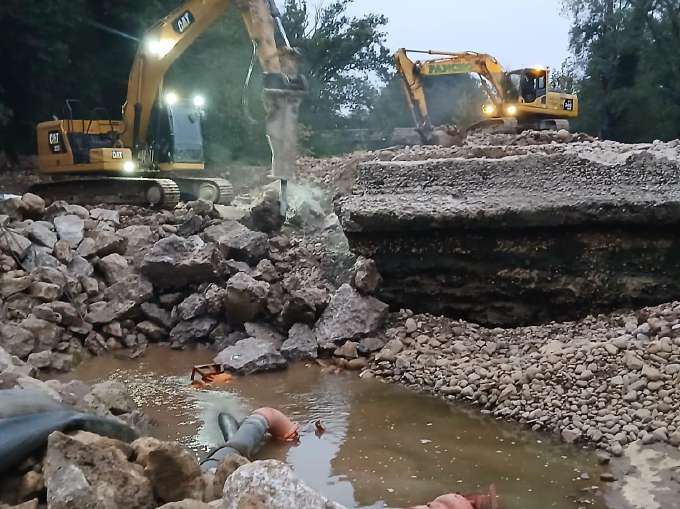
The Cantabrian Hydrographic Confederation expands its physical field data network with the installation of a new hydrological control station on the Saja River, next to the town of Vilnovo, in the municipality of Reocín.
The objective of this action is to strengthen the Automatic Hydrological Information System (SAI CH Cantábrico) with a new point of continuous monitoring of the levels and flows of the Saja River. The project is funded by the Recovery, Transformation and Resilience Plan, funded by the European Union – NextProductionEU.
During the work, the old azud of the Pavón hydroelectric plant has been demolished, in disuse and with an advanced state of deterioration. In its central section, the azud presented a dig that generated a siphon through which part of the flow flowed. Its elimination guarantees the longitudinal continuity of the channel and facilitates the migratory movement of the fish species present in this stretch. Instead, a new capacity structure adapted to flow control is adapted.
The actions, with a total investment of 521 117.05 €, include the recovery of river permeability and the installation of the necessary measuring equipment. This new registration point allows us to obtain more accurate data and build a more complete history of the hydrological behavior of the Saja River.
In general, the raw information collected automatically in the bases of the UPS is updated five-monthly, hourly or daily, depending on the nature of the station, origin, typology, technology and characteristics of the service.
Its main objectives are:
- The improvement of hydrological information.
- The management of hydraulic resources, in order to optimize their allocation and operation, especially in situations of scarcity.
- The monitoring of avenues, in order to prevent and minimize their damage.
- The control of ecological flows.
The improvement actions of the Cantabrian SAI CH are of special interest for agencies and administrations with competence in civil protection during the management of episodes of flooding, since the data obtained are fundamental for the early warning system and the decision support system, especially in the areas defined as areas with significant potential risk of flooding (ARPSIs).
The works have been executed through the public company Tragsa, within the program Actions of river recovery and improvement of continuity in the field of the CHC. In 2024, the investment destined in Cantabria to projects of recovery and improvement of the river continuity amounted to 1.8 million euros, distributed in 29 actions in 20 municipalities