
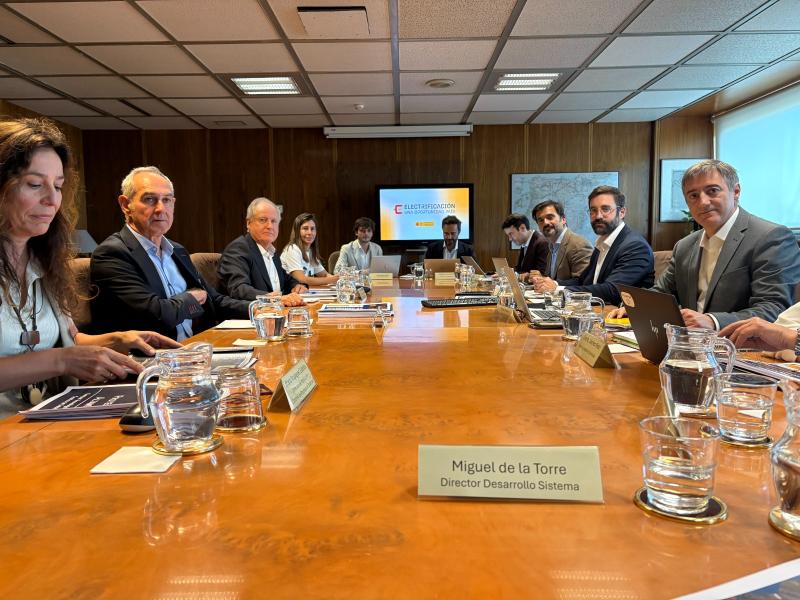
The Secretary of State for Energy, Joan Groizard, met with Eduardo Arasti, Minister of Industry, Employment, Innovation and Trade of Cantabria, in the round of meetings that the Ministry for Ecological Transition and the Demographic Challenge (MITECO) maintains with the autonomous communities to share the technical starting scenario of the Electricity Planning with horizon 2030, before the beginning of the public hearing, in which all the agents will be able to allege and make contributions.
At the meeting, with the participation of technicians from the Autonomous Government, the Secretary of State for Energy and the System Operator, the two governments agreed that this Planning will allow better use of the opportunities offered by the energy transition process, facilitating the connection of new industrial projects and, in general, the electrification of the economy, thanks to the competitive prices provided by renewable energies.
In the specific case of Cantabria, the initial Planning proposal provides for the consolidation of networks to feed new industries in the eastern part of the community and, above all, in the center of the territory, allowing the execution of projects linked to hydrogen, new clean fuels and transport, including railway infrastructures and the electrification of ports, especially that of Santander.
Likewise, the commitment to energy storage systems is consolidated, both with batteries and by hydroelectric pumping.
CONTINUATION OF THE PROCESSING
The initial proposal of Planning for 2030 has been prepared following technical criteria based on the contributions presented in the phase of proposals, as well as the priorities of the Cantabrian Executive. In this regard, the joint work of both governments will be intensified to study the feasibility of new strategic projects in the phase of claims.
The phase of claims to the document will be submitted to public consultation after this first round of autonomous meetings and in parallel its strategic environmental assessment, also open to participation, will be processed. Once the contributions have been collected in the public consultation phase, the physical, technical and environmental feasibility of the set of proposals presented will be analyzed, taking into account the guiding principles of Planning.
The result of this second technical analysis will be the subject of a report by the National Commission of Markets and Competition, which analyzes compliance with the criteria of economic-financial sustainability. On its conclusions, the consolidated document and the strategic environmental statement will be prepared, which will be presented to the Congress of Deputies before its approval by the Council of Ministers.
AN OPPORTUNITY COUNTRY
On September 12, the Vice-President of the Government and Minister for the Ecological Transition, Sara Aagesen, presented the main lines of the first Planning proposal, which foresees an investment of more than 13.5 billion euros. The contributions received in the elaboration of the proposal show the interest to materialize in Spain all kinds of projects, thanks to the competitiveness of energy prices that provides the high penetration of renewables in the electricity system. In fact, since 2020, network access rights have been granted for energy demand projects – industry, housing, data centers, electric vehicles… – amounting to more than 43 GW, a volume higher than the country’s maximum demand, of 38.2 GW in 2024.
In the process of drafting the planning proposal, many more requests for access to the networks have been received. Consequently, MITECO wants the increase in capacity of the infrastructures foreseen in the Planning proposal to allow to materialize the best projects, those that bring more socio-economic benefits with the least environmental impact. At the same time, it wants to prevent consumers from experiencing an increase in electricity bills associated with the increased size of the networks if they are not linked to effective and real demand projects.
Thus, after a detailed analysis of the access requests received, the initial planning proposal of MITECO estimates to meet demands for 27.7 GW for projects with connection to the transport network; as well as to enable another 5.3 GW of support to the distribution networks, a figure that can result in a greater capacity in these networks depending on the configuration in each case. This volume of capacity, equivalent to 85% of the current maximum demand, will be progressively added to the capacity that will be released when, five years after being granted, the access rights granted since 2020 for large projects that have not been implemented will expire.