
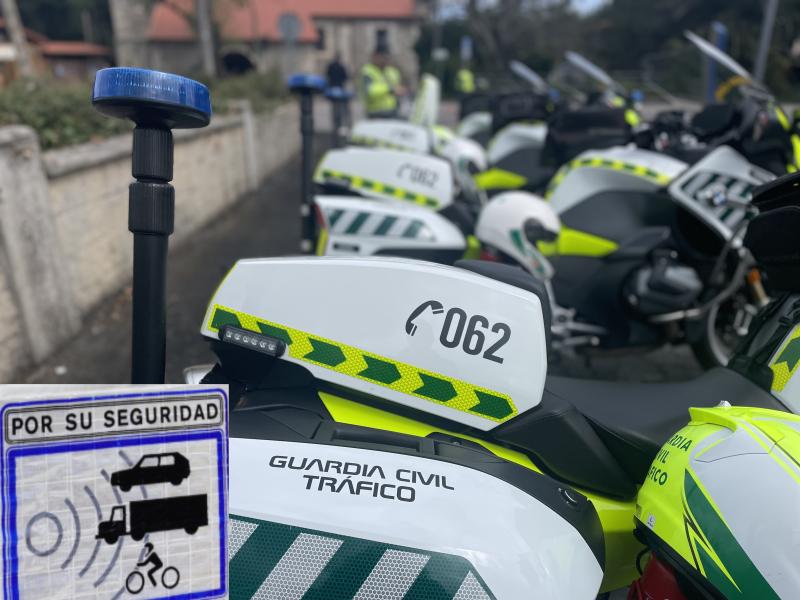
The Directorate General of Traffic starts on Monday a new intensive surveillance campaign focused this time on compliance with speed limits as one of the key risk factors in road accidents.
Inadequate speed is the third most common concurrent factor in traffic accidents, especially in those with fatalities. In 2024 with 24-hour data within the DGT area, 218 fatal accidents were recorded nationwide in which this factor was present.
Therefore, until Sunday, April 13, the agents of the Traffic Group of the Civil Guard, as well as those of the other local police who join it, will especially control sections of risk associated with speed, as well as those points where the circulation exceeds the established limit and there is a high accident rate, all following the recommendations of international and European organizations that urge the agencies in charge of road safety of the different countries to monitor that the established speed limits are met.
In Cantabria, the municipalities that have been invited to participate are: Santander, Castro Urdiales, Piélagos, Camargo, El Astillero, Colindres, Laredo, Santoña and Santa Cruz de Bezana.
As this is a campaign also developed at European level by the association RoadPol (European Roads Policing Network), surveillance will be carried out not only in Spain but in all the countries that belong to that association.
In the last campaign held in July 2024, between the agents of the Traffic Group of the Civil Guard and those of the local police of the municipalities that joined, a total of 30,649 vehicles were controlled in Cantabria, 751 of them being reported.
Control points and new technologies
In addition to these periodic campaigns, the Directorate of Traffic uses other speed control tools such as fixed radars, mobile radars or air control from the Agency ' s helicopters.
The European Commission launched in May 2018 the third and final phase of its actions to modernise the European transport system with a series of measures aimed at allowing all European people to benefit from safer road traffic, less polluting vehicles and more advanced technological solutions, while at the same time supporting the industrial competitiveness of the European Union industry.
Among other measures, all new registered vehicles since July 6, 2024, must have a series of advanced safety functions, the so-called ADAS, among which is the Intelligent Speed Assistant (ISA).
This system, made up of the vehicle’s navigator, which shows the speed limit on the road on which it travels, and a signal recognition system that complements digital cartography and detects temporary speed limitations, helps the driver to know and respect the speed limits, thus contributing to the improvement of road safety.