
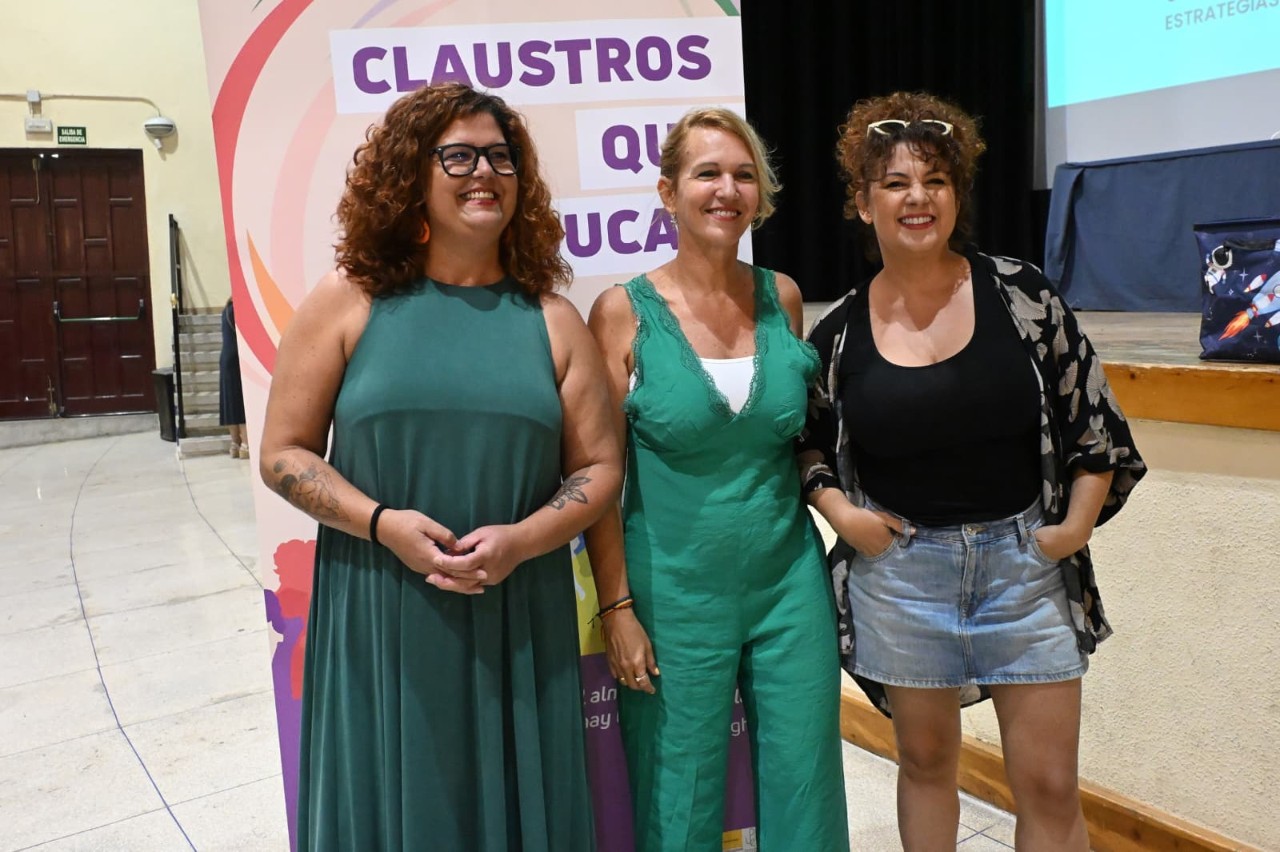
The Provincial Directorate of the Ministry of Education, Vocational Training and Sports has this week resumed the training sessions of the project ‘Claustros que coeducan’, a pioneering program that involves, for the first time, all the teachers of the educational centers in training in equality.
After a first phase held in June, with the presentations of experts such as the equality expert and ex-delegate of the Government for Gender Violence, Miguel Lorente, and the Head of the Coordination Unit Against Violence Against Women of the Government Delegation, Laura Segura Sarompas, this week the second part of the training will take place, which will last until Friday, with the participation of Cadigenia Creative Training, a team with more than 15 years of experience that combines pedagogy, rigor and humor to transform education into equality.
The Provincial Director of Education in Melilla, Elena Fernández Treviño has highlighted the methodology of Cadigenia through humor, “a powerful tool of social transformation that breaks bridges between generations, ideological barriers and any kind of cortapisa. In addition, it allows a participatory work in which teachers get involved and reflect on how to transfer these values to the classroom.”
Fernández Treviño stressed that the objective is to work for equality, not as an isolated action of the teams that work in the educational centers in terms of equality, “but it must be an idiosyncrasy owned by the center and that must permeate all departments and all teachers.” In the face of the negationist and anti-feminist currents, he has defended that “what we do is transmit that equality, as we know we must transmit it, so that the teachers do not receive other stereotypes or clichés”.
Pedagogy of humor
For their part, the teachers of Cadigenia, Tatiana Sánchez and Susana Ginesta, have explained that they work with an innovative method that combines pedagogy, rigor and humor, using the performing arts and emotional management as educational tools.
Sánchez has stressed the importance of bringing coeducation to the daily teaching practice. “No matter how feminist you are, no matter how much you like this society to be egalitarian, training is essential.” In this sense, he insisted on the need to go beyond “one-day actions at school”, betting on teachers “integrating coeducation throughout the course in a motivated way”.
“Education is the solution to end inequalities,” he said, while stressing that it is the most effective way to “break stereotypes, dismantle sexist attitudes and build an egalitarian society.”
In the same vein, Ginesta has pointed out that the aim is to provide teachers with practical and creative tools on coeducation, equality and feminism. “We also want to give them the excitement, motivation and creative tools to create their own impact activities. These are practical and creative tools that can be worked on in any subject, any day of the year”, he explained.
Throughout these sessions, the teachers of the educational centers of Melilla participate in participatory dynamics, debates, collaborative conclusions and even activities with an artistic touch, such as a Galician Romancero, with which Cadigenia will put the finishing touch to the days.