
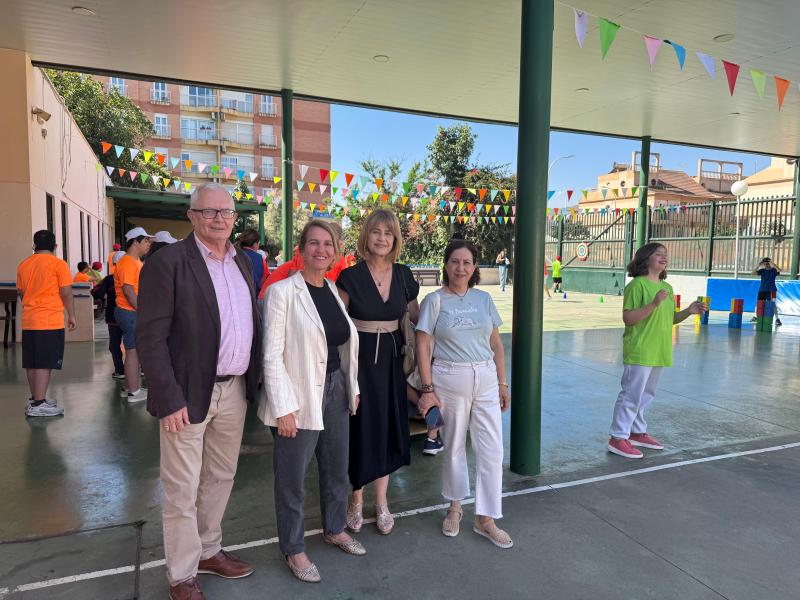
The Queen Sofia Centre for Special Education (CEE) has today celebrated its already traditional day of open doors, an event that is repeated every year with the aim of raising awareness of the work carried out by the centre with students with functional diversity. This year, students from the CEIP Constitution and La Salle College participated in the visit, who were able to share various activities with the students of Queen Sofia.
The Provincial Director of the Ministry of Education, Vocational Training and Sports in Melilla (MEFPyD), Elena Fernández Treviño, accompanied the centre’s team during the day. “The intention is to show the daily reality of these professionals who work with students with diverse capacities and very specific needs, and to make the rest of the educational community aware of the diversity that exists in our classrooms,” he said.
During the visit, the students shared activities, workshops and projects with the visitors, in an atmosphere of coexistence and inclusion. The day has also served to make visible the commitment of teachers and families with an educational model based on personalized attention.
Fernández Treviño wanted to thank “the magnificent work done by this center, its management team, the teaching staff and the entire educational community. Their involvement in the city is fundamental.”
Towards an inclusive education model
Asked about the possibility of expanding the capacity of the CEE Reina Sofía or creating new centres of this profile, the Provincial Director explained that the line of work of the Ministry and the Provincial Directorate goes in another direction: progressively expanding the number of open classrooms and TEA classrooms in the ordinary centres of the city. “We want to move towards an inclusive model where all boys and girls, regardless of their abilities, can be enrolled in regular schools,” he said.
Currently, Melilla has 13 specific classrooms of this type. With the expectation of opening four more next year, the city will reach the 17 specific classrooms to cater for students with special educational needs. “Our idea is to move towards the normalization of all the diverse abilities of the students. Of course, we need sufficient material and human resources. Without them, it will not be possible to advance in inclusion,” he stressed.
Fernández Treviño recalled that this strategy is part of the European line and of countries such as Portugal, Italy or Canada, where we work for a total inclusion in the ordinary educational system. “Real inclusion is not about opening more specialized centers, but about all centers being able to welcome and provide quality care to all students,” he concluded.