
- Claims fell from 3,216 in 2019 to 2,905 last year, 9.67% less. With 14% of the vehicles, Madrid has 6% of all accidents and 6% of deaths throughout Spain
- 97% of the causes of fatal road accidents are of human origin: due to distractions, lack of attention or inadequate speed
- Mercedes González: “The best recipe against fatal accidents is a better road education: with maximum attention at the wheel and respect for speed standards and limits”
The delegate of the Government in the Community of Madrid, Mercedes González, has today highlighted that “the best recipe against fatal accidents is road education”, an aspect to which special attention has been devoted in the third session of the Autonomous Commission of Traffic and Road Safety, which has presided at the headquarters of the General Directorate of Traffic (DGT). “More road education to pay the utmost attention to driving and to respect the rules and speed limits. And in this commitment to save lives, the recently approved Organic Law of Education (LOMLOE), promoted by the Government of Spain, will be very important. A new standard that has meant a transcendental change since it makes Road Education a subject with specific objectives, evaluable and obligatory teaching,” said Mercedes González.
“To go to the root of everything, which is education, together with the important traffic control devices of the DGT and the tireless work of the 700 guards of the Traffic Sector of the Civil Guard in Madrid”, to whom he has thanked all his effort, with which it has been possible “to achieve the goal set as a goal to reduce the number of deaths from traffic accidents by half in 10 years”. “An ambitious goal, but not an impossible one”, according to the Road Safety Strategy 2021-2030.
III Autonomous Commission
The fundamental objective of the Autonomous Commission of Traffic and Road Safety of Madrid, constituted on April 7 in the Government Delegation, is “to achieve cooperation between administrations in the elaboration and execution of national road safety plans and coordinate and promote the action of the different agencies and entities to improve road safety in Madrid”. It is chaired by the Government delegate and is made up of representatives of the three administrations: Government of Spain, Community of Madrid and the municipalities of Madrid, through the Federation of Municipalities of Madrid (FMM), with representation today of the Consistories of the city of Madrid, Arroyomolinos and Cercedilla.
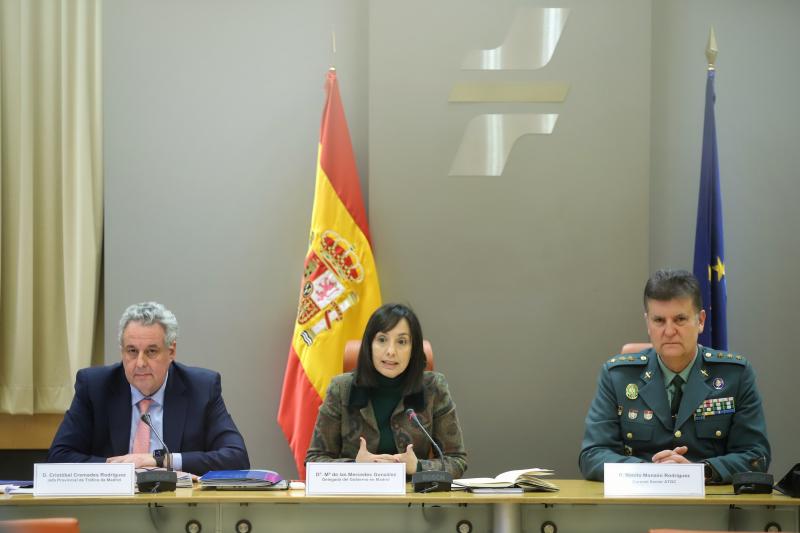
At the end of the meeting, Mercedes González appeared at a press conference with the provincial head of Traffic of Madrid, Cristóbal Cremades. The head of the Traffic Sector of the Civil Guard, Colonel Benito Monzón, was also present.
Accidents and mortality on the roads
This Tuesday’s session took stock of 2022, the first year of normality after the pandemic, in which, compared to the last year of normality (2019), Madrid has had a significant fall in the accident.
“In these 12 months, there have been a total of 63 fatal accidents on the interurban roads of the Community of Madrid that have left 70 people dead. In 2019, there were 90 deaths. This is equivalent to 20 fewer deaths on our roads, which means that last year the mortality in our region fell by more than 22%,” according to the data offered by Mercedes González.
“But not only mortality, but all the accident indicators have fallen in the Community of Madrid in 2022,” he added. Road accidents have fallen from 3,216 in 2019 to 2,905 last year, almost 10% less (9.67%). Serious injuries also dropped from 196 to 175, down 10.71%; and minor injuries also dropped from 4,333 to 4,055, down 6.41%.
Track types
As for the type of roads on which accidents occurred, 47% were on motorways or highways. With 21 accidents and as many deaths on motorways, 10 accidents and 12 deaths on motorways; while 53% of deaths occurred on the other interurban roads: 23 fatal accidents with 27 deaths on single carriageway roads and 8 fatal accidents with 9 deaths on conventional double carriageway roads.
More traffic and more vehicles
“The Community of Madrid figures are considerably good not only by comparing data from past years in our region, but also compared to the national average. Madrid is the region with the most passing traffic in the country, and also the province of Spain with more vehicles, almost 15%. We have a fleet of almost 5 and a half million vehicles (5,415,738) and in our Community there are 3 vehicles for every 4 inhabitants, in addition to having a driver’s census of almost 3 and a half million (3,415,795). In addition, 6 out of 10 people of legal driving age have a permit in the region, which, with 14% of vehicles throughout the national territory, has 6% of all accidents and 6% of deaths throughout Spain,” said the Government delegate.
Bikers and cyclists
“Although the evolution is good, some data must also be regretted for concern, especially with regard to the most vulnerable drivers: the deceased motorists have increased over those of 2019 (from 16 to 18) and the dead cyclists have gone from 3 to 7,” explained Mercedes González. However, “another vulnerable group, pedestrians, have reduced their mortality by half: from 17 in 2019 to 9 in 2022.”
Months, days and times
As for the months of highest mortality, last year were: September, with 9 deaths in 7 accidents; June, with 8 deaths; and October, with 7. With regard to the days of greatest mortality, it is noteworthy that there is no difference between working days and weekends: the day of greatest mortality was Tuesday with 12 deaths, followed by Saturday with 11 and, after these, Monday, Wednesday and Saturday with 10, respectively.
And in terms of schedules: there is a clear incidence of deaths during the day, especially from 7 a.m. to 2 p.m., with 27 deaths, followed by 2 p.m. to 8 p.m., with 22. However, “the times that could be considered a priori more dangerous, at night and at dawn, have half the mortality: 11 and 10 dead, respectively.”
Human factor
Regarding the causes, the delegate of the Government explained that “97% are of human origin, only 1% occurred last year due to the road and 2% due to causes attributable to the vehicle”. As for the human factor that causes accidents, the greater number are the result of distractions and lack of attention, of carrying an inadequate speed, or of not respecting the priority.