
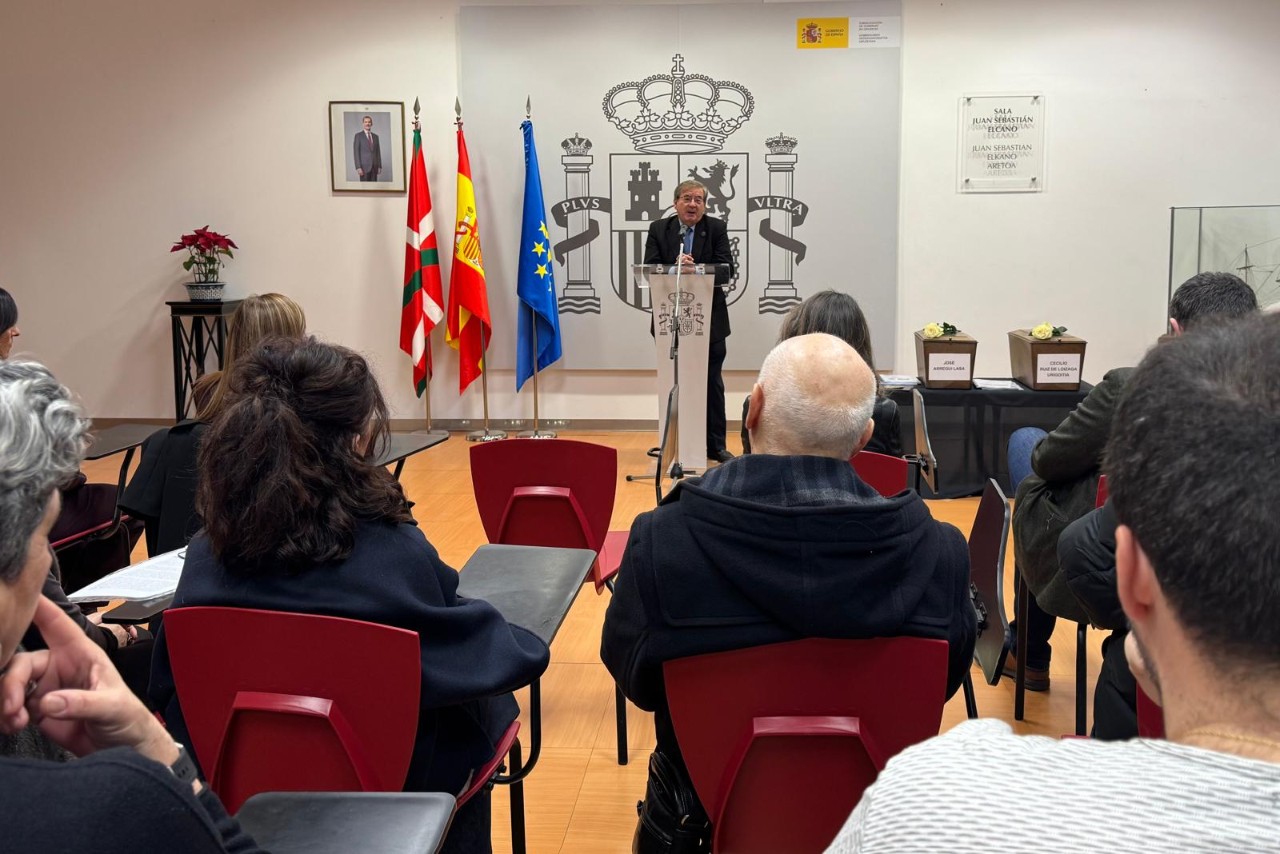
The Government of Spain has delivered today, in an institutional act held in the Subdelegation of the Government in Gipuzkoa, the mortal remains of D. Cecilio Ruiz de Loizaga and D. José Severo Arregui Lasa, exhumed from the Cuelgamuros Valley and returned to his relatives, thus completing a long process of reparation and dignity within the framework of public policies of democratic memory.
The event was chaired by the Secretary of State for Democratic Memory, Fernando Martínez, and was attended by the Government’s delegate in the Basque Country, Marisol Garmendia, the Basque Government’s Justice and Human Rights Councillor, María Jesús San José, other institutional representatives, the forensic technical team responsible for the exhumations and relatives of the victims.
The Secretary of State for Democratic Memory stressed during his speech that “the restitution of the remains to their families is not only an administrative act, but an ethical commitment of the State to truth, justice and reparation”, recalling that the remains of these two people were transferred to the then Valley of the Fallen in 1959 without the consent of their families.
Cecilio Ruiz de Loizaga, who died in 1939 at the age of 26, and José Severo Arregui Lasa, who died in 1938 at the age of 19 from gunshot wounds, were initially buried in Mondariz (Pontevedra). Decades later, his remains were moved to the Valley along with other bodies, in a procedure that violated the right of families to decide on the fate of their loved ones who lost their lives.
The director of the Forensic Technical Team, Francisco Etxeberria, has defended the “scientific and rigorous work developed for the identification and exhumation of the remains, highlighting the importance of institutional collaboration and accompaniment to families throughout the process.”
The event was also attended by relatives of both victims, who expressed their emotion and gratitude for this gesture that for them represents the closure of an open wound for more than eight decades.
The delivery of the remains, accompanied by technical-forensic reports and a white rose, is part of the application of the Democratic Memory Act, which guarantees the right of families to recover their loved ones and to give them a dignified burial.
With this act, the Government of Spain reaffirms its commitment to democratic memory, based on respect, dignity, human rights and contributing to historical truth and coexistence through recognition and reparation.