
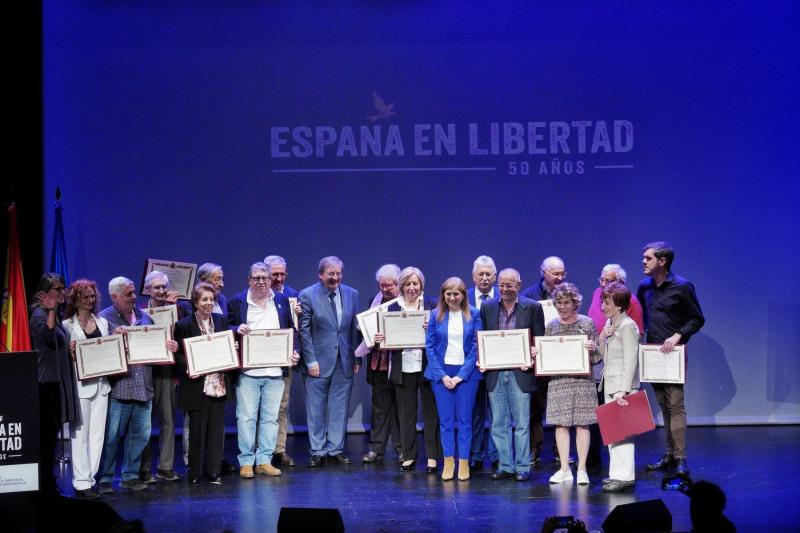
The Secretary of State for Democratic Memory and the commissioner for the celebration of 50 years of Spain in freedom paid tribute in the Azkuna Zentroa - Alhóndiga Bilbao to the neighborhood movements that, before and during the Transition, played an essential role in the construction of democracy from the neighborhood.
The Secretary of State for Democratic Memory, Fernando Martínez, has pointed out that “the neighborhood movement has been an authentic school of citizenship that trained us in democratic practices and a hotbed for creating awareness in the fight for freedoms and democracy in Spain.” He also recalled that the protagonists of these mobilizations “contributed to the recovery of democracy in Spain and, especially, to the improvement of the neighborhoods of our cities. Their solidarity made every traffic light achieved, every dispensary and school in operation or every bus that was able to reach the neighborhood, a collective conquest.”
For her part, Carmina Gustrán, Commissioner for the Celebration of Spain’s 50th Anniversary in Freedom, has stressed that “the struggles of the neighbourhood movements constituted an undeniable factor of democratization and expansion of rights and welfare to broader sectors of the population.” In this regard, he added that “access to housing and essential public services remain today basic rights that must continue to be claimed and enforced if we want a healthy democracy. Many of the struggles of the neighborhood movement are still alive: we must be vigilant; the freedoms and rights won must be nurtured and strengthened day by day.”
At the event, Declarations of Recognition and Reparation have been given to 16 women and men linked to neighborhood associations. In this way, the State expressly assumes its obligation to protect, maintain and promote the democratic memory of these people and neighborhood groups who, from the neighborhoods, fought for basic rights such as decent housing, access to health, public education, social services and the improvement of living conditions in cities and towns throughout Spain. At a time marked by repression, uncertainty and the collective desire for change, thousands of anonymous people organized themselves into neighborhood associations to demand social justice, democratic participation and territorial equity.
The tribute emphasizes that democracy was built not only in the institutions, but also in the squares, in the civic centers, in the neighborhood assemblies, where networks of solidarity were woven and consensus forged that anticipated and accompanied the political changes. Today, half a century later, those struggles are still alive in the conquered rights.
With the participation of representatives of historic neighborhood associations, institutions and experts in democratic memory, this event seeks to project to the present the legacy of a movement that helped make democracy real from below. A tribute to those who, on the margins, built a center.
Declarations of Recognition and Reparation have been delivered to: Julia Manzanera, Prisciliano Castro, Carmen Avendaño, Juan José Reca, María Arrondo, Carlos Trevilla, María Bernardita Caravera, José Molina, Milagros García, Domingo Laborda, Custody Moreno, Jordi Gasull, Carmen Berlanga, Leandro Sánchez, and José Ricardo Álvarez.
The event featured the performance of Pedro Pastor and the Chorus of Engineers of Bizkaia.