
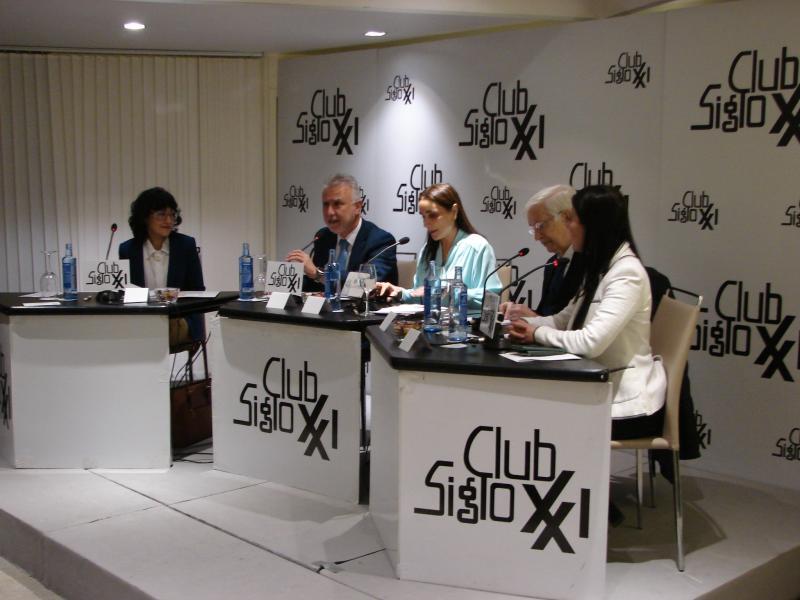
Ángel Víctor Torres, Minister of Territorial Policy and Democratic Memory, presented at the Club Siglo XXI the round table series “The Conquest of Freedom of Expression. The weeklies “Notebooks for dialogue”, “Triunfo” and “Change 16”, framed in the programming of the commemoration ‘Spain in freedom. 50 years’. In this first session, together with Minister Torres, Óscar Alzaga, professor of Constitutional and Political Law, and María Paz Pando, professor of Contemporary History at the University of Salamanca, participated.
In order to know with a complete vision of how Spain’s transformation from dictatorship to democracy was possible, it is essential to approach the press that was published in the years before and after the death of General Franco, in 1975. Above all, to know the journals of opinion that, since before the end of the dictatorship, were familiarizing the Spanish with concepts such as public freedoms, national reconciliation, political pluralism, the rule of law, freedom of expression and, in general, the catalogue of rights that would later be enshrined in the 1978 Constitution.
Thus, magazines such as “Notebooks for Dialogue”, “Triumph” and “Change 16” were the advance of democracy in a few years not easy for press freedom.
The first session of the cycle focused on “Notebooks for Dialogue”, the publication created in 1963 by the former Francoist Minister of Education, Joaquín Ruiz Giménez. Attached to the Christian democracy, it advocated the restoration of the wounds of the Spanish War and an agreed political reform. Their influence was so notorious that up to 150 members of parliament from the first democratic courts of 1977 had been linked in one way or another to the magazine, as well as writers such as Jorge Guillén and Juan Goytisolo.
“Triunfo” was, for its part, a cultural platform of the left and another of the great democratic referents of the time. He received sanctions for a special issue published on April 24, 1971, dedicated to the crisis of marriage, which was considered an attack on public morals. The former judge and former mayor of Madrid, Manuela Carmena, collaborated in that number by advocating for civil marriage. In “Triunfo” collaborated, among others, Manuel Vázquez Montalbán, Luis Carandell and Manuel Vicent.
“Change 16” was founded in 1971 by the journalist Juan Tomás de Salas, in his effort to edit a publication that would serve as a platform to combat Franco’s regime and claim democratic Spain. Two weeks after Franco’s death, “Change16” is published under the title:"The thing is set in motion," calling for a change of government to make new policy. Throughout 1975, “Change 16” became the largest publication in the country, reaching 197,276 copies. In 1976, it would exceed all expectations by achieving a print run of 347,918 copies and a 46.1% share of the magazine market.
The Secretary of State for Democratic Memory, Fernando Martínez, and the commissioner for Spain’s 50 years in freedom, Carmina Gustrán, have participated in the event at the Club Siglo XXI.