
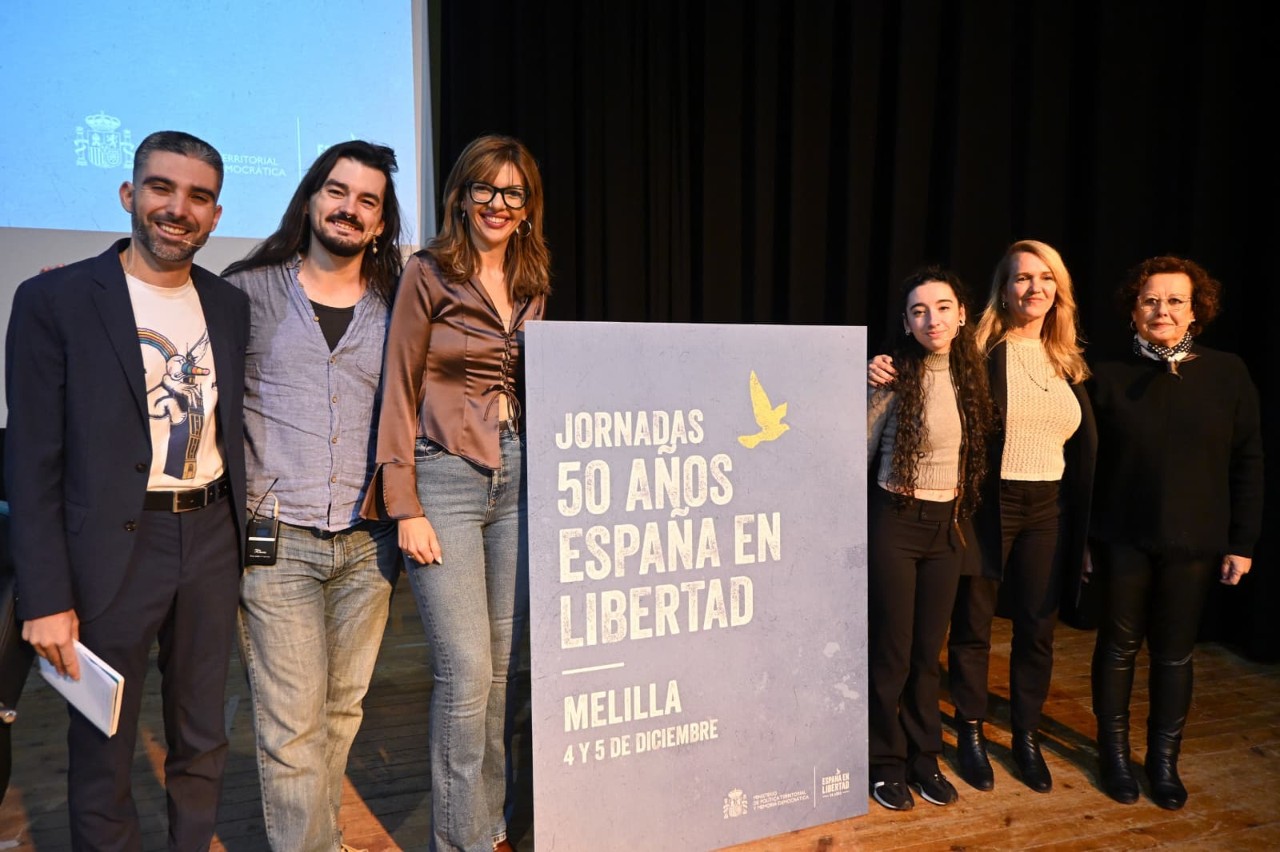
Melilla has joined the rest of the country in commemorating half a century since the dictator’s death this year and has organized the Days “50 years of freedom and democracy in Melilla” to bring closer the value of half a century of rights, progress and coexistence and eliminate the hoaxes of Franco’s regime.
The IES ‘Leopoldo Queipo’ has been the chosen venue for this activity that is carried out under the impetus of the Government Delegation in Melilla and the Commissioner for the Celebration of the 50 years of Spain in freedom, and that has brought together students, teachers and citizens and that has counted on the participation of the archaeologist and writer Mikel Herrán; the graduate in Hispanic Philology and teacher, Pura Sánchez; and the historian and popularizer Josefine Table.
Thus, yesterday afternoon, the Delegate of the Government, Sabrina Moh, inaugurated the conference recalling that “defending democracy is our collective responsibility, and begins by remembering where we come from”, stressing that Melilla “must reclaim these fifty years of freedoms because they are part of our collective identity and our present as a plural and diverse city”.
The head of the Government Delegation stressed that these days seek knowledge, reflection and democratic awareness: “Democracy has brought to Spain the period of greatest stability, prosperity and rights in our history. We cannot forget that if we are here today it is because freedom and democracy triumphed in the end.”
The Provincial Director of Education, Elena Fernández Treviño, for her part, said that “the school is the first space where we learn what it means to live together, respect and understand our past. Bringing these conversations to an institute is, in itself, a democratic act”, so he has stressed the importance of students having access to this type of activities.
The journalist of RTVE in Melilla Raúl Prieto was responsible for moderating and directing the round table “Dismantling hoaxes: with dictatorship we did not live better”, which dealt with aspects such as the repression of the Franco regime against women or minorities, the lack of rights and freedoms for citizenship or the rise of hate messages that are resurfacing.
This second day of today will have the screening of the film ‘The Master who promised the sea’, followed by a debate with the students of the center, as well as the intervention of the students of the 1st of Baccalaureate of the IES ‘Leopoldo Queipo’ Mohamed Mohamed El Biyan, who has been one of the winners of the National School Contest ‘Live, Feel and Tell Democracy: Spain in freedom. 50 years’ from the Ministry of Education, Vocational Training and Sports.
Critical Thinking
The Government Delegate during this morning’s media attention highlighted the importance of activities such as these since “it is important that students begin to develop critical thinking.” Something that education has pointed to is key and, in that sense, it has advanced that the institutions will continue to work “so that our young people can have those tools that allow them to continue moving towards an egalitarian and fair future.”
Moh stressed the importance of the students knowing what these 50 years of democracy have meant and also that they can look to the past “to know how to interpret it and, above all, to be able to give necessary tools for a future in democracy”.
For his part, Josefine Table, very popular in social networks for his work of popularizing (@josefinetable), has made it clear that it is false that during the Franco regime it lived better and has stressed the importance of highlighting what those years meant, as well as claiming “the story of the transition built from below”.
The researcher has insisted on the need to appeal directly to young people, remembering that current generations perceive Francoism as a “more distant and diffuse” past. Faced with this, he defended that “we must remember” and “remember” what he described as “fundamental”.
The historian has also referred to the presence of young people who express sympathy towards the dictatorship. He has rejected the fact that it is a spontaneous phenomenon and has framed it in “a cultural offensive on the part of the extreme right”, with a “clear political intentionality” that takes advantage of the lack of training tools among youth.
However, he has assured that this trend can be reversed with pedagogy, since most young people who repeat these ideas do so not from an ideological conviction, but because of ignorance or dynamics linked to humor, identity or belonging to a group.
Table has called for not to fall into alarmist narratives that portray young people as “neo-Nazis,” and has stressed that those who hold these ideas remain “a minority.” “We have to keep going. We cannot give young people up for lost, we are not lost,” he said.
The creator of content, in addition, has highlighted the extraordinary example represented by the film screened this morning on the role of education and the republican magisterium in the construction of democratic values and has warned that “we cannot take for granted and forever that certain rights we have cannot be lost”, in reality “we are in the midst of a reactionary anti-democratic wave that is shaking those foundations”.
For this reason, he stressed that “we have to understand that democracy is practically a daily decision and a daily practice that is built precisely in this way, putting these issues in value”.
Strengthening the democratic culture
The archaeologist and populariser Mikel Herrán (@putomikel), explained that the session held yesterday was aimed at a general public and focused on a broad debate on the increase of speeches that question democratic institutions, the disarticulation of democracy and the spread of the idea that “with Franco we would live better”. As he has pointed out, this climate is combined with the advance of the far-right and its growing presence in public spaces, issues that he considers necessary to address without abstractions.
Herrán has defended that today’s day is oriented to bring that reflection to practice through direct work with young people, “talking from you to you” and addressing Francoist myths and hoaxes that continue to circulate, such as the alleged creation of Social Security by the dictator or the idea that during the dictatorship there were no housing problems.
Therefore, it has opted for a horizontal approach to address them with youth. “It’s not about saying ‘I have to tell you this and you have to believe it’, but about talking about what worries you, why you think this, and disarticulating those hoaxes little by little,” he said.
The populariser has rejected the need to talk about young people as “neo-Francoists” or “neo-Nazis”, but they are in a process of formation and what they need are appropriate tools, something to which, in his opinion, the projection of ‘The Master Who Promised the Sea’ contributes.
Herrán has made it clear that this activity allows us to show, through a story based on real events and with elements of fiction, how the Civil War and the first Franco regime were, appealing to empathy and favoring pedagogy.
In addition, it has advanced that these activities generate conversations between the students beyond the meeting itself, allowing those who have been most involved to have tools to debate among themselves “from you to you” and contribute to “the ball keep rolling” in a democratic conversation.
Asked about the role of the media in the current context, Herrán considered that they play a “very important role, both for better and for worse.” He has pointed out that some media, sometimes unconsciously and in others deliberately, have given publicity to Francoist hoaxes, especially through social networks or alternative platforms.
In his opinion, by placing “at the same table of debate” democratic positions and “totally undemocratic” positions, legitimacy has been given to speeches contrary to human rights. This, he said, has contributed to the increase in the nostalgic or neo-Francoist discourse reflected in current statistics.