
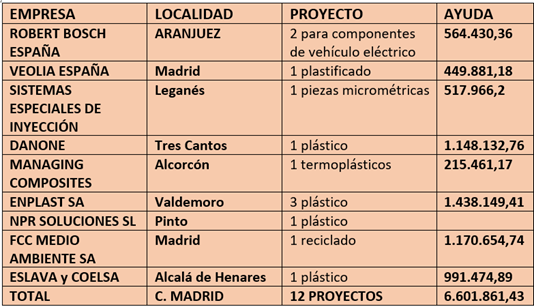
- The beneficiary companies will receive grants ranging from 100,000 to more than one million euros.
- Most of the beneficiaries are in the southern cordon of the Community. 6,601,861.43 will be invested in 9 companies.
- The projects aim to increase environmental protection and improve the management of waste from third parties, as well as R&D for ecodesign and digitalisation to innovate in terms of processes and organisation.
The Biodiversity Foundation of the Ministry for Ecological Transition and the Demographic Challenge (MITECO), has published the “Proposal for a provisional resolution of the call for grants, on a competitive basis, for the promotion of the Circular Economy in the plastic sector within the framework of the Circular Economy PERTE of the Recovery, Transformation and Resilience Plan”, which includes grants of more than 6 million euros for 12 companies in the Community of Madrid.
Most of the projects of the companies in Madrid are concentrated in plastic, a total of 10. The other two projects of the multinational ROBERT BOSCH ESPAÑA, in its plant in Aranjuez, address developments in innovative technologies of industrial value in the manufacture of components of the electric vehicle for which it will receive 564,430.36 euros.
For its part, the Enplast SME, based in Valdemoro, has three accepted projects in which it will be able to invest 1,438,149.41 of the Perte aid to develop different technologies related to plastic.
FCC Medio Ambiente will also be able to count on the help of funds (1,170,654.74 euros) for the creation of an innovative line for the recovery of plastic polymers from banal, commercial and industrial waste in the Community of Madrid.
Increase in the allocation
Due to the great demand that the call has had in the plastic sector and the high number of requests received, the call, which was initially endowed with 97.5 million, has increased its endowment by another 57 million.
Of the 201 applications received, 125 projects have been selected (seven of them are carried out by groupings that unite 14 companies). In terms of their nature, 48.12% are led by SMEs (24.82% by small companies and 23.31% by medium-sized companies), while the rest, 51.87%, are not classified as SMEs.
In total, these initiatives will be implemented by 132 companies that stand out for their commitment to the circularity of their projects, and that will receive grants of between 100,000 euros and about 9 million euros per project. Projects must be completed by 31 October 2027.
DISTRIBUTION BY CATEGORY
The category that receives the most aid is the action aimed at improving the management of waste to third parties, which presents 45 projects with a contribution of 84.2 million euros, which highlights the role that the implementation of innovative technologies that promote the circular economy in the plastic sector is acquiring. The projects that group the increase in the level of environmental protection of the beneficiaries (environmental improvements of the entity that reduce the impacts of its products or its own waste) has 62 projects and 61.6 million aid, revealing that reducing the extraction and consumption of virgin raw materials, the generation of waste, the emission of microplastics or the use of polymers and materials with lower environmental impacts is one of the major concerns of the companies in this call.
In this line, it also highlights that among the beneficiaries there are 13 projects for research and development for ecodesign (3.1 million) and five digitization projects to innovate in terms of processes and organization for organizational and process innovations that impact on greater circularity (2.8 million).
TYPOLOGY OF PROJECTS
Among the beneficiaries are projects for the productive improvement of the process of joining plastic components in the automotive field; the reduction of the consumption of virgin raw material and the increase of the efficiency of the use of materials; the adaptation of packaging lines to be able to use recycled plastic; the reduction of the consumption of virgin raw materials through the reuse of pre- and post-consumption waste; the recycling and valorisation of plastic waste; new sustainable packaging solutions based on circular economy for the logistics industry; the development of platforms of integral management of plastic waste based on the optimization and digitalisation of plastic recycling plants for maximum product traceability; or the manufacture of diapers for adults with less content of non-biodegradable materials and reduction.
The proposed projects are spread over 14 Autonomous Communities: Andalusia, Aragon, Balearic Islands, Castile and Leon, Castile-La Mancha, Catalonia, Community of Madrid, Autonomous Community of Navarre, Valencia, Extremadura, Galicia, Basque Country, Principality of Asturias and Region of Murcia.
CIRCULAR ECONOMY PEARL
The Circular Economy PERTE, financed by the Next Generation EU funds, aligned with the Spanish Circular Economy Strategy and the European strategies, has public aid worth 492 million, with which it is expected to mobilize resources in excess of 1.2 billion euros during its execution.
The plastic sector in Spain is of great importance. Proof of this is the turnover of the subsector of manufacture of plastics in primary forms, which rises slightly above 17% of the total of the chemical industry.
Plastic is therefore an important material for our economy, which has an important role in many processes and sectors such as food or health, but which we often misuse, decoupled from its characteristics. About two-thirds of the world’s plastic production is used for short-life cycle products, and one-third of the plastic is disposable.
Unsustainable patterns of plastic production and consumption, anchored in the linear economy, and the lack of proper waste management have made plastic pollution one of the environmental challenges of our time.
CURB PLASTIC POLLUTION
According to the IPBES (Intergovernmental Science-Policy Platform on Biodiversity and Ecosystem Services), since 1980 plastic pollution has multiplied tenfold in our seas and already constitutes more than 80% of marine litter. This greatly affects ecosystems and especially endangered species such as sea turtles (86% affected) and marine mammals and birds (43% and 44% respectively). But also to economic sectors such as fishing or tourism, and it has affections for our health through microplastics.
The use of secondary raw materials minimizes the environmental impacts of resource extraction and waste generation, but the penetration of such materials is not consolidated at a constant pace and is limited by a fragmented market, not unrelated to the behavior of the prices of virgin raw materials, in a context of the use of plastic for functions unrelated to the characteristics of the material and the abuse of the superfluous use of plastic.
Added to this are the costs of collecting, processing and managing plastics, the low availability of recycled plastic polymers and the lack of available technologies for the valorisation of certain polymers, additives or multilayer products. On the other hand, the small size of most companies hinders innovation, the ability to adapt production to new circular models, as well as the professionalization of management.
Therefore, public support is necessary to encourage the transformation of the sector towards a sustainable and circular model, with special emphasis on reducing resource extraction, waste generation and increasing reuse and recycling rates.