
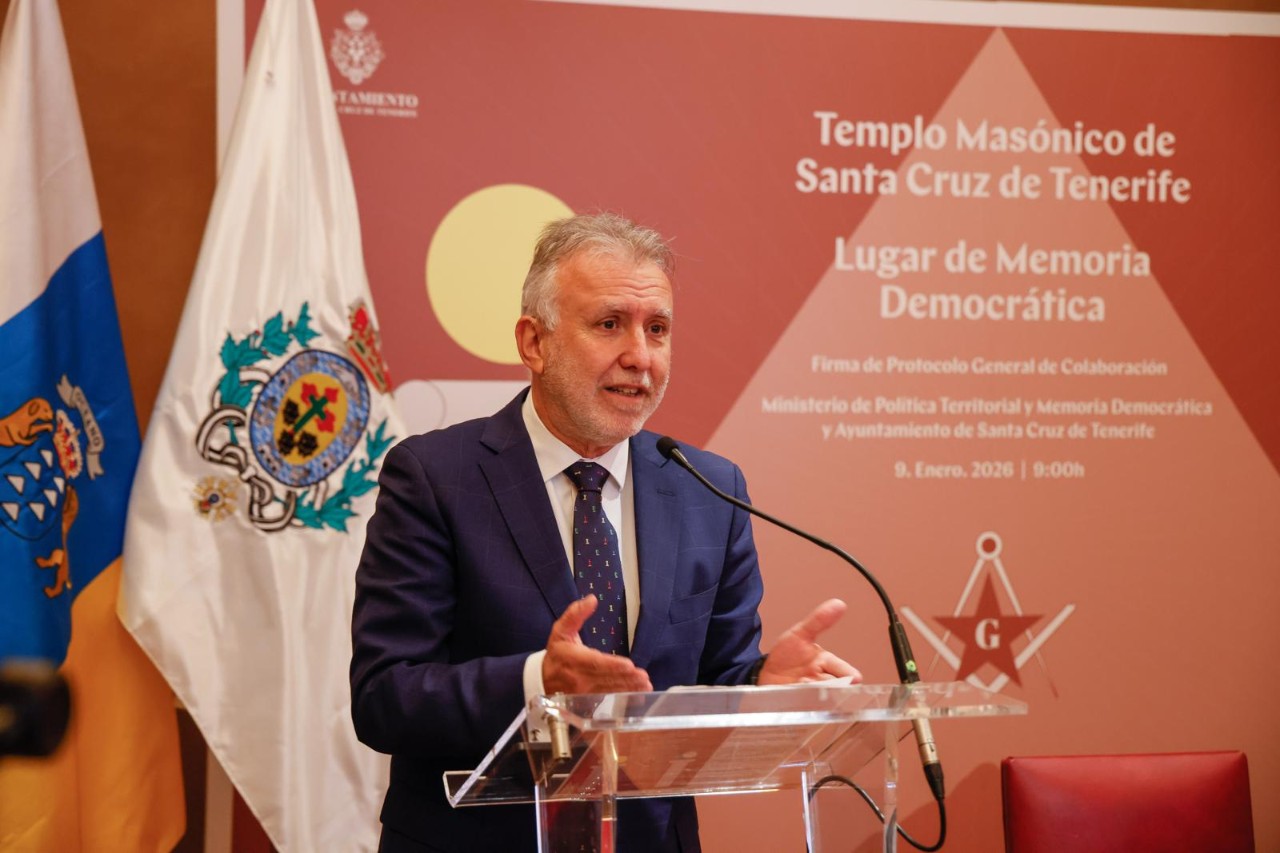
The Minister of Territorial Policy and Democratic Memory, Ángel Víctor Torres, signed this Friday the protocol of collaboration with the City of Santa Cruz de Tenerife for the promotion of public policies of Democratic Memory from the local level.
The protocol has been signed in the restored temple of the Azaña lodge, just on the day that the opening of the procedure to declare it ‘Place of Democratic Memory’ is published in the BOE. It is an institutional recognition at the state level that is granted to an enclave de High memorial value for being “a place where serious violations of human rights and crimes against humanity were committed, having been subjected to systematic persecution by the Franco regime since the first days of the coup d’état of July 1936”.
Minister Torres stressed that the declaration of this temple - the first to be built ex profeso in our country - reflects an act of justice and reparation because, for several decades, it “was a symbol of tolerance and modernity, space for civic coexistence, secular education, critical thinking and social commitment that, after the coup of 1936, was occupied, denatured and turned into a place of propaganda, interrogation, repression and torture.”
For the minister, the recovery of the temple as an informative space “is fundamental to understand Franco’s repression and the criminalization of freedom of thought”, and he added that the recognition that begins today with the opening of the dossier “transcends Freemasonry and also honors all the victims in the Canary Islands of the military coup, war and dictatorship in a territory where repression was especially intense despite not having war fronts”.
The mayor of the city, José Manuel Bermúdez, has assured that “today Santa Cruz is once again taking an important step in the right direction, that of memory, dignity and democratic coexistence, each day more necessary in these complex times. And we do so in this unique Temple, which for years has remained silent, but which today speaks loudly again, illuminating an essential part of our common history.”
Bermúdez has detailed that “the Masonic Temple is not just any building, because, as I pointed out on the day of its reopening and its return to the town of Santa Cruz de Tenerife, it is an architectural and symbolic jewel that once again shines in the heart of our city and has already been visited by more than 6,000 people since its reopening, which demonstrates the interest in knowing our heritage and our history”.
Memory from the local level
The collaboration protocol signed by the Minister of Territorial Policy and Democratic Memory, Ángel Víctor Torres, and the mayor of the city, José Manuel Bermúdez, aims to strengthen institutional cooperation to develop Democratic Memory policies at the local level.
Among the committed actions is to advance in the study, preservation and dissemination of the archives of the Masonic lodges of the Canary Islands; to establish the bases to facilitate inter-administrative coordination in access to historical state documentary funds; or to promote educational, cultural and scientific activities aimed at making known the enlightened, humanist and democratic values of Masonry, as well as the persecution it suffered during the dictatorship.
The protocol also opens the door to future specific agreements for cultural, exhibition and educational projects, such as the one that is being programmed for the coming weeks with a permanent photographic exhibition on Freemasonry in the Canary Islands, financed by the Ministry of Territorial Policy and Democratic Memory.
In addition, within the activities programmed in the territory on the occasion of the 50th anniversary of Spain in Libertad, this Friday in the Masonic Temple a colloquium of experts moderated by the journalist of the SER Chain, Marta Cantero, with the interventions of Manuel de Paz, professor of the University of La Laguna, María José Turión, specialist in women and masonry, and Pedro Álvarez, professor of History of Education at the University of Comillas.