
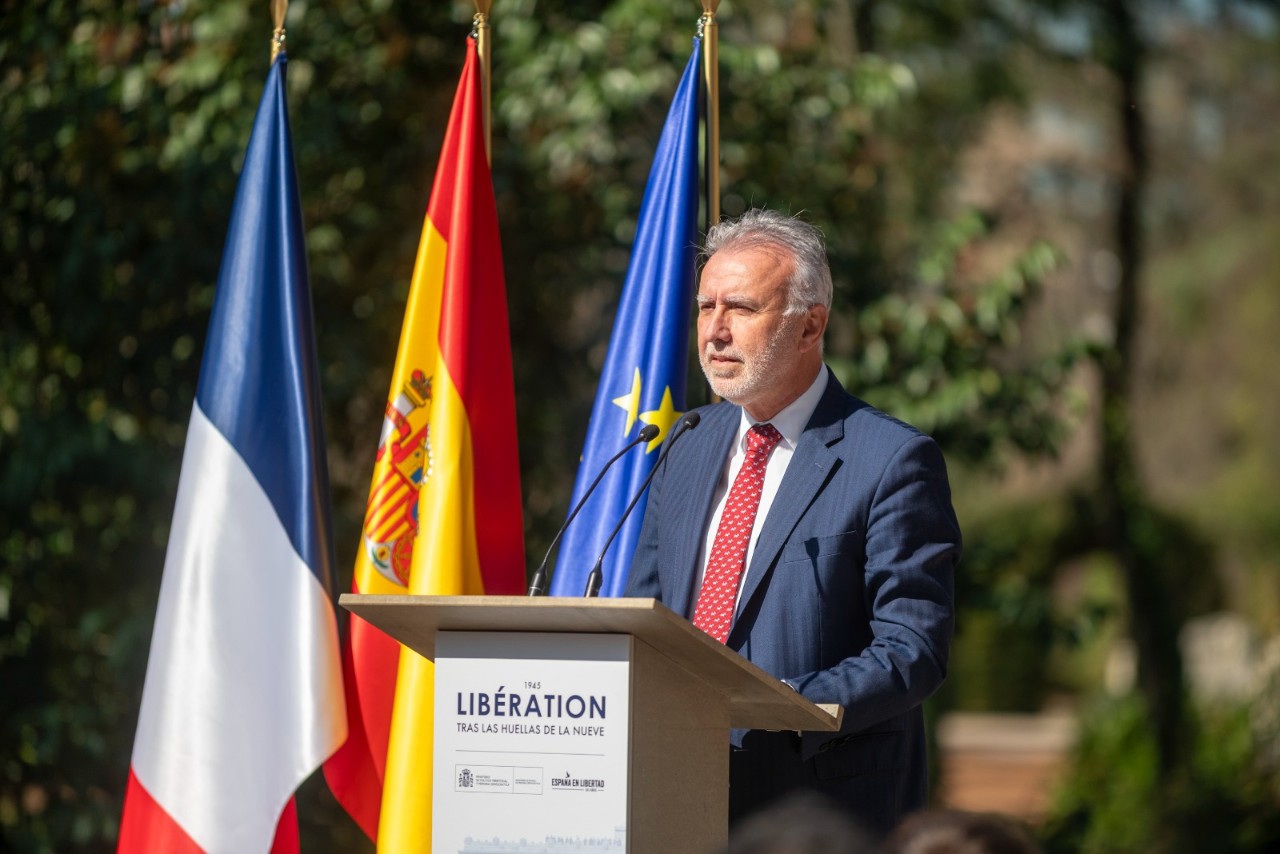
The Minister of Territorial Policy and Democratic Memory, Ángel Víctor Torres, accompanied by the French minister delegated to the Ministry of Armed Forces and Veterans Affairs, Alice Rufo, has inaugurated today, in Madrid, the exhibition 1945. Libération. In the footsteps of ‘the Nine’, which pays tribute to ‘the Nine’, a company made up mainly of Spanish exiles in the 2nd French Armoured Division, and which was the first to enter Paris, on August 24, 1944, for the Liberation of France from the Nazi yoke.
“The story of the 181 Spanish heroes of ‘la Diez’, like that of all the men and women who gave their lives to safeguard freedom, embodies the essence of what it means to be a democrat,” said the minister, who considers this exhibition to be “an exercise in gratitude to those heroes. But also a tribute to peace and freedom.”
Torres wanted to emphasize that “knowing what happened on August 24, 1944, provides us with tools of incalculable value to face a moment like the current one, where the principles of international law and the values that emerged after the Second World War seem to have been broken”.
For the minister, that gesture meant the entry of Spain into the annals of the European Democratic Memory and forever unites France and Spain, which share the same values of “freedom, equality and fraternity”. For this reason, the Government of Spain already declared, on August 25, 2025, the Place of Democratic Memory the Garden of ‘the Nine’, in Paris.
In addition, Torres has made an appeal to leave those who will succeed us “a world in peace” and added that young people need to know what it has cost to achieve democracy and that “coexistence breaks down in a second, almost without realizing it”. Therefore, he said, “once again, loud and clear: no to war.”
The exhibition inaugurated today, which began to be prepared in February 2024 on an official trip from Torres to Paris, when the minister announced that France would temporarily cede to Spain an armoured semi-caterpillar used by Spanish fighters, is curated by the historian Diego Gaspar Celaya, and can be visited in the gardens of the Campo del Moro in Madrid from March 12.
It is a chronological tour, with historical photographs and audiovisual resources in memory and recognition of the exiled Spaniards who fought against fascism in Europe.
They are nine thematic blocks arranged chronologically to tell the company’s social history, with Paris at the centre and connecting with the 80th anniversary of the capital’s liberation.
Delegate Minister Alice Rufo, for her part, said that “Spain and France are working to build and transmit their memory. The 80 years of the Liberation of Paris, which we celebrate in the summer of 2024 and during 2025, have allowed us to honor them. The inauguration of this exhibition is today a new step in the recognition. The transfer of this semi-caterpillar from France to Spain illustrates the powerful link and solid values that unite our two countries, that of a shared memory. This unique semi-caterpillar represents all vehicles driven by Spanish fighters who entered Paris on August 24, 1944.”
“The men of the 9th company of Chad’s marching regiment, General Leclerc’s famous 2nd armoured division, had renamed them ‘Guadalajara’, ‘Teruel’, ‘Guernica’, ‘Admiral Buiza’ or ‘Ebro’, in memory of the battles of the Republicans. Two days later, they escorted General De Gaulle through the liberated Champs Elysées. The Parisian crowd cheered them, not knowing that among those soldiers were fighters from Spain, who had become true brothers of arms for the French,” he added.
Finally, he recalled that “the poet Aragon evoked the resistant foreigners who had decided to fight for France as “French by preference”, “foreigners and, nevertheless, our brothers” (“L’Affiche rouge”). That is what the men of La Nine and all those who enlisted in the Free French Forces, in the great army of the French Resistance mean to us.”
Signing of a Memorandum on the Common European Memory
After the inauguration, Minister Torres and Minister Rufo have signed a Memorandum to establish relations of cooperation and good practices on the participation of the Spanish in the forces of liberation, with the aim of strengthening democratic values and the common European memory.
This document aims to promote the exchange of information on the participation of the Spanish and Spanish in the resistance and liberation of France during the Second World War.
On the basis of this historical participation, the generation and development of actions aimed at the fulfilment of shared objectives in terms of the dissemination of democratic and cultural memory, academic research, promotion of respect for human rights and democratic values, dialogue and culture of peace and other matters of common interest on the common European memory will be strengthened.