
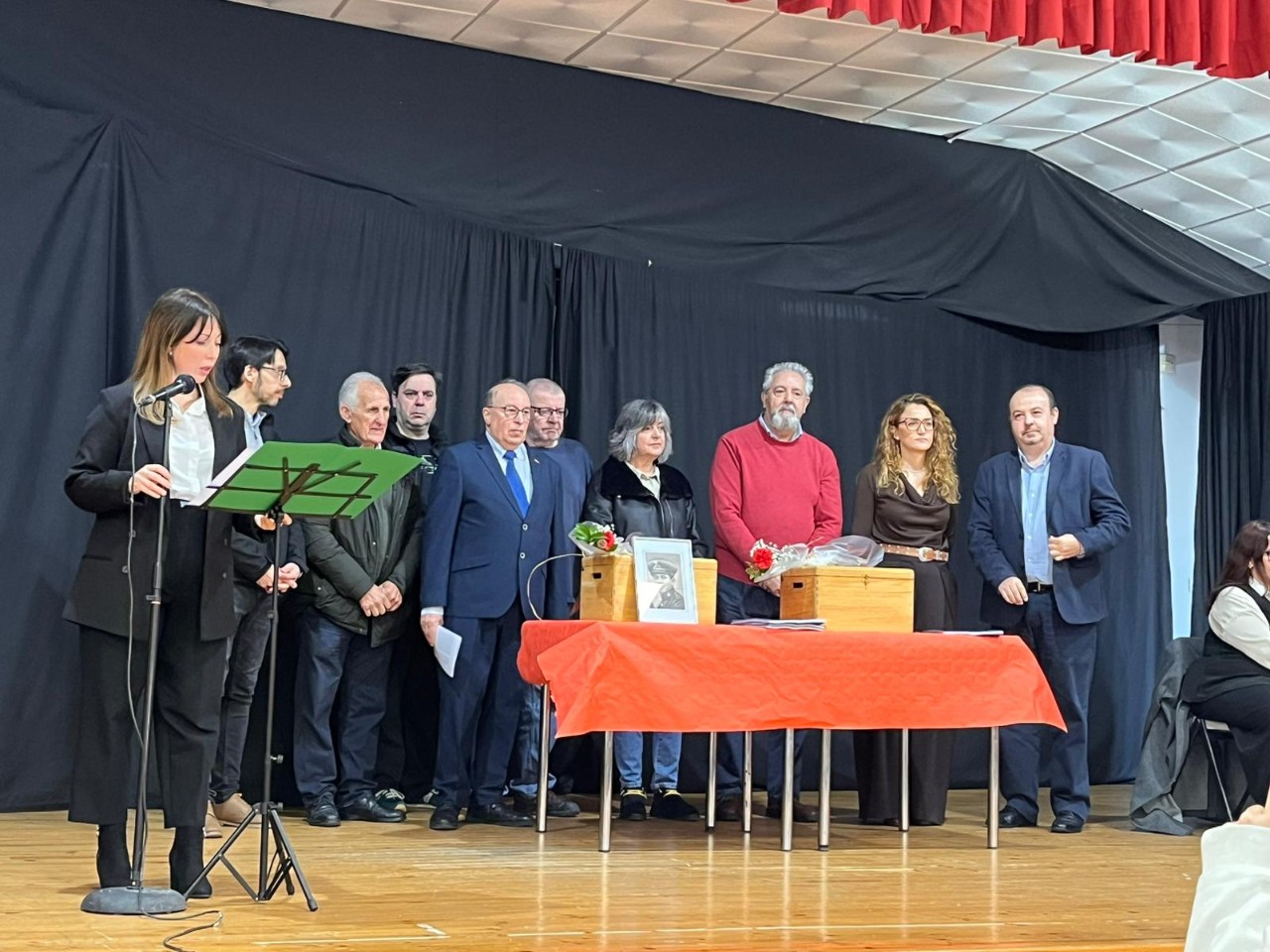
The Director General of Attention to the Victims of the Government of Spain, Zoraida Hijosa, attended today in the house of culture of Mesegar de Tajo the act of handing over the remains of Agustín Felipe Labrado Bolonio and Timoteo Higuera Ocaña, killed on October 16, 1936 and exhumed from a common grave in this Toledan town.
Fifty years after the end of the Franco dictatorship and almost ninety years since the murders took place, the act has been the culmination of a long process of search, exhumation and identification that allows their families to close decades of uncertainty.
The archaeological intervention was carried out in August 2025 within the framework of the II Four-Year Exhumation Plan of the Ministry of Territorial Policy and Democratic Memory. The works were carried out by the Manuel Azaña Association, based in Talavera de la Reina, and had the collaboration of the City of Mesegar de Tajo.
During the exhumation, bone remains corresponding to two individuals were recovered. The subsequent anthropological study and comparative DNA analysis with direct relatives allowed to confirm the identity of both reprisals.
Zoraida Hijosa highlighted in her speech “the firm commitment of the Government of Spain to the principles of truth, justice, reparation and guarantees of non-repetition”, and stressed that “acts such as today represent the dignity of a democracy that looks to the past, without fear of the future, with hope”.
The Director-General has specifically addressed family members: “Today they have their loved ones back. His strength, his insistence and his patience have been a constant guide. This act of reparation would not have been possible without their struggle.”
The event also included the participation of the Deputy Minister of Institutional Relations of the Community Board of Castilla-La Mancha, Javier Vicario; the Mayor of Mesegar de Tajo, José Luis Arrogante Collado, and the President of the Manuel Azaña Association, Isabelo Herrero, who agreed on the importance of institutional collaboration to advance democratic memory policies.
Hijosa concluded by saying that this tribute “is not an end, but part of an ongoing commitment to public policies of democratic memory. We will continue to work, without taking a step backwards, to restore identity and dignity to all the victims who are still in mass graves.”
With this act, Mesegar de Tajo becomes a new space of memory and dignification, closing a historical wound and reaffirming the institutional commitment to the victims of the Spanish War and the Franco dictatorship.