
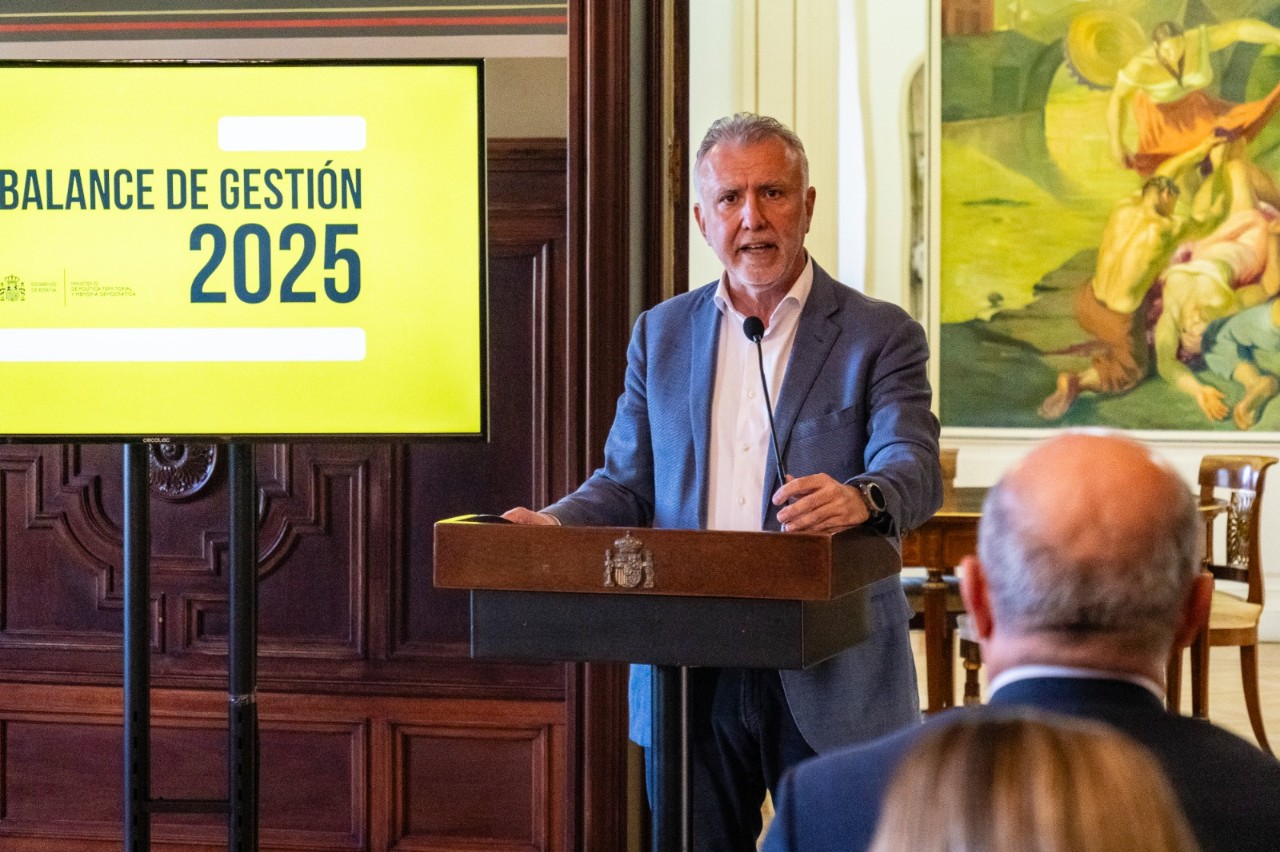
The Minister of Territorial Policy and Democratic Memory, Ángel Víctor Torres, appeared today to give an account of his management at the head of the Ministry and stressed that “dialogue and agreement have marked these two years of legislature”, where progress has been made in measures for the victims of DANA, the reconstruction of La Palma and the structural solution for unaccompanied migrant minors, who are crowded in the border territories.
Torres has stressed that in this year that ends “many of the objectives set have been materialized”, and has begun referring to the reform of Article 35 of the Law on Foreigners, “the milestone of the year, of the legislature and of the last 30 years. A historical claim to which an answer is given despite being a regional competence.”
The Minister has indicated that, with data as of December 26, there are already 1,241 files initiated in the three communities that have a migration contingency (676 minors who were already in our territory and 565 who have entered after August 29). There have been 810 final transfer decisions, which have served to relocate 368 minors. “If we add to that figure the children seeking asylum who are already in other communities, we talk about a thousand minors relocated in six months,” he added.
In the Canary Islands, with 461 resolutions already signed, the Canarian Government has relocated 133 minors (28%). In Melilla, with 83 resolutions, 36 relocations have been carried out (43%). In the case of Ceuta, of 266 resolutions, 199 boys and girls have been transferred to other communities (74.8%).
Another of the achievements this year materialized on December 11, when the Congress of Deputies approved (with the vote against the People's Party) the Royal Decree-Law (RDL) that allows the CCAA and local entities to use the surplus for Financially Sustainable Investments. Torres recalled that ten of the 17 communities (those with surpluses) “will be able to invest 2,787 million in works and projects that result in people’s lives. In the case of local entities, we are talking about a total of 7,075 million euros”. The minister recalled that this measure was “demanded by the president of the Spanish Federation of Municipalities and Provinces”.
One aspect highlighted by the minister is the “firm commitment” of the Government of Spain to the neighbours and neighbours affected by the volcano of La Palma. Also on December 11, the minister defended in Congress a RDL with new measures for Isla Bonita, such as the deduction of 60% of the income tax for all palm trees and palm trees; a moratorium on the payment of credits for farmers; a moratorium for the Cabildo de La Palma and the Government of the Canary Islands in aid for Ecological Transition projects; and the use of 100 million surpluses for the agricultural sector of the island. The RDL was approved without any vote against.
“In total, the Government of Spain has already invested 1,237 million euros so that La Palma gradually returns to normality,” said Torres, who also stressed that La Palma will be the headquarters of the National Center of Vulcanology.
The minister then focused on the measures and aid aimed at the reconstruction of the areas affected by the terrible DANA of 29 October 2024. “So far, the Spanish Government has invested 9,009 million euros in recovery and victims. Of these, 1,745 million have been appropriated by the Ministry that I direct, destined for works in the municipalities. This is the first time that the Spanish Government has taken over 100% of the investment in municipal infrastructure after a natural disaster,” he said. “In addition, we have agreed with the Government of the Valencian Community that a joint commission for reconstruction will be held soon in which all affected municipalities will be represented.”
This is further proof that it is dialogue that marks the path of the Government of Spain and the Ministry. Not in vain, with the governments of Pedro Sánchez, litigation with the CCAA has been reduced by 57%, and 66% more agreements have been reached than with previous conservative governments. In addition, 18 transfers have been made to the CCAA in this legislature and 40 in total in the 7 years of Pedro Sánchez’s government.
Democratic Memory
“This has been a special year for the area of Democratic Memory. It has been the year in which we have celebrated the 50 years of Freedom that our country has enjoyed, after the death of the dictator,” said the minister. “There have been 650 acts and a campaign with a very clear message: ‘Democracy is your power’, so that young people know what it means to live in a system of freedoms,” he continued.
Ángel Víctor Torres also wanted to refer to the great reception given to the measure of the Democratic Memory Act that allows descendants of the Republican exile to apply for Spanish nationality. “2.4 million people who have requested an appointment from Argentina, Chile, Venezuela or Cuba, among many other countries, to become new Spaniards,” he said. So far, 490,000 applications have been accepted and there are already 255,000 who already have the passport in their hands.
The exhumations of the bodies of the victims of war and dictatorship are another of the outstanding achievements of Democratic Memory. “We have reached the figure of 9,000 exhumed victims, almost half of whom, in 2020, were estimated likely to recover,” said Torres, who pointed out that one of the “most rewarding and exciting” moments of her task is to communicate to families that she has found her long-longed loved one. Acts have been carried out to deliver exhumed remains to their relatives in Víznar, Manzanares, Borja and Magallón.
The resignificance of the Cuelgamuros Valley has also had a special prominence in 2025. “We called and the international contest of ideas to turn this terrible place into a space for reflection and non-repetition has already failed,” he added.
Significant progress has also been made in the declaration of the so-called Places of Memory. They are spaces, 17 until today, that “due to their symbolism and historical relevance” deserve this distinction. Likewise, “this year we have delivered 421 declarations of recognition and reparation to victims, in which not only are they recognized as victims, but the war councils are declared illegal and the trials and sentences that condemned them are null and void.” In total, there are already 1,600 declarations delivered since the entry into force of the Democratic Memory Act.