
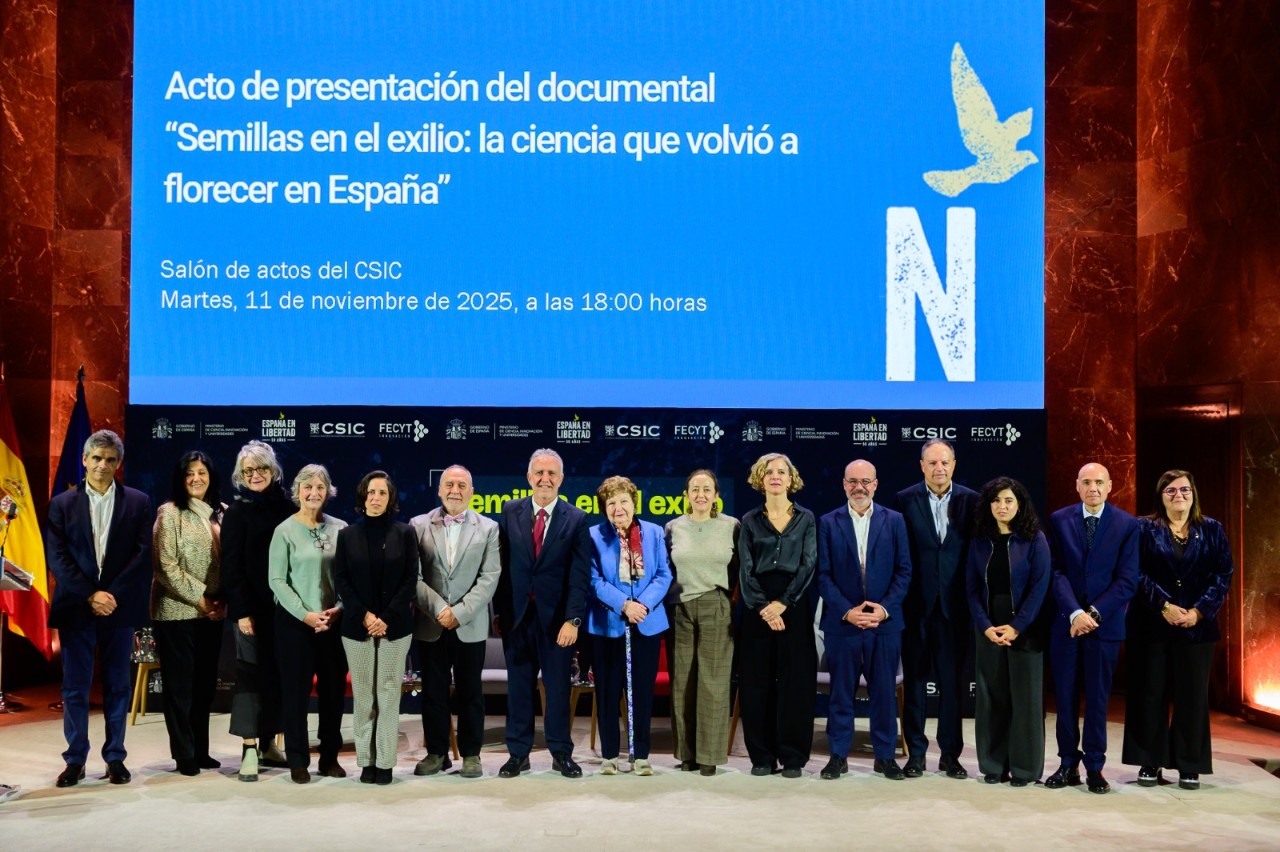
The Minister of Territorial Policy and Democratic Memory, Ángel Víctor Torres, highlighted “Spain’s commitment to science and innovation, which explains today that our country is an engine of employment in Europe and an example of green and fair growth in the world”.
Torres, who closed the presentation of the documentary “Seeds in exile: the science that flourished again in Spain”, organized by the Ministry of Science, Innovation and Universities, described as “excellent” this work that visualizes how “the cannons of War and dictatorship extinguished the light of knowledge, moving our country from hope to obscurantism, from color to black and white, showing us at the same time that science, in the end, opens its way; that the desire to learn, know and understand the world around us are unstoppable”.
“Seeds in exile: the science that flourished again in Spain”
The documentary shows the transformation of our country, which evolves from the fixed photo to the movement, from stagnation and regression to progress, from dictatorship to democracy, has been produced by the Ministry of Innovation, Science and Universities, in collaboration with the Spanish Foundation for Science and Technology (FECYT), is part of the acts of “50 years of Spain in Freedom” and has the analysis of José Manuel Sánchez Ron, professor emeritus of history of science at the Autonomous University of Madrid (UAM) and member of the Royal Spanish Academy (COISE and CSIC).
Torres stressed that “Spain rises when it cultivates and takes care of its talent and the documentary glimpses the country that could have arisen, if the advances of the democratic regime of 1931 had not been curtailed, showing us the future that could have been and was not, when we change knowledge for dogma, and talent for submission”.
The minister has put as examples of that painful setback “the library of the Student Residence, converted into a church, or the first astronaut suit, transformed into a parachute of war. They are symbols of how the dictatorship cut off the wings of a Spain that revered with an unprecedented scientific impulse.”
“Remembering is also recovering the lost future, restoring truth and repairing injustices,” he added, and recalled “Spaniards of great talent and human stature, such as Odón de Buen or Emilio Herrera, who dedicated their time to improving our lives and guaranteeing us a dignified future, through science.”
Torres stressed that this documentary, like the commemorative events of 50 years of Spain in freedom, “also honors teachers, researchers and researchers, and those who dreamed, lived and died for a cultured, integrative and just country. His legacy, his knowledge and ideas remain among us and have moved us forward and placed us at the forefront of global science.”
“Our democracy, like modern democracies, is born of the values of equality, freedom and reason, which guided science towards an ethical mission: to transform society, combat ignorance and expand human dignity. The Enlightenment brought that vision to politics, promoting public education and science as engines of progress and equal opportunities,” he said.
More investment in R&D than ever
Torres pointed out that “prosperity depends on investing in R&D and researchers than science in solving people’s needs and the challenges of the world, with sustainable development. Science is living its best moment in Spain today, with 50% more investment in R&D and 25% more people working in research and innovation than just seven years ago, when Pedro Sánchez came to the government.”
He recalled how in a pandemic “we came out of the crisis through the door of science, although today we are still hurt by the deaths of DANA, a tragedy that confirmed to us that climate change and negationism kill, that science saves lives, protects coexistence and sustains democracy, if we empower it from institutions”.
Torres ended his speech by emphasizing that “in the face of hoaxes and disinformation we need more public reason and shared evidence” and stressed that science and democracy are mutually needed and Spain trusts in its talent, modernization, science and democracy: “We have learned from the pain, we have rescued the memory of those who preceded us and we have chosen hope for a worthy future.”
The Secretary of State for Science, Innovation and Universities, Juan Cruz Cigudosa, for his part, also explained that “Spain today grows and transforms into a new knowledge economy, with more university students, more scientists and more investment in R&D than ever.”
Cruz Cigudosa, has assured about the documentary that it has a main objective: “Continue to build democratic, economic and social progress from knowledge. We want to contribute to remembering and awakening consciences.”