
The Minister of Territorial Policy and Democratic Memory, Ángel Víctor Torres, paid tribute today, in Montauban (France), to Manuel Azaña, in the week in which the 85th anniversary of his death is celebrated. Torres has inaugurated the 20th Manuel Azaña Conference, in the Ancien Collège of the French town, and has deposited some flowers in the tomb of the last president of the Second Republic.
The minister stressed Azaña “was not just any politician”, but “a committed intellectual and a reformist convinced that progress is not born of confrontation, but of the firm defense of democratic values”.
For Torres, the Spanish politician “embodied the dignity of an entire country” when, “with great pain, he saw how the democratic project he had promoted was razed by intolerance and violence.”
“His project for Spain was that of a Republic that educated, guaranteed rights, distributed opportunities and respected the diversity of its peoples,” said the minister, who was accompanied by the Secretary of State for Democratic Memory, Fernando Martínez; the Spanish Ambassador to France, Victorio Redondo; the Consul General of Spain in Toulouse, Manuel Larrotcha; the Deputy Mayor of Montauban, Philippe Becade; and the President of the Présence Association of Manuel Azaña, Bruno Vargas; among others.
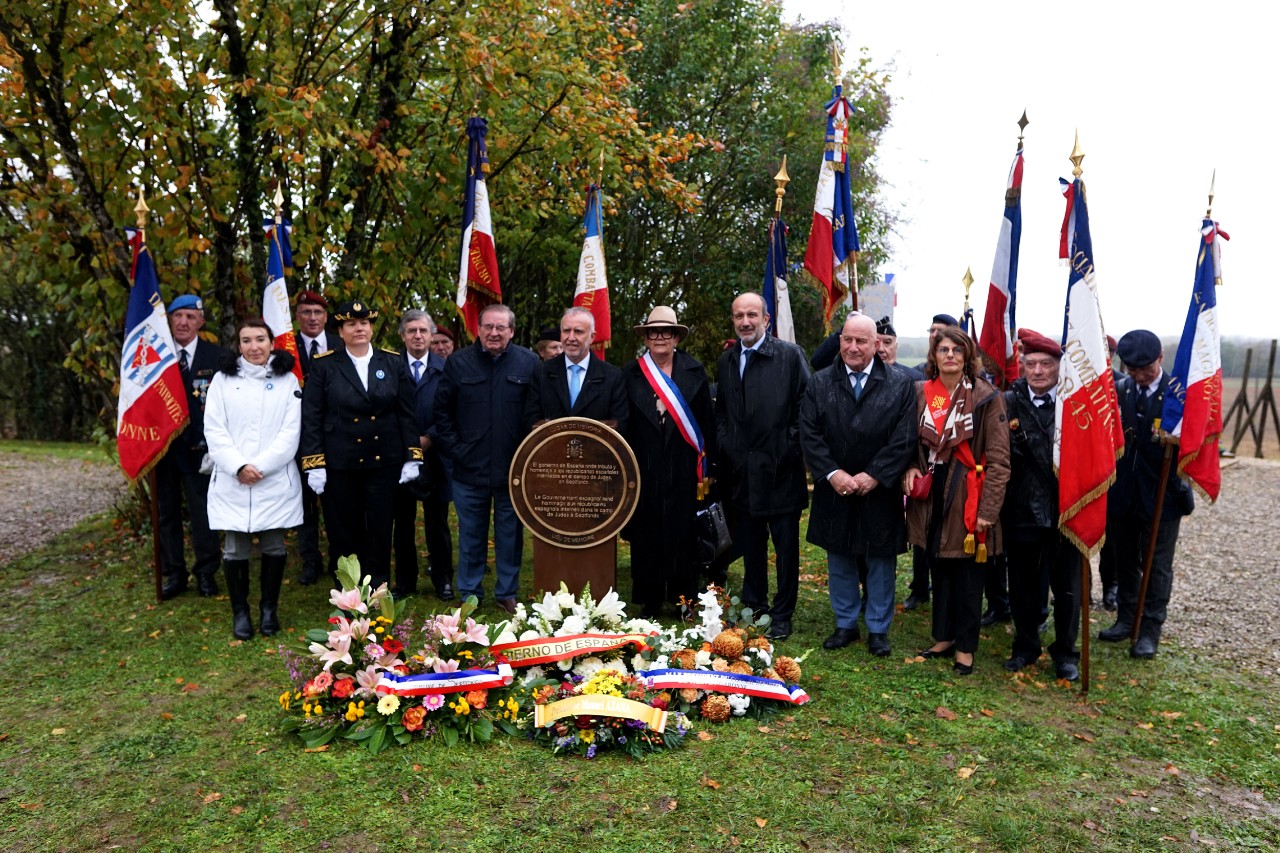
Plate of Place of Memory for the field of Septfonds
After the tribute to Azaña, the minister has unveiled the plaque that recognizes the former camp of Sepfonds, known at the time as Camp de Judes, as a Place of Democratic Memory. Torres recalled that thousands of Spanish reactionaries were interned in this place, in subhuman conditions, as happened with other similar spaces in France, after the Republican exile of the so-called “withdrawal”, which was forced by the Coup d’Etat and the Spanish War.
Torres had a memory for stories like that of Joaquín Llin, a Valencian who left home at the age of 21 and his family never saw him again. “Her granddaughter nieces, Remedios and Vicenta, who were already octogenarian, were able to recover, with great emotion, some objects from her great-uncle, who was interned in this field,” she said.
“Let this Place of Remembrance be, at the same time, school and warning: school for those who must learn to protect their rights; warning for those who use exclusion as a political resource,” the minister concluded.