
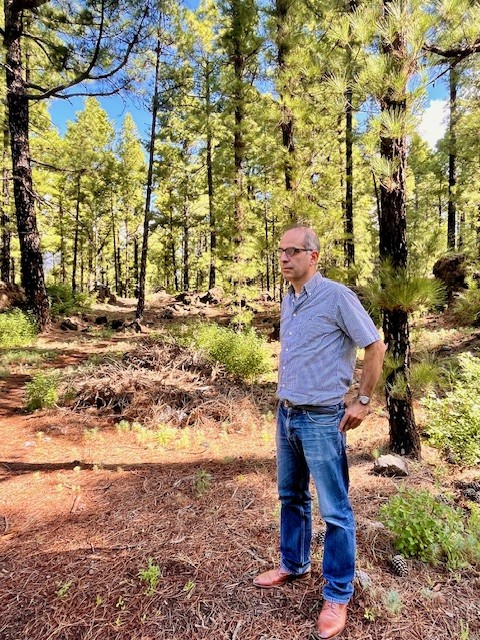
In this initial phase on the ground, the work will focus on surface exploration in different enclaves of the Island. “It is important for the population to know that these first contacts are only investigations, but that does not mean that it is finally installed on that site, but that thousands of measurements are made and then the technical and economic viability of geothermal is determined based on agreements with the owners of the land,” said Izquierdo. Therefore, even if the 837 potential grids have already been selected, the exact locations of the project and the conditions are still being studied. In this sense, he has praised the work of awareness and pedagogy on the benefits of geothermal energy that is being carried out from SODEPAL throughout the island.
A very beneficial financing for La Palma
The Commissioner has highlighted that La Palma was the island most benefited from the state call to study deep geothermal, promoted by the Ministry for Ecological Transition and the Demographic Challenge (MITECO). Specifically, 48 million euros of public funds were allocated, while the total figure for the Canary Islands amounted to 106 million euros, including performances in Tenerife and Gran Canaria. All within the strategic process that seeks to take advantage of the energy potential of the volcanic subsoil, especially after the eruption of the Tajogaite. “Initially the deadline for the execution of the funds for geothermal energy was June 2026, but in an extraordinary way we managed to extend them two more years, and if certain requirements are met, until 2030,” said Izquierdo.
Adding the necessary private cofinancing, the total public-private investment in La Palma will reach 96 million euros. The State High Office has stressed that these funds come from the Recovery Plan linked to the Next Generation EU, channeled through the Institute for Diversification and Energy Saving (IDAE). “We are facing the greatest public commitment to deep geothermal energy in Spain; that La Palma is the main beneficiary demonstrates confidence in the energy potential of our island,” said the High Office of the State.
The Commissioner has also highlighted the potential beyond the energy field, focusing on new opportunities linked to scientific tourism and high added value, taking for example as an international model the spa of ‘Blue Lagoon’ in Iceland, “which would make volcanic energy a differentiating element of our destination with experiences of high economic margin, innovation and sustainability”, he said.
In the same vein, it should be remembered that La Palma was selected by the European Commission as one of the 30 leading islands in the ‘Clean Energy for the EU Islands’ programme, with the aim of being 100% renewable by 2030. “This recognition positions La Palma as a pilot territory in energy innovation and allows it to access specialized technical assistance at European level,” he said.