
February 27, 1981 was a memorable day, symbolic expression of the resistance and democratic will of the vast majority of the Spanish people against those who planned to return to dictatorship or, at least, paralyze the process of transformation that the Spanish people had begun after the death of the dictator Franco, ratified with his massive vote in favor of the Democratic Constitution of 1978.
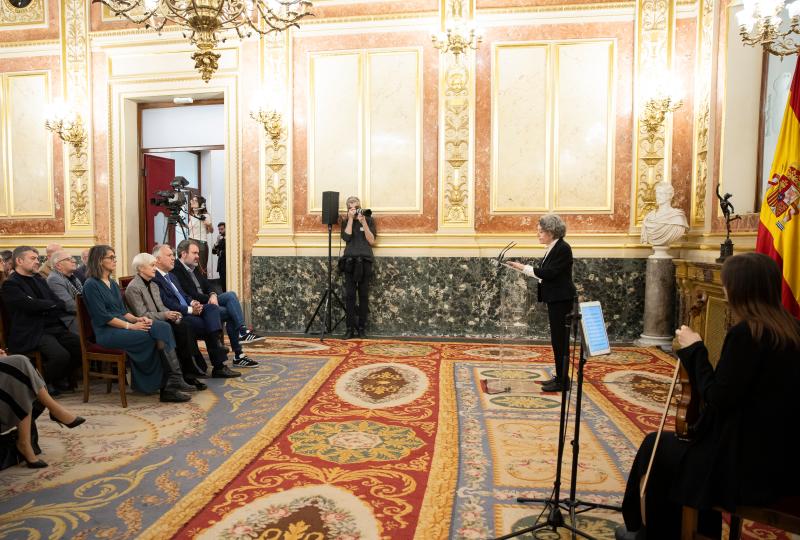
Ángel Víctor Torres, Minister of Territorial Policy and Democratic Memory, and Isaura Leal Fernández, Second Secretary of the Congress of Deputies, participated in the Congress of Deputies, of the act of opening the file for the declaration of Place of Intangible Democratic Memory, the Demonstrations for Democracy of February 27, 1981.
The event was attended by the journalist Rosa María Mateo, who was in charge of reading the manifesto condemning the coup d’état in the demonstration held in Madrid on February 27, 1981, which she repeated today in the Hall of Lost Steps of the Congress of Deputies.
After the failure of the coup d’état on 23 February, demonstrations in defence of democracy and the Constitution were called for 27 February 1981. Almost all the political forces called on the Spanish to demonstrate in defence of democratic values, peaceful coexistence and the Constitution as the fundamental rule for organizing political life. This call was joined by hundreds of municipal corporations, neighborhood and trade union associations, artists, intellectuals and countless groups that were not going to allow the achievements since 1975 to be undone.
The demonstration in Madrid was called by UCD, PSOE, the People’s Alliance and the Communist Party and was followed, under the slogan “For freedom, democracy and the Constitution”, by one and a half million people.
The media attested to the massive influx in the demonstrations called for in all corners of Spain: in Barcelona two hundred and fifty thousand were the demonstrators; two hundred thousand in Valencia; one hundred thousand in Seville, Zaragoza and Oviedo, fifty thousand, Alicante and Granada and Murcia or thirty thousand in Valladolid, A Coruña and Malaga. In smaller cities, such as Almería, ten thousand people were concentrated, in Salamanca nine thousand or in Cáceres about eight thousand. In almost all provincial capitals, more or less mass demonstrations were held. The popular reaction in rejection of the attempted coup d’état took place in a peaceful, massive and vindictive manner.