
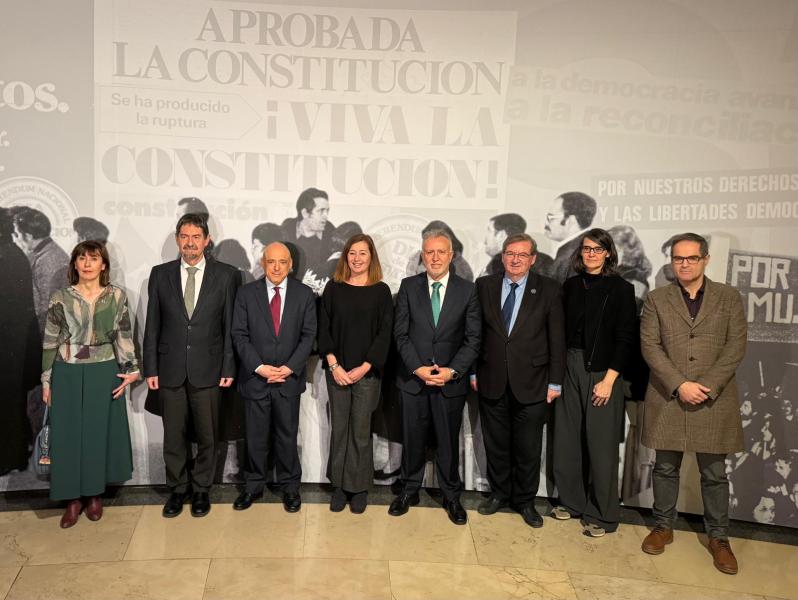
For the Minister of Territorial Policy, Ángel Víctor Torres, “art, in its secrecy and marginality, became a vehicle of resistance, a tool of struggle against the Franco regime.” As Torres pointed out, this is a “complete journey, in the form of pictorial works, sculptures, press clippings and posters, through our Constitution; and also through that Spain that was devoid of fear and looked forward to the future. A future that had been built with enormous sacrifices, above all, of the citizenship of our country, the true engine of change.”
The minister also wanted to underline that “art, in its secrecy and marginality, became a vehicle of resistance, a tool of struggle against the Franco regime.”
“Today we are reclaiming not only the text of the Constitution, but the democratic spirit that paid for its birth and that is reflected in each line of the works that make up this exhibition”, added Torres in the presentation, in which Francina Armengol, president of the Congress of Deputies, Fernando Martínez, Secretary of State for Democratic Memory, Carmina Gustrán, commissioner for the 50 years of Spain in freedom, and Isabel García, curator of the exhibition have also participated.
The catalogue presented today includes a reproduction of the 38 works on display, ranging from Joan Rabascall’s Mai 1968, created in 1968, to Marine Hugonnier’s Art for modern architecture, Coup d’état attempt by Tejero (24.02.1981), created in 2011. It is, therefore, and like the exhibition itself, a journey through almost 50 years of Spanish contemporary art. According to the curators of the exhibition, Isabel García and Javier Pérez, “only a glance like the artistic could offer a more or less approximate idea of that time of Spanish society.”
The exhibition can be seen until March 21, 2025 in offices of the Congress of Deputies, by appointment.