
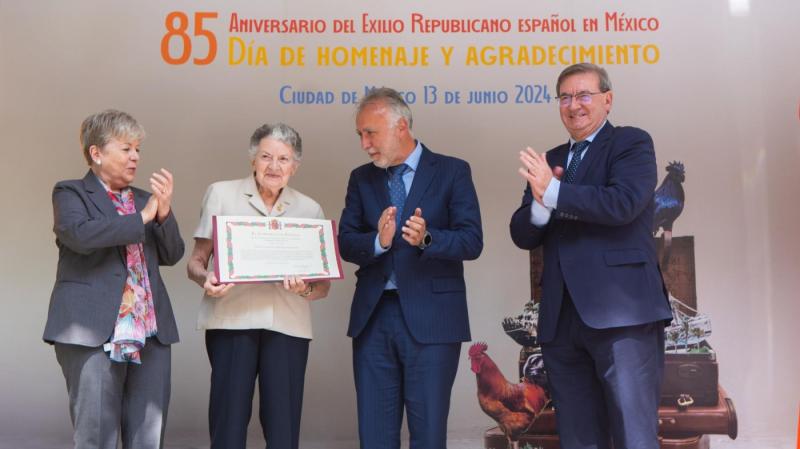
The Minister of Territorial Policy and Democratic Memory, Ángel Víctor Torres, presided today, in the residence of the ambassador in Mexico, the act of commemoration of the 85th anniversary of the arrival in Veracruz of ‘Sinaia’, the first ship of Spanish exile.
The North American country hosted 25,000 Republicans, who were welcomed “with open arms” by the then president Lázaro Cárdenas and by the Mexican people. “Without Mexico and Lázaro Cárdenas, thousands of Spaniards would have had an uncertain future, in the vortex of World War II and the persecution initiated on French soil against the republicans, who would soon begin to know the horror of Nazism, while Spain became a great prison full of anguish, terror and repression,” said the minister, who has been accompanied by the Spanish ambassador to Mexico, Juan Duarte; the Secretary of State for Democratic Memory, Fernando Martínez; and the Secretary of Foreign Affairs of the Government of Mexico, Alicia Bárcena.
The first exiles arrived, above all, in three mass expeditions, aboard the ‘Sinaia’, the ‘Ipanema’ and the ‘Mexique’, in the summer of 1939. In the first, about 1,600 Republicans traveled. They were “artists, writers and intellectuals together with farmers, mechanics, teachers and a long etcetera of men and women that shows the plurality of Spanish republican exile,” said Torres. The newcomers were soon integrated into Mexican society. The displays of affection and solidarity were “the first episode of a friendly relationship between the Mexican people and the exiles”, which were fruitful in meeting spaces such as schools such as the Madrid School, the Luis Vives Institute or the Spanish Athenaeum, which celebrates this year 75 years of life spreading the memory of the Spanish exile and which is, since yesterday, the first Place of Memory recognized by the Spanish Government abroad.
During the act of gratitude and tribute, a statement of recognition and reparation was given to the families of the victims exiled in Mexico, including Lázaro Cárdenas and his wife Amalia Solórzano.
The minister also visited the tomb of the poet Luis Cernuda, and made a floral offering in the Spanish Pantheon before the graves of Spanish intellectuals, teachers, scientists and artists in exile such as León Felipe, César García Lombardía, Ramón Xirau, Matilde de la Torre, José Moreno Villa, José Giral Pereira, Max Aub, Cipriano Rivas, Manuel de Rivas, Rafael Altamira, Manuel Tagüeña and Carmen Parga.