
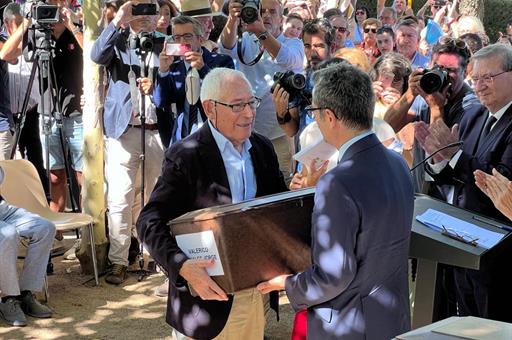
The Minister of the Presidency, Relations with the Courts and Democratic Memory has presided over the act of handing over the mortal remains that were exhumed and subsequently identified in the Cuelgamuros Valley. After the event, the burial took place in the pantheon built in the cemetery of Pajares de Adaja.
Pajares de Adaja, Ávila (Spain)
The Minister of the Presidency, Relations with the Courts and Democratic Memory, Félix Bolaños, presided over the act of handing over 12 people killed in the summer of 1936 in the first weeks of the civil war in the province of Ávila. The event, organized by the Secretary of State for Democratic Memory, was attended by the Secretary of State for Democratic Memory, Fernando Martínez, the mayor of Pajares de Adaja, the group of relatives of Pajares de Adaja and Navalmoral de la Sierra, as well as part of the technical team that has participated in the investigation and exhumation tasks.
After the institutional act, in which authorities, relatives and technicians have participated, the remains found in the Cuelgamuros Valley in the pantheon built in the cemetery of Pajares de Adaja in 2004 have been buried, except two bodies that have been transferred to Navalmoral de la Sierra by decision of their relatives.
Residents of Pajares de Adaja and Navalmoral de la Sierra (Ávila)
These are neighbours of two Aboriginal municipalities. The neighbors of Pajares de Adaja Víctor Blázquez del Oso, Valerico Canales Jorge, Emilio Caro García, Román González Enríquez, Flora Labajos Labajos, Celestino Puebla Molinero, and Pedro Ángel Sanz Martín, members of the local Pueblo house, were killed by falangists on August 20, 1936 and thrown into a common grave in Aldeaseca (Ávila).
The residents of Navalmoral de la Sierra Gregorio Pérez del Peso, Raimundo Meneses Redondo and Rito Martín Redondo were murdered on August 4, 1936 by Falangists when they participated in the mowing work in Fuente el Saúz (Ávila). All of them have been genetically identified, except for two more neighbors of Navalmoral, still unidentified.
The bodies were transferred without the knowledge or permission of their relatives to the crypts of the Valley of Cuelgamuros, formerly Valley of the Fallen, on March 23, 1959 in the same box, numbered 198 in the register of the cemetery of the monument. The exhumation in 2003 of the common grave of Aldeaseca, in which scattered remains were found, led relatives, including Fausto Canales, to find documentation on the transfer to the Valley.
From then on, they started a long process to obtain the exhumation of their relatives from the Francoist mausoleum and the return to their original municipalities. Other families in other parts of the country joined this claim. In 2016 there was a court ruling in favor of the exhumation of the Lapeña brothers, who came from the cemetery of Calatayud.
After the elaboration of a Plan of Forensic Intervention established by the Ministry of the Presidency, Relations with the Courts and Democratic Memory through the State Secretariat of Democratic Memory that has received the approval of National Heritage and the Forensic Medical Council of the Ministry of Justice, in 2020 the process of exhumation of 143 people claimed by their relatives was launched. After numerous bureaucratic, technical and judicial obstacles, the exhumations began on June 12, 2023 at level 0 of the Chapel of the Holy Sepulchre.
Forensic Intervention Plan
To this end, an archaeological methodology has been used through the detailed analysis and registration of all the evidence contained in the collumbarium of Level 0 of the Chapel of the Holy Sepulchre.
The designated multidisciplinary team proceeded to the inspection of Level 0 of the Chapel of the Holy Sepulchre using an archaeological methodology in order to search for container number 198. Protocols, methodology and procedures of a forensic nature have been used in accordance with international standards such as the Minnesota Protocol (2016) of the United Nations, as well as the good practices that have been recommended by the International Committee of the Red Cross.
The task is very complex due to the scale of the burials and the deterioration of the crypts. Between 1959 and 1983, a total of 11,060 individual and collective boxes containing the remains of 33,833 victims were transferred to the Cuelgamuros Valley. At level 0 of the Chapel of the Holy Sepulchre, where this box has been found, 1,057 boxes with 4,266 victims were deposited.
Box 198 is the first tangible result of this institutional effort to recover the bodies requested by their relatives. With the institutional and dignified dedication to their families, the State fulfills its commitment in the search for the disappeared from the war. Starting in September, the tasks will be taken up to try to locate another of the requested boxes whose identification is viable, within the great technical difficulties that this task has.