
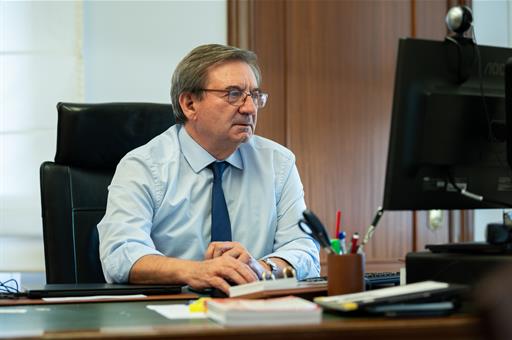
The Secretary of State for Democratic Memory, Fernando Martínez, has declared that "the search, location and identification of the remains of people buried in mass graves is a moral duty of a democratic society." This moral duty would be closely related to the dignification of the victims of civil war and dictatorship.
Fernando Martínez has made these statements in a conference organized by the Secretary of State, together with the Andalusian Federation of Municipalities and Provinces (FAMP) and the Spanish Federation of Municipalities and Provinces (FEMP), with the collaboration of the Junta de Andalucía, on the first call for aid to Local Entities for the realization of activities related to the recovery of democratic memory.
The meeting, held electronically, was attended by the representatives of the 46 municipalities of Andalusia that, in the first phase, will benefit from the grants of the Secretary of State to implement actions in different areas of research, collection of testimonies, prospecting, exhumation and analysis of remains.
In addition to the Secretary of State, the meeting was attended by the delegate of the Government in Andalusia, Pedro Fernández Peñalver; the representative of the Commissioner for the Concord of Andalusia, Francisco Javier Arroyo; the President of the FAMP and the Deputation of Seville, Fernando Rodríguez Villalobos and the General Secretary of the Spanish Federation of Municipalities and Provinces (FEMP), Carlos Daniel Casares Díaz.
In his speech, Fernando Martínez highlighted the "clear political and moral commitment to the victims and their families" maintained by the Ministry of the Presidency, Relations with the Courts and Democratic Memory since 2018. This commitment is reflected in all the aid approved by the Government for the recovery of democratic memory, and especially for exhumations.
In this regard, he recalled the approval of a shock plan in which a direct subsidy to the FEMP of 750,000 euros was included. This budget was used to finance the actions carried out by the municipalities to investigate, locate, exhume and identify missing persons in graves of the civil war and Franco’s regime. This aid will be used to subsidise 92 exhumation projects throughout Spain, of which 46 are from Andalusia. In addition, the Secretary of State has directly awarded exhumation grants worth 450,000 euros which, according to the Secretary of State, have benefited 22 exhumation projects, eight of which are carried out in Andalusia.
Fernando Martínez has highlighted the importance of this aid with a very graphic example. "As a result of this shock plan," he said, "the process of opening 114 graves throughout Spain has begun. When more graves have been exhumed throughout our history with scientific rigor it has been in the six years of José Luis Rodríguez Zapatero's government, and then in those six years they added 177 graves."
Once the subsidies provided for in the shock plan have been distributed, and after the approval of the General State Budgets, the Secretary of State has begun to develop a four-year plan for democratic memory. In this regard, the Secretary of State has explained that 60% of the 11.3 million euros budget for democratic memory in 2021 is mainly intended for the exhumation of mass graves.
One of the first decisions taken within the framework of this four-year plan was the holding, last March, of a sectoral conference on Democratic Memory, chaired by the First Vice-President and Minister of the Presidency, Relations with the Courts and Democratic Memory, Carmen Calvo. This sectoral conference approved the distribution between the Autonomous Communities and Autonomous Cities of Ceuta and Melilla of aid of three million euros intended mainly for exhumations.
Fernando Martínez has highlighted that, of those three million euros, 507,000 euros correspond to Andalusia. According to the Secretary of State, the fact that Andalusia has been the one that gets the highest percentage of aid both from the shock plan and from the first annuality of the four-year plan is due to the fact that "in Andalusia the repression was very harsh". According to studies carried out by Andalusian universities, and coordinated by Fernando Martínez himself, around 60,000 Andalusians were shot during the war and the first decade of the Franco dictatorship.