
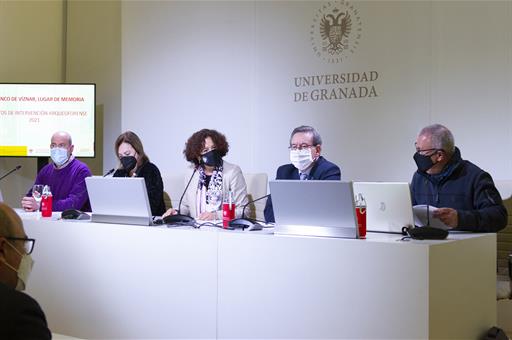
The Secretary of State for Democratic Memory, Fernando Martínez, participated in the presentation of the Barranco de Víznar exhumation project, a place of memory at the University of Granada.
University of Granada
The Secretary of State for Democratic Memory, Fernando Martínez, has assured today that with the exhumations of mass graves "what we humbly intend is to contribute to closing wounds and above all to closing a black page in the history of our country" since "oblivion is totally incompatible with democracy".
Fernando Martínez made these statements in the framework of the presentation of the Barranco de Víznar exhumation project, a place of memory, which was developed at the University of Gradada. Along with the Secretary of State, Pilar Aranda, rector of the University of Granada, Sandra García, delegate of the Government in Andalusia, Joaquín Caballero, mayor of Víznar and Francisco Carrión, professor of the Department of Prehistory and Archaeology of the University of Granada, participated in the event.
In his speech, the Secretary of State reviewed the most important points of the draft Democratic Memory Act and stressed that "the historical memory, the democratic memory of Spain is part of the memory of Europe and is also part of the memory of the defence of human rights at international level". In this sense, he pointed out that "the commitment to memory is a commitment to the future of democracy".
In his speech, he pointed out that one of the key issues of the new rule is the knowledge of the truth and that in this context the exhumations of mass graves. In this regard, he highlighted the shock plan implemented by the Ministry of Presidency, Relations with the Courts and Democratic Memory that, through the Secretary of State for Democratic Memory, will be able to exhume 114 graves throughout Spain, half of them in Andalusia.
The Barranco de Víznar exhumation project is one of those included in this crash plan. This project is the result of research carried out by the University of Granada and memorialist associations such as the Granada Association for the Recovery of Historical Memory. In the Barranco de Víznar, work is being done in two sectors in which, according to estimates by the Granadona Association of Historical Memory, up to 400 people may have been buried. The Secretary of State has given an aid of 28,000 euros to the University of Granada to work in sector 2 and another of 18,000 euros, through the Spanish Federation of Municipalities and Provinces to the City of Víznar.
The pit number 1, known as the well of the Ravine of Víznar is an old well for collecting water from the nearby Sierra de la Alfagura, with a diameter of more than 20 meters and a depth estimated at more than eight meters. In 1936 this well had dried up because of the drought of those years and used as a clandestine pit. This well was used as a place of illegal burial of between 100 and 150 Grenadians executed by the rebelled troops and parked in the quartering of the town of Víznar. Along with the murdered civilian population it is very possible that among them is the former rector of the University of Granada Salvador Vila Hernández, professor of Semitic Philology and disciple of Miguel de Unamuno. He was shot on October 22, 1936.